Creative Biolabs is offering the most comprehensive services for antibody development projects. With strict regulation and effective execution, we are dedicated to providing the most valuable solutions to complete your projects.
HighlightsCreative Biolabs is offering the most comprehensive services for antibody development projects. With strict regulation and effective execution, we are dedicated to providing the most valuable solutions to complete your projects.
HighlightsCreative Biolabs has established a broad range of platforms for developing novel antibodies or equivalents. These cutting-edge technologies enable our scientists to meet your demands from different aspects and tailor the most appropriate solution that contributes to the success of your projects.
HighlightsWith deep understanding in antibody-related realms and extensive project experience, Creative Biolabs offers a variety of references to help you learn more about our capacities and achievements, including infographic, flyer, case study, peer-reviewed publications, and all kinds of knowledge that can assist your projects. You are also welcome to contact us directly for more specific solutions.
HighlightsGet a real taste of Creative Biolabs, one of the most professional custom service providers in the world. We are committed to providing highly customized comprehensive solutions with the best quality to advance your projects.
HighlightsIn the high-stakes landscape of biopharmaceutical development, the ability of an antibody to move beyond surface binding and actively enter the cell is the ultimate gatekeeper for therapeutic success. Creative Biolabs stands at the forefront of this niche, providing a world-class Internalizing Antibody Discovery Service that transforms how researchers identify and validate Internalizing Antibody Candidates. With over two decades of specialized experience, we have refined the internalizing antibody development process into a high-precision science. Our approach combines massive combinatorial libraries with high-throughput screening (HTS) and precise cellular models, ensuring that every lead molecule is optimized for endosomal trafficking and lysosomal delivery.
The concept of an Internalizing Antibody has become the cornerstone of "smart" therapeutics. Unlike traditional naked antibodies that rely on ADCC or CDC, internalizing antibodies act as "Trojan Horses."
At Creative Biolabs, our Internalizing Antibody Discovery workflows are specifically designed to maximize the "Internalization Rate Constant" (kint), ensuring that your therapeutic window is as wide and effective as possible.
Most discovery programs fail because they screen for affinity first and function second. At Creative Biolabs, we integrate functional internalization criteria into the very first step of the discovery phase.
We have pioneered a unique "Whole-Cell Internalization Panning" strategy. Instead of panning against immobilized proteins, we allow the phage library to interact with live cells in a physiological state.
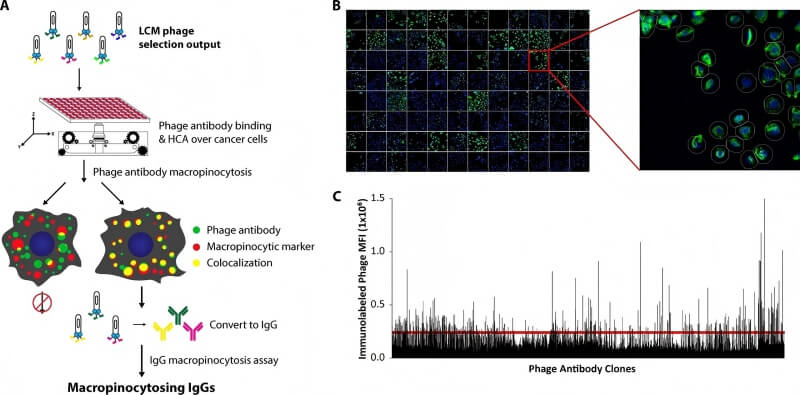 Fig. 1 Outline of screening strategy and data from the first step of the screening, i.e. phage binding to DU145 cells.1
For projects requiring natural immunity, our automated hybridoma platform utilizes robotic liquid handling to screen thousands of clones per week. We use pH-sensitive fluorescence assays to identify Internalizing Antibody Candidates in real-time, moving directly from a primary screen to functional validation.
Table 1. Comparison of Discovery Methodologies
| Feature | Phage Display (Internalization Panning) | Hybridoma / B-Cell Screening |
| Library Size | 1010 - 1012 (Ultra-high) | 103 - 105 (Natural) |
| Screening Speed | Rapid | Moderate |
| Modification Ease | High (Directly as scFv/Fab) | Low (Requires sequencing first) |
| Target Type | Best for complex/rare epitopes | Best for high-affinity natural IgG |
| Internalization Focus | Integrated into panning | Secondary functional screen |
Discovery is just the beginning. A raw lead often requires Engineering Optimization to meet clinical requirements. Our scientists utilize structural biology and computational modeling to fine-tune the antibody-receptor interface.
Counter-intuitively, the highest affinity antibody is not always the best internalizer. Very high affinity can lead to "receptor entrapment" where the antibody stays stuck at the membrane. We perform "Affinity Tuning" to find the "sweet spot" where the antibody binds strongly enough to trigger endocytosis but allows for proper intracellular trafficking.
The format of the antibody significantly impacts its internalizing behavior. We offer:
A discovery program is only as good as the cells it uses. Creative Biolabs maintains an extensive biobank of precise cellular models, including:
When you partner with Creative Biolabs for Internalizing Antibody Discovery, you follow a rigorous, milestone-driven path:
The market for internalizing antibody development is crowded, but few possess the depth of Creative Biolabs.
Explore our integrated ecosystem of antibody services to complement your discovery program:
The journey from a target to a clinical candidate is fraught with challenges. Partner with Creative Biolabs, where 20 years of biological expertise meets the cutting edge of antibody engineering.
Reference
All listed services and products are For Research Use Only. Do Not use in any diagnostic or therapeutic applications.