Creative Biolabs is offering the most comprehensive services for antibody development projects. With strict regulation and effective execution, we are dedicated to providing the most valuable solutions to complete your projects.
HighlightsCreative Biolabs is offering the most comprehensive services for antibody development projects. With strict regulation and effective execution, we are dedicated to providing the most valuable solutions to complete your projects.
HighlightsCreative Biolabs has established a broad range of platforms for developing novel antibodies or equivalents. These cutting-edge technologies enable our scientists to meet your demands from different aspects and tailor the most appropriate solution that contributes to the success of your projects.
HighlightsWith deep understanding in antibody-related realms and extensive project experience, Creative Biolabs offers a variety of references to help you learn more about our capacities and achievements, including infographic, flyer, case study, peer-reviewed publications, and all kinds of knowledge that can assist your projects. You are also welcome to contact us directly for more specific solutions.
HighlightsGet a real taste of Creative Biolabs, one of the most professional custom service providers in the world. We are committed to providing highly customized comprehensive solutions with the best quality to advance your projects.
HighlightsIn the intricate landscape of drug discovery, identifying the precise molecular targets of a small molecule is the cornerstone of understanding its mechanism of action (MOA), predicting efficacy, and foreseeing potential off-target toxicities. At Creative Biolabs, our Small Molecule-Target Interaction Assay Services provide an unparalleled, in-depth view of how your compound engages with the proteome, empowering you to make data-driven decisions and accelerate your drug discovery pipeline. Our state-of-the-art services are designed to support every stage of your research, from hit validation and lead optimization to drug repurposing and toxicity profiling. We combine sophisticated mass spectrometry platforms with a suite of innovative assays to deliver robust, actionable data.
A small molecule's therapeutic effect is dictated by its direct interactions with specific proteins (targets) within the cell. Identifying these targets is no longer a "black box" problem. Modern chemoproteomics has provided powerful tools to illuminate these interactions directly in complex biological systems.
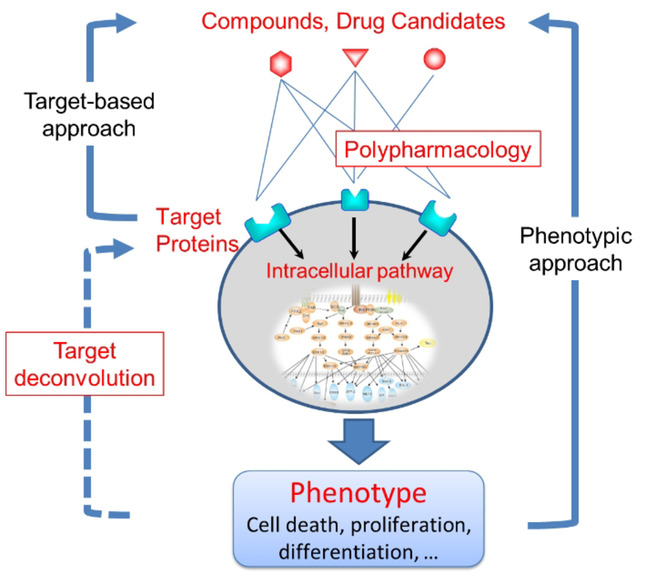 Fig. 1 The phenotypic and target-based approaches, target deconvolution, and polypharmacology in drug discovery.1
Creative Biolabs offers a multi-platform approach to target identification, recognizing that no single method is universally optimal. We tailor our strategy to your compound, research question, and biological system. Our core platforms are powered by the latest advancements in mass spectrometry and biochemical analysis.
Activity-based Protein Profiling (ABPP) is a powerful functional proteomics technology for identifying enzyme targets based on their catalytic activity. This method utilizes chemical probes that covalently bind to the active sites of specific enzyme families. By competing with these probes, a small molecule inhibitor's targets can be identified and quantified on a proteome-wide scale.
Principle: Covalent, activity-directed chemical probes are used to label active enzymes. Target engagement by an inhibitor molecule prevents probe labeling, which is then measured by mass spectrometry.
Our Platform: We leverage a diverse library of custom and standard probes targeting major enzyme classes (e.g., kinases, proteases, metalloenzymes). Our advanced ABPP platform combines multiplexed analysis with high-resolution LC-MS/MS for deep proteome coverage.
The DARTS method capitalizes on the principle that the binding of a small molecule can stabilize its target protein, rendering it more resistant to proteolysis. This simple, yet robust, label-free technique can identify targets without requiring any modification to the compound of interest.
Principle: Protein lysates are incubated with the small molecule or a vehicle control, followed by digestion with a protease (e.g., pronase). Target proteins stabilized by the compound will be protected from degradation, and these differences are identified by SDS-PAGE or mass spectrometry.
Our Platform: We have optimized the DARTS workflow for both low and high-throughput applications. Our protocol includes careful protease concentration titration and a sophisticated quantitative mass spectrometry pipeline (SILAC, TMT, or label-free) to accurately quantify changes in protein abundance post-digestion.
LiP-MS is an emerging and powerful technology that identifies target proteins by detecting compound-induced conformational changes across the entire proteome. Rather than just identifying if a protein is a target, LiP-MS can provide structural insights into the binding event.
Principle: A small molecule binding to a protein can alter its three-dimensional structure. This change can expose or hide specific sites from proteolytic cleavage. LiP-MS uses a non-denaturing protease to generate a unique peptide "fingerprint" of the proteome. Changes in this fingerprint upon compound treatment indicate a binding event.
Our Platform: Creative Biolabs is at the forefront of LiP-MS implementation. We utilize an optimized, temperature-controlled workflow and a sophisticated data analysis pipeline to map these conformational changes with high precision, often pointing directly to the compound's binding site or allosteric effects.
To help you choose the best approach for your project, we have summarized the key features of our main platforms. Our experts are always available to help you design the optimal strategy.
Table 1. Comparison of Small Molecule-Target Interaction Assay Platforms
| Technology | Principle | Sample Type | Key Advantage | Best For... |
| ABPP | Competition with covalent, activity-based probes | Lysates, Live Cells, Tissues | Directly measures functional enzyme activity | Covalent inhibitors, screening enzyme families, functional profiling |
| DARTS | Ligand-induced stabilization against proteolysis | Lysates, Purified Proteins | Label-free, no compound modification needed | Unmodified compounds, initial hit validation |
| LiP-MS | Ligand-induced conformational change affecting proteolysis | Lysates | Provides structural insights, detects allosteric effects | Allosteric modulators, proteome-wide structural footprinting |
We ensure a transparent and collaborative process from start to finish.
To further support your drug discovery program, explore our other relevant services. Explore our full range of biomolecular interaction services here: Biomolecular Interaction based Binder Discovery
Take the guesswork out of your drug discovery program. Partner with Creative Biolabs to precisely identify your small molecule's targets and illuminate its mechanism of action. Speak with one of our experts and get a customized quote for your project.
Q: How do I get started with a project at Creative Biolabs?
A: The first step is to contact us through our online form or by email. One of our PhD-level technical specialists will schedule an initial, no-obligation consultation to discuss your specific compound, research objectives, and biological system. From there, we will prepare a detailed, customized project proposal for your review.
Q: What materials do I need to provide to Creative Biolabs?
A: Typically, clients provide their small molecule compound of interest. We ask for information on its structure, purity, and solubility if available. For the biological matrix, you can either provide us with your specific cell pellets, tissues, or lysates, or we can source/culture the required materials for you as part of the service.
Q: How much of my small molecule compound is required for an assay?
A: The amount of compound needed varies depending on the chosen platform, the desired concentration range for testing, and the scale of the experiment. For a typical proteome-wide screening project, we generally request 5-20 mg of the compound to ensure sufficient material for optimization and replicate analyses. We will provide a precise estimate in your project proposal.
Q: Can your assays distinguish between specific on-targets and non-specific or off-target binding?
A: Yes, this is a key strength of our platforms. We employ several strategies to ensure high-confidence target identification. This includes running dose-response experiments to confirm target engagement is concentration-dependent, using structurally related inactive analogues as negative controls (if available), and applying sophisticated bioinformatics algorithms to score and rank potential hits based on statistical significance and specificity.
All listed services and products are For Research Use Only. Do Not use in any diagnostic or therapeutic applications.