
Creative Biolabs is offering the most comprehensive services for antibody development projects. With strict regulation and effective execution, we are dedicated to providing the most valuable solutions to complete your projects.
HighlightsCreative Biolabs is offering the most comprehensive services for antibody development projects. With strict regulation and effective execution, we are dedicated to providing the most valuable solutions to complete your projects.
HighlightsCreative Biolabs has established a broad range of platforms for developing novel antibodies or equivalents. These cutting-edge technologies enable our scientists to meet your demands from different aspects and tailor the most appropriate solution that contributes to the success of your projects.
HighlightsWith deep understanding in antibody-related realms and extensive project experience, Creative Biolabs offers a variety of references to help you learn more about our capacities and achievements, including infographic, flyer, case study, peer-reviewed publications, and all kinds of knowledge that can assist your projects. You are also welcome to contact us directly for more specific solutions.
HighlightsGet a real taste of Creative Biolabs, one of the most professional custom service providers in the world. We are committed to providing highly customized comprehensive solutions with the best quality to advance your projects.
HighlightsThe field of biotechnology and molecular biology has experienced revolutionary changes in biological understanding due to advancements in sequencing technologies. Research into molecular complexities of organisms now heavily depends on DNA and protein sequencing techniques. The article analyzes de novo protein sequencing and DNA sequencing which are essential molecular biology methods through a detailed comparison of their methodologies applications and limitations.
Sequencing technologies, whether used for DNA or proteins, offer powerful insights into the molecular composition of living organisms. The advancement of these technologies has opened new avenues in research and drug discovery, as well as in understanding the complexities of diseases and the human genome.
DNA sequencing refers to the process of determining the exact sequence of nucleotides in a segment of DNA. The goal is to map out the genetic code, allowing researchers to understand gene structure, function, and expression. With the completion of the Human Genome Project in 2003, DNA sequencing has become an essential tool in genetics, genomics, and biomedical research. Techniques such as Next-Generation Sequencing (NGS) and Sanger sequencing are widely used today.
Protein sequencing is the process of determining the amino acid sequence of a protein. Since proteins are responsible for executing the majority of cellular functions, understanding their structure is essential for comprehending biology at a molecular level. Proteins are produced from genes through the process of transcription and translation, but they undergo extensive modifications post-translation, which DNA sequencing alone cannot fully reveal. Hence, protein sequencing is pivotal for studying protein function, interactions, and disease mechanisms.
The ability to sequence DNA and proteins is crucial in a variety of fields, including:
DNA sequencing has evolved significantly since the early days of molecular biology. The two most common methods are Sanger sequencing and Next Generation Sequencing (NGS).
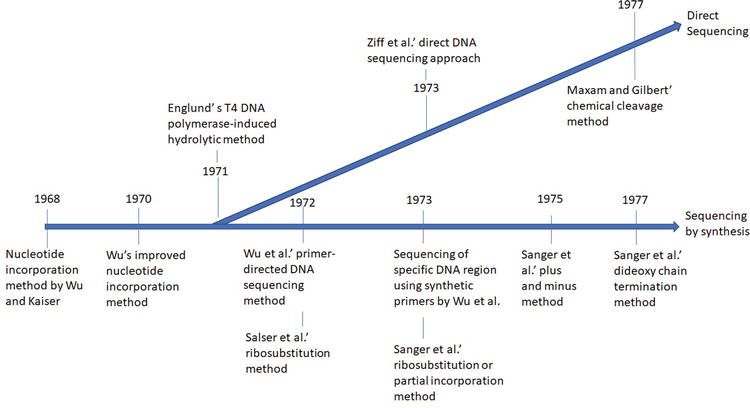 Fig. 1 Timeline of the developments in DNA sequencing methods during the first decade.1
Developed by Frederick Sanger in the 1970s, Sanger sequencing was the first widely adopted method for DNA sequencing. It relies on the use of dideoxynucleotides (ddNTPs), which terminate DNA chain elongation, creating fragments of varying lengths that can be analyzed to determine the sequence.
Key Features:
Next Generation Sequencing (NGS) technologies which emerged in the mid-2000s enable massive parallel sequencing of DNA thereby determining millions of sequences simultaneously. NGS technology manages large-scale sequencing projects efficiently and excels at whole-genome sequencing tasks.
Key Features:
| Feature | Sanger Sequencing | NGS |
| Throughput | Low (typically 1-2 samples per run) | High (millions of sequences per run) |
| Read Length | Long (up to 1,000 bp) | Short (50-300 bp) |
| Cost | High per base (for large genomes) | Lower cost per base for large-scale projects |
| Data Analysis | Straightforward, simple analysis | Complex, requires bioinformatics tools |
| Accuracy | High for small fragments | Variable, dependent on technology |
The complexity of protein sequencing surpasses that of DNA sequencing because proteins experience post-translational modifications and maintain a folded structure which presents significant analysis challenges.
Researchers initially used Edman degradation for protein sequencing which worked by removing each amino acid in sequence from the protein's N-terminus. These protein sequencing methods cannot analyze long sequences and struggle to sequence proteins that have complex modifications.
De novo protein sequencing means identifying the amino acid sequence of a protein without any existing knowledge about its sequence or the DNA that encodes it. Researchers now use this method as a vital proteomics tool to study proteins from organisms whose genomes remain unsequenced and when genetic information cannot be accessed.
Key Techniques:
Modern protein sequencing heavily depends on mass spectrometry (MS) for its processes. The technique functions through the ionization of proteins followed by mass-to-charge ratio measurement. Researchers examine the resultant spectra to determine the amino acid sequence.
Advantages:
| Aspect | DNA Sequencing | Protein Sequencing |
| Starting Material | DNA (genomic or cDNA) | Proteins or peptides |
| Technique | Sanger or NGS | Mass Spectrometry (MS/MS), Edman degradation |
| End Product | Nucleotide sequence | Amino acid sequence |
| Challenges | Repetitive sequences, complex genomes | Protein structure, post-translational modifications |
Sequencing data requires different interpretation methods when dealing with DNA versus protein samples. The sequencing of DNA reveals nucleotide sequences directly whereas protein sequencing necessitates extra processing steps to make sense of mass spectrometry results and build peptide chains.
| Technology/Tool | DNA Sequencing | Protein Sequencing |
| Sequencing Method | PCR, NGS, Sanger | Mass Spectrometry, LC-MS/MS |
| Bioinformatics Tools | Genome assemblers, alignment tools | Peptide matching, database search tools |
| Data Complexity | Low, straightforward mapping to genomes | High, due to protein complexity and modifications |
Table 1. Key Advantages and Disadvantages of De Novo Protein Sequencing vs. DNA Sequencing
| Feature | De Novo Protein Sequencing | DNA Sequencing |
| Principle | Direct amino acid sequencing from mass spectra | Determining nucleotide base order |
| PTM Detection | Direct identification | Indirect inference |
| Novel Proteins | Well-suited | Limited without genomic data |
| Database Dependence | Independent | Relies on genomic databases |
| Cost | Can be higher for large scale | Cost-effective for large scale |
| Throughput | Lower | High (NGS) |
| Time Efficiency | 2-3 weeks (example) | Varies (NGS can be fast) |
| Sensitivity | Higher in some cases (fewer random matches) | Lower in some cases |
| Computational Complexity | Higher | Lower for standard analysis |
The choice between de novo protein sequencing and DNA sequencing depends on multiple factors such as research goals alongside time limitations and available resources.
In conclusion, both de novo protein sequencing and DNA sequencing are powerful techniques in molecular biology. Creative Biolabs offers de novo antibody sequencing and de novo protein sequencing services, powered by our propriety DASS (Database Assisted Shotgun Sequencing) technology to meet the diverse protein research needs of our clients, driving innovation and advancement in the field of biomedical science.
Learn more about Creative Biolabs' de novo antibody sequencing services:
All listed services and products are For Research Use Only. Do Not use in any diagnostic or therapeutic applications.








