
Creative Biolabs is offering the most comprehensive services for antibody development projects. With strict regulation and effective execution, we are dedicated to providing the most valuable solutions to complete your projects.
HighlightsCreative Biolabs is offering the most comprehensive services for antibody development projects. With strict regulation and effective execution, we are dedicated to providing the most valuable solutions to complete your projects.
HighlightsCreative Biolabs has established a broad range of platforms for developing novel antibodies or equivalents. These cutting-edge technologies enable our scientists to meet your demands from different aspects and tailor the most appropriate solution that contributes to the success of your projects.
HighlightsWith deep understanding in antibody-related realms and extensive project experience, Creative Biolabs offers a variety of references to help you learn more about our capacities and achievements, including infographic, flyer, case study, peer-reviewed publications, and all kinds of knowledge that can assist your projects. You are also welcome to contact us directly for more specific solutions.
HighlightsGet a real taste of Creative Biolabs, one of the most professional custom service providers in the world. We are committed to providing highly customized comprehensive solutions with the best quality to advance your projects.
HighlightsDe novo sequencing stands as a fundamental pillar in biological research, enabling the elucidation of primary sequence information for nucleic acids (DNA/RNA) and proteins directly from experimental data, without the guidance of a known reference sequence. This approach is paramount when studying novel organisms, uncharacterized proteins, or systems where reference genomes are unavailable, incomplete, or significantly divergent.
The term "de novo" is Latin for "from the new" or "from the beginning." In the context of molecular biology, de novo sequencing refers to the process of determining the precise order of nucleotides in a DNA or RNA molecule, or the amino acid sequence in a protein, without any prior knowledge of the sequence. It is akin to piecing together a complex puzzle without the final picture on the box. This contrasts sharply with re-sequencing or reference-based approaches, which map sequence reads to an existing template.
For nucleic acids, this involves fragmenting the DNA or RNA, sequencing these smaller pieces, and then computationally assembling them into a contiguous sequence (contig) or a complete genome/transcriptome. For proteins, it typically involves digesting the protein into peptides, analyzing these peptides by mass spectrometry, and inferring the peptide sequences from their fragmentation patterns, which are then ordered to reconstruct the protein sequence.
The core principle of de novo sequencing, whether for nucleic acids or proteins, revolves around a few key stages:
The primary goals of de novo sequencing include:
Understanding the distinction between de novo and reference-based sequencing is crucial for selecting the appropriate strategy for a given research objective.
| Feature | De Novo Sequencing | Reference-Based Sequencing (Re-sequencing) |
| Reference Genome | Not required. | Required. |
| Primary Goal | Constructing a novel genome/transcriptome/protein sequence. | Identifying variations (SNPs, indels) relative to a reference. Mapping reads. |
| Computational Load | Generally higher, especially for assembly. | Generally lower, primarily mapping and variant calling. |
| Detection Power | Can identify novel sequences, large structural variants, entirely new genes/proteins. | Limited to variations relative to the reference; may miss large novel insertions or highly divergent regions. |
| Cost & Time | Can be more expensive and time-consuming. | Often faster and more cost-effective if a good reference exists. |
| Applications | Novel organism sequencing, antibody sequencing, metagenomics, transcriptome assembly for unannotated species. | Population genetics, variant discovery in known species, RNA-Seq for gene expression quantification against a reference. |
| Challenges | Assembly of repetitive regions, coverage gaps, computational complexity, error propagation. | Reference bias, mapping errors in repetitive regions, difficulty with large structural variants. |
At Creative Biolabs, we provide expert consultation to help you determine the most effective sequencing strategy tailored to your research needs and the nature of your biological samples.
This involves assembling the complete genome sequence of an organism for the first time. It is indispensable for:
While often synonymous with genome sequencing, de novo DNA sequencing can also refer to sequencing smaller, specific DNA molecules where a reference is absent. Examples include:
This is the predominant strategy for de novo genome sequencing. It involves:
The advent of long-read sequencing technologies has significantly enhanced de novo shotgun sequencing, particularly for resolving repetitive regions and complex structural variations that are challenging for short-read technologies alone.
In proteomics, de novo sequencing refers to determining the amino acid sequence of a protein or peptide directly from its experimental mass spectrometry data, without relying on sequence databases.
This is crucial for:
This is the core technique underlying de novo protein sequencing using mass spectrometry. Peptides (generated by enzymatic digestion of proteins, e.g., with trypsin) are ionized and subjected to tandem mass spectrometry (MS/MS). In an MS/MS experiment:
Specialized algorithms are used to interpret these complex spectra and derive peptide sequences.
A specialized and highly significant application within proteomics, de novo antibody sequencing is vital for the development and characterization of therapeutic antibodies and for immunological research. Given the hypervariable nature of antibody complementarity-determining regions (CDRs), de novo approaches are often essential. Creative Biolabs excels in this area, offering robust de novo antibody sequencing services for:
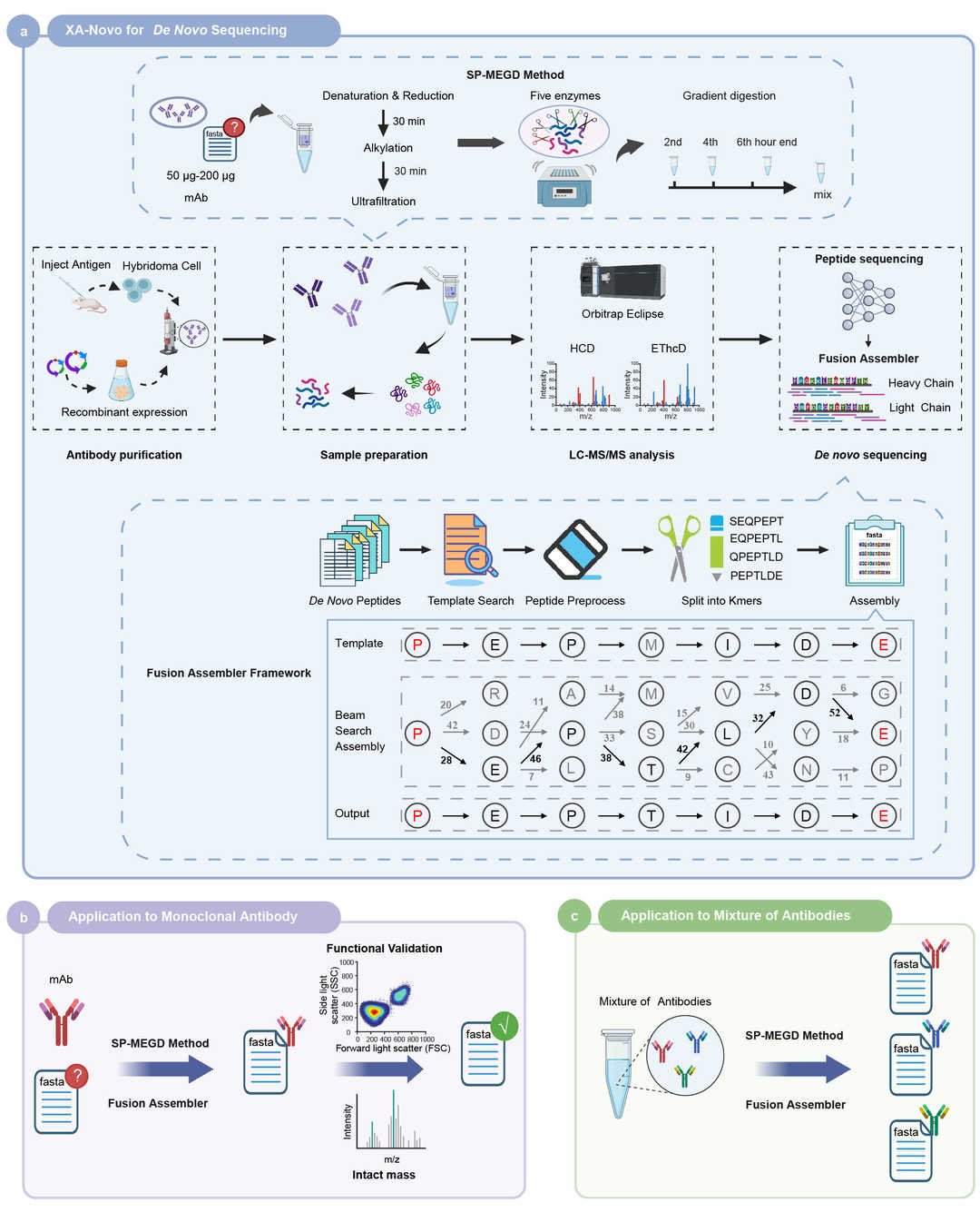 Fig. 1 MS-based de novo sequencing solution of monoclonal antibodies.1
Creative Biolabs' proprietary methodologies combine advanced mass spectrometry with sophisticated bioinformatics to deliver high-accuracy, full-length (variable and constant regions) antibody sequences, including the correct pairing of heavy and light chains.
De novo transcriptome sequencing (RNA-Seq without a reference genome) allows for the assembly and analysis of the complete set of transcripts in a cell or tissue at a specific developmental stage or condition, without prior genomic information. Key applications include:
Similar to genome assembly, transcriptome assembly from short reads can be challenging due to alternative splicing and varying expression levels. Long-read sequencing is also increasingly applied to obtain full-length transcript isoforms.
De novosequencing continues to find new applications:
The success of de novo sequencing hinges on sophisticated instrumentation and analytical techniques. The choice of technology depends on the type of molecule (DNA, RNA, or protein), the size and complexity of the target sequence, and the specific research goals.
Mass spectrometry (MS) is the cornerstone technology for de novo protein and peptide sequencing. It measures the mass-to-charge ratio (m/z) of ionized molecules, allowing for precise mass determination and structural elucidation.
In a typical proteomics workflow, proteins are first digested into peptides using enzymes like trypsin. These peptides are then separated (e.g., by liquid chromatography, LC) and introduced into the mass spectrometer. For de novo sequencing, tandem mass spectrometry is essential. A specific peptide ion (precursor ion) is selected in the first mass analyzer (MS1), fragmented, and the fragment ions (product ions) are analyzed in the second mass analyzer (MS2). The resulting MS/MS spectrum contains information about the masses of the amino acids in the peptide.
Electrospray Ionization (ESI) is a soft ionization technique commonly coupled with MS for analyzing biomolecules, including peptides and proteins. ESI generates gas-phase ions from analytes in solution with minimal fragmentation, often producing multiply charged ions. This allows larger molecules like peptides to be analyzed within the m/z range of common mass analyzers. When coupled with tandem MS (ESI-MS/MS), it provides a powerful platform for de novo peptide sequencing.
As mentioned, MS/MS is the key. The process involves:
The choice of fragmentation method and mass analyzer impacts the quality of data for de novo sequencing:
At Creative Biolabs, our state-of-the-art mass spectrometry facility is equipped with a suite of instruments capable of various fragmentation techniques, coupled with advanced bioinformatic pipelines for high-confidence de novo peptide and antibody sequencing.
NGS technologies, also known as high-throughput sequencing, have revolutionized de novo sequencing of DNA and RNA. They generate millions to billions of short sequence reads (typically 50-300 base pairs). The main challenge with short-read de novo assembly is resolving repetitive sequences longer than the read length and spanning large gaps. Paired-end or mate-pair libraries (sequencing both ends of larger DNA fragments) help to bridge gaps and order contigs into scaffolds.
Often referred to as long-read sequencing, these technologies offer significantly longer read lengths (kilobases to megabases), which are a major advantage for de novo assembly. Hybrid assembly approaches, combining the accuracy of short reads with the length of long reads, are also popular strategies to achieve high-quality de novo assemblies.
At Creative Biolabs, we combine decades of experience with cutting-edge technologies and a dedicated team of experts to provide comprehensive de novo sequencing services. We offer de novo antibody sequencing and de novo protein sequencing services, powered by our propriety DASS (Database Assisted Shotgun Sequencing) technology to meet the diverse protein research needs of our clients, driving innovation and advancement in the field of biomedical science.
Learn more about Creative Biolabs' de novo antibody sequencing services:
All listed services and products are For Research Use Only. Do Not use in any diagnostic or therapeutic applications.








