Unlocking Protein Secrets: The Power of Edman Protein Sequencing
Introduction Workflow Strategies & Methodologies Applications
Introduction to Edman Degradation
What is Edman Degradation?
Edman Degradation is a classical biochemical method for sequencing amino acids in a peptide or protein. Developed by Pehr Edman in 1950, this technique systematically removes one amino acid at a time from the N-terminus of a polypeptide chain, allowing for its identification. It revolutionized protein chemistry by providing a direct way to determine the primary structure of proteins, a critical step in understanding their function, evolution, and disease implications.
N-terminal Sequencing
N-terminal sequencing, specifically achieved through Edman Degradation, refers to the process of identifying the sequence of amino acids starting from the free amino group (N-terminus) of a protein or peptide. This initial sequence information is invaluable for several reasons:
-
Protein Identification: The N-terminal sequence can often be unique enough to identify a protein, especially when compared against known protein databases.
-
Cloning Strategies: Knowledge of the N-terminal sequence can aid in designing degenerate oligonucleotide probes for gene cloning.
-
Post-Translational Modification (PTM) Analysis: The presence or absence of a free N-terminus can indicate PTMs like acetylation or pyroglutamic acid formation, which block the Edman reaction.
-
Proteolytic Cleavage Site Determination: Identifying new N-termini after protease digestion helps map cleavage sites.
Principle and Mechanism of Edman Degradation
The power of Edman Degradation lies in its elegant three-step chemical cycle, which is repeated sequentially to identify successive amino acids. The core principle involves the selective labeling, cleavage, and identification of the N-terminal amino acid without hydrolyzing the rest of the peptide chain.
Key Reagents and Their Roles
The success of the Edman degradation cycle hinges on two primary reagents:
-
Phenyl Isothiocyanate (PITC)
-
Role: PITC is the highly reactive labeling reagent. Its isothiocyanate group (−N=C=S) specifically reacts with the free, unprotonated α-amino group of the N-terminal amino acid under mildly alkaline conditions.
-
Function: This reaction forms a stable phenylthiocarbamyl (PTC) derivative of the N-terminal amino acid. This derivatization is crucial as it "tags" the amino acid for subsequent removal.
-
Trifluoroacetic Acid (TFA)
-
Role: TFA is a strong, non-oxidizing acid used in the cleavage step.
-
Function: Under anhydrous acidic conditions provided by TFA, the peptide bond immediately following the PTC-derivatized N-terminal amino acid is selectively cleaved. This precise cleavage is essential to ensure that only one amino acid is removed per cycle, leaving the remaining peptide intact for the next round of degradation.
Step-by-Step Process
The Edman degradation cycle consists of three distinct chemical reactions:
-
Coupling: PITC reacts with N-terminal amino group to form phenylthiocarbamyl (PTC) derivative
-
Reaction: The free N-terminal amino group of the polypeptide performs a nucleophilic attack on the carbon atom of the isothiocyanate group of PITC. This reaction occurs under mildly alkaline conditions (e.g., pH 9.0) to ensure the amino group is deprotonated and reactive.
-
Product: A phenylthiocarbamyl (PTC) peptide is formed. The N-terminal amino acid is now tagged with the phenylthiocarbamyl group.
-
Cleavage: PTC-amino acid cleaves off as an anilinothiazolinone (ATZ) derivative under acidic conditions
-
Reaction: The PTC-peptide is then exposed to anhydrous acidic conditions, typically with TFA. The sulfur atom of the thiocarbamyl group attacks the carbonyl carbon of the first peptide bond, leading to cyclization and the release of the N-terminal amino acid as an anilinothiazolinone (ATZ) derivative.
-
Product: The ATZ-amino acid is released, and the remaining peptide chain, now shortened by one amino acid, retains a free N-terminus, ready for the next cycle.
-
Conversion: ATZ-amino acid converted to a stable phenylthiohydantoin (PTH)-amino acid for identification
-
Reaction: The ATZ-amino acid, being unstable, is immediately converted to its more stable and identifiable phenylthiohydantoin (PTH)-amino acid form. This conversion typically occurs in an aqueous acid solution (e.g., 25% TFA).
-
Product: The stable PTH-amino acid is then separated and identified, usually by High-Performance Liquid Chromatography (HPLC), by comparing its retention time with those of known PTH-amino acid standards.
Repetitive Cycles for Sequential Identification
The beauty of Edman Degradation lies in its cyclical nature. After the identification of the first N-terminal amino acid, the shortened peptide, now with a new free N-terminus, is subjected to the exact same three-step cycle. This iterative process allows for the sequential removal and identification of amino acids, revealing the primary sequence of the polypeptide from its N-terminus. Modern automated sequencers can perform these cycles efficiently, allowing for the determination of sequences up to 30-60 amino acids in length.
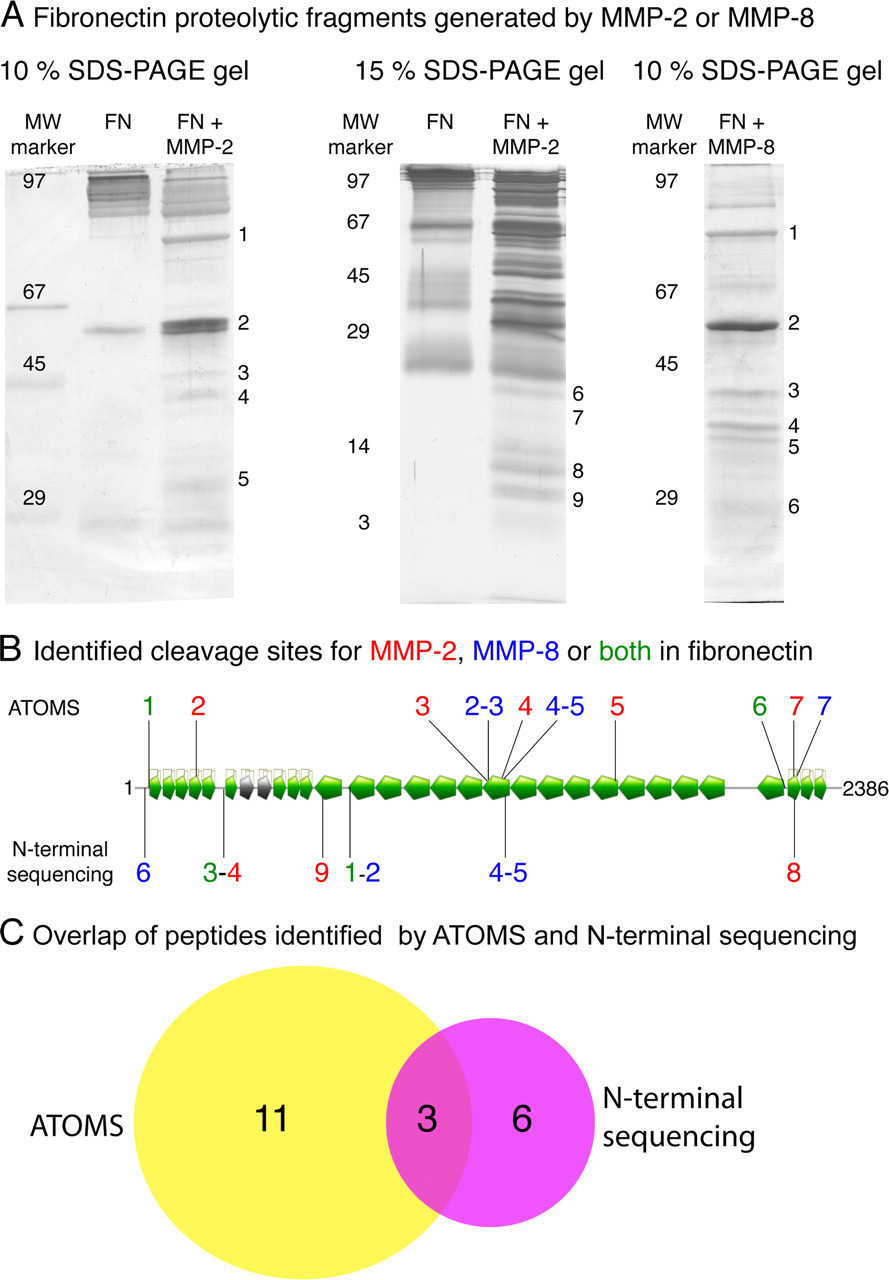 Fig. 1 Comparative analysis of cleavage sites identified by ATOMS and N-terminal sequencing.1
Applications of Edman Protein Sequencing
Despite the advent of mass spectrometry, Edman Protein Sequencing remains an indispensable tool in specific applications within protein research and development. Its direct nature provides a level of certainty that is often unmatched by other methods for N-terminal analysis.
Determining N-terminal sequences of various proteins and peptides
This is the primary and most direct application. Edman sequencing provides definitive identification of the N-terminal amino acid sequence, which is crucial for:
-
De novo sequencing: For proteins where no prior sequence information is available.
-
Verification: Confirming the N-terminal sequence of a known protein.
Sequencing novel proteins without prior database information
For newly discovered or uncharacterized proteins, Edman sequencing is invaluable. It provides the initial sequence tag required to:
-
Database Search: Search for homologous proteins in sequence databases.
-
Gene Cloning: Design degenerate primers for cloning the corresponding gene.
Verification of recombinant proteins and protease cleavage sites
In biotechnology, Edman sequencing is critical for quality control and characterization:
-
Recombinant Protein Integrity: Confirming that recombinant proteins have the correct N-terminal sequence, indicating proper translation initiation and processing.
-
Protease Activity Mapping: Identifying the exact cleavage sites of proteases by analyzing the newly generated N-termini after enzymatic digestion. This is vital in enzyme characterization and drug development.
Analysis of proteins separated by gel electrophoresis
Proteins separated by SDS-PAGE can be transferred onto a PVDF (polyvinylidene difluoride) membrane. These membrane-bound proteins can then be directly subjected to Edman degradation, making it a powerful tool for:
-
Protein Identification from Gels: Identifying proteins isolated from complex mixtures after electrophoretic separation.
-
Characterization of Purified Proteins: Obtaining N-terminal sequence information from purified protein bands.
Advantages and Disadvantages of Edman Degradation
Like any analytical technique, Edman Degradation possesses unique strengths and limitations that dictate its appropriate application.
Advantages
-
Direct amino acid identification (gold standard for N-terminal analysis): Edman sequencing directly identifies each amino acid by its unique chemical properties (specifically, the retention time of its PTH derivative). This provides unambiguous sequence information, making it the "gold standard" for N-terminal verification.
-
No need for protein databases: Unlike mass spectrometry-based proteomics, which often relies on comparing experimental data to theoretical peptide masses in databases, Edman sequencing is a de novo sequencing method. It does not require prior knowledge of the protein sequence or access to extensive protein databases for identification.
-
Can distinguish amino acids with similar molecular weights: Edman degradation can differentiate between isobaric amino acids (amino acids with the same nominal mass but different exact masses), such as leucine and isoleucine, which can be challenging to distinguish solely by mass spectrometry without specific fragmentation patterns. The chromatographic separation of their PTH derivatives provides clear distinction.
-
Able to sequence newly purified proteins: For novel proteins that have been purified but for which no sequence information exists, Edman degradation provides the crucial initial N-terminal sequence data, enabling further characterization and molecular biology studies.
Disadvantages
-
Limited peptide length (typically under 30-60 amino acids): The efficiency of each coupling and cleavage step is not 100%. With each cycle, a small percentage of the peptide fails to react or cleave correctly, leading to an accumulation of "lag" sequences. This effectively limits the readable sequence length to typically 30-60 amino acids, beyond which the signal-to-noise ratio becomes prohibitive.
-
N-terminal blocking (e.g., acetylation, pyroglutamic acid formation): Many proteins undergo post-translational modifications that block the free N-terminal α-amino group. Common examples include acetylation (e.g., N-terminal acetyltransferase) or cyclization to pyroglutamic acid. If the N-terminus is blocked, PITC cannot react, and the Edman degradation cannot proceed, rendering the protein unsequenceable by this method without prior de-blocking.
-
Cannot determine disulfide bridge positions: Edman degradation provides information about the linear sequence of amino acids. It does not provide any information about the three-dimensional structure of the protein, including the positions of disulfide bonds, which are crucial for protein folding and stability.
-
Slow and low throughput compared to other methods (e.g., mass spectrometry): Each cycle of Edman degradation is a relatively slow chemical process, taking tens of minutes. This makes it a low-throughput method compared to modern mass spectrometry techniques, which can identify thousands of proteins from complex mixtures in a single experiment.
-
Interference from by-products and reagents: The chemical reactions involved can produce by-products that interfere with the identification of PTH-amino acids. Contaminants from samples or reagents can also co-elute with PTH-amino acids during HPLC, complicating analysis and requiring highly purified samples.
At Creative Biolabs, we combine decades of experience with cutting-edge technologies and a dedicated team of experts to provide comprehensive de novo sequencing services. We offer de novo antibody sequencing and de novo protein sequencing services, powered by our propriety DASS (Database Assisted Shotgun Sequencing) technology to meet the diverse protein research needs of our clients, driving innovation and advancement in the field of biomedical science.
Learn more about Creative Biolabs' de novo antibody sequencing services:
Reference
-
Doucet, Alain, and Christopher M. Overall. "Broad coverage identification of multiple proteolytic cleavage site sequences in complex high molecular weight proteins using quantitative proteomics as a complement to edman sequencing." Molecular & Cellular Proteomics 10.5 (2011). Distributed under Open Access license CC BY 4.0, without modification. https://doi.org/10.1074/mcp.M110.003533
All listed services and products are For Research Use Only. Do Not use in any diagnostic or therapeutic applications.









