
Creative Biolabs is offering the most comprehensive services for antibody development projects. With strict regulation and effective execution, we are dedicated to providing the most valuable solutions to complete your projects.
HighlightsCreative Biolabs is offering the most comprehensive services for antibody development projects. With strict regulation and effective execution, we are dedicated to providing the most valuable solutions to complete your projects.
HighlightsCreative Biolabs has established a broad range of platforms for developing novel antibodies or equivalents. These cutting-edge technologies enable our scientists to meet your demands from different aspects and tailor the most appropriate solution that contributes to the success of your projects.
HighlightsWith deep understanding in antibody-related realms and extensive project experience, Creative Biolabs offers a variety of references to help you learn more about our capacities and achievements, including infographic, flyer, case study, peer-reviewed publications, and all kinds of knowledge that can assist your projects. You are also welcome to contact us directly for more specific solutions.
HighlightsGet a real taste of Creative Biolabs, one of the most professional custom service providers in the world. We are committed to providing highly customized comprehensive solutions with the best quality to advance your projects.
HighlightsIn the era of precision medicine and advanced functional genomics, the construction of high-quality genomic libraries remains the cornerstone of genetic research. Creative Biolabs, a world-renowned leader in biotechnology with over two decades of experience, provides premium Lambda Phage based Genome Library Construction services. By leveraging the unique biological properties of bacteriophage lambda, we offer researchers a robust platform to capture, store, and analyze the complete genetic information of any organism with unparalleled fidelity and coverage.
A genomic library is a collection of the total genomic DNA from a single organism. The Lambda Phage based Genome Library Construction involves the fragmentation of genomic DNA, followed by the ligation of these fragments into lambda phage vectors. These recombinant molecules are then packaged into infectious phage particles in vitro.
Compared to plasmid-based libraries, lambda phage vectors are preferred for genomic library construction because they can accommodate larger DNA inserts (up to 25 kb) and exhibit significantly higher transformation efficiency through in vitro packaging systems. This makes them ideal for representing complex eukaryotic genomes or searching for rare genes.
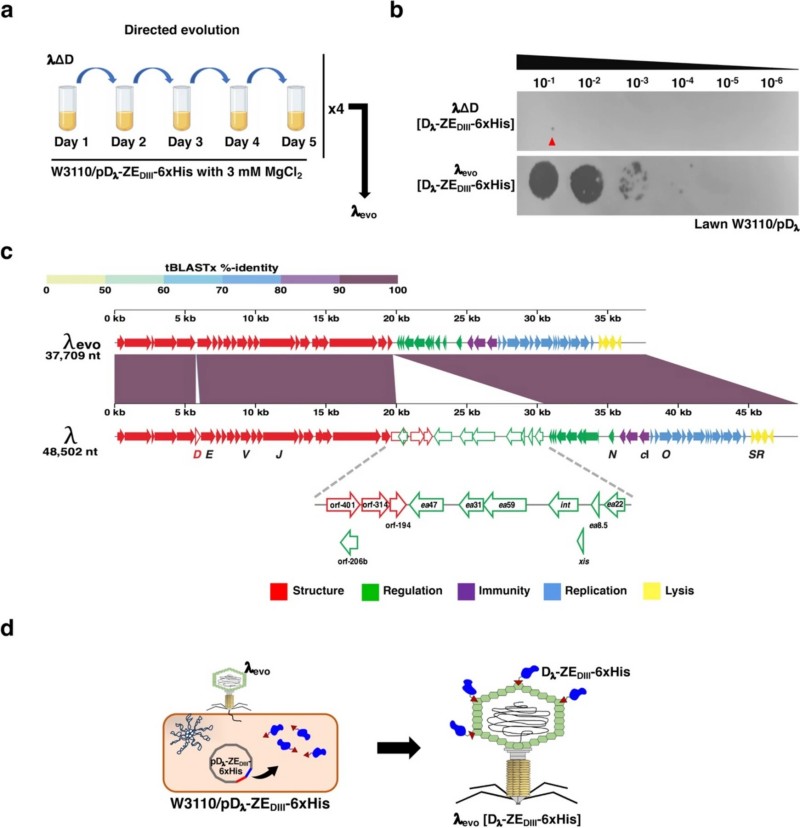 Fig. 1 The phage display system in λevo.1
To stay at the forefront of the industry, Creative Biolabs integrates the latest technological advancements into our Lambda Phage based Genome Library Construction workflow.
We utilize a variety of specialized lambda vectors depending on the research goal:
Standard hydrodynamic shearing can be imprecise. We offer:
Our proprietary packaging extracts achieve efficiencies of >109 pfu/μg of DNA, ensuring that even precious, low-quantity samples can be converted into comprehensive libraries.
The construction process at Creative Biolabs is a rigorous, multi-step pipeline governed by strict Quality Control (QC) standards.
| Step | Process Description | Key Quality Control (QC) |
| 1. DNA Extraction | High-molecular-weight (HMW) DNA isolation from tissues, cells, or microbes. | Gel electrophoresis (check for >50kb bands) & NanoDrop. |
| 2. Fragmentation | Physical shearing or partial enzymatic digestion to target size (e.g., 15-20 kb). | Analytical pulse-field gel electrophoresis (PFGE). |
| 3. Size Selection | Removal of small fragments and undigested DNA via sucrose gradient or PFGE. | Verification of fragment size distribution. |
| 4. Vector Preparation | Digestion and dephosphorylation of lambda arms. | Background ligation check (self-ligation test). |
| 5. Ligation & Packaging | Ligation of inserts to arms and in vitro packaging into phage heads. | Titer determination (pfu/mL). |
| 6. Amplification | Representative amplification of the primary library to create a stable stock. | Stability and recombination check. |
| 7. Validation | Random clone picking, insert size analysis, and NGS-based coverage check. | Average insert size & percent of recombinant clones. |
Our Lambda Phage based Genome Library services support a wide range of downstream applications:
At Creative Biolabs, we don't just build libraries; we engineer genetic resources designed for discovery. Our experts utilize cutting-edge packaging systems and optimized vector backbones to ensure:
Ready to accelerate your genomic research? Our PhD-level scientists are available to discuss your specific project needs and provide a customized strategy for your Lambda Phage based Genome Library Construction.
Reference
All listed services and products are For Research Use Only. Do Not use in any diagnostic or therapeutic applications.








