Creative Biolabs is offering the most comprehensive services for antibody development projects. With strict regulation and effective execution, we are dedicated to providing the most valuable solutions to complete your projects.
HighlightsCreative Biolabs is offering the most comprehensive services for antibody development projects. With strict regulation and effective execution, we are dedicated to providing the most valuable solutions to complete your projects.
HighlightsCreative Biolabs has established a broad range of platforms for developing novel antibodies or equivalents. These cutting-edge technologies enable our scientists to meet your demands from different aspects and tailor the most appropriate solution that contributes to the success of your projects.
HighlightsWith deep understanding in antibody-related realms and extensive project experience, Creative Biolabs offers a variety of references to help you learn more about our capacities and achievements, including infographic, flyer, case study, peer-reviewed publications, and all kinds of knowledge that can assist your projects. You are also welcome to contact us directly for more specific solutions.
HighlightsGet a real taste of Creative Biolabs, one of the most professional custom service providers in the world. We are committed to providing highly customized comprehensive solutions with the best quality to advance your projects.
HighlightsSingle domain antibody formats derived from camelid immune systems have drawn sustained interest in basic research due to their compact architecture, simplified folding behavior, and compatibility with diverse experimental environments. Among the many attributes explored by researchers, resistance to elevated temperature has emerged as a particularly valuable property when these binding domains are applied in demanding laboratory workflows. Creative Biolabs supports this research direction through thermal stability focused phage display screening strategies that prioritize structural resilience while preserving functional binding characteristics. Rather than treating heat resistance as an afterthought, Creative Biolabs integrates temperature related selection logic into early discovery stages. This approach allows researchers to identify variants that maintain integrity under stress while remaining suitable for routine experimental use.
Elevated temperature exposure is routinely encountered during protein expression, purification, long term storage, and assay workflows. Variants with limited thermal tolerance often display aggregation tendencies or progressive loss of binding performance, even under standard laboratory conditions.
Compact antibody architectures often benefit from efficient folding and reduced structural complexity. However, sequence level variation within framework regions can still lead to pronounced differences in thermal behavior and overall molecular robustness.
Recent advances in protein engineering suggest that thermal tolerance is frequently governed by distributed framework features rather than single dominant substitutions. These subtle contributions collectively influence conformational flexibility and resistance to heat induced unfolding.
Phage display provides a versatile experimental system for connecting sequence diversity with measurable stability outcomes. By applying defined thermal challenges during selection, stability related traits can be enriched alongside binding functionality.
For more details on how thermally resilient variants can optimize your expression protocols and reduce variability, connect with Creative Biolabs' team of experts.
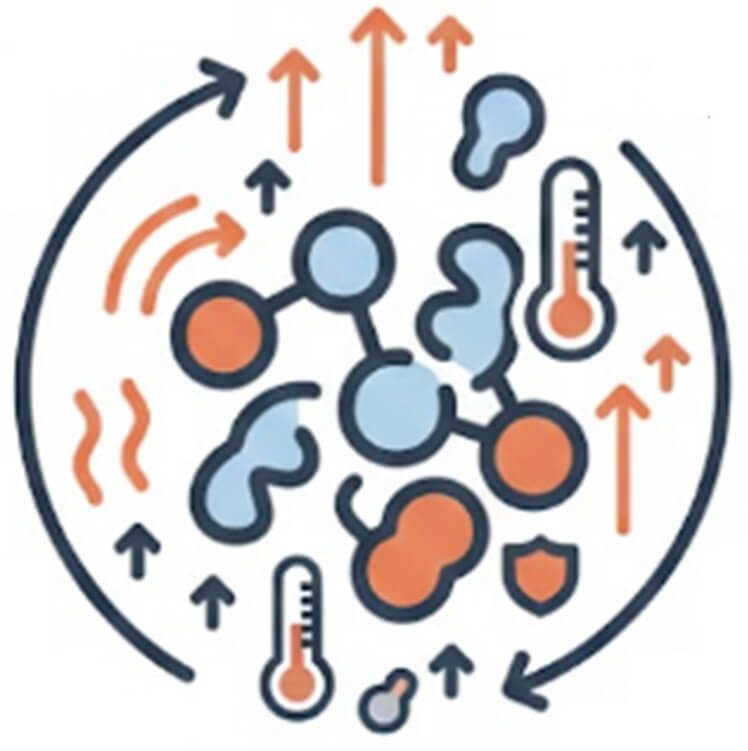
Creative Biolabs' screening platform combines deliberate library design with carefully managed temperature exposure during phage display selection cycles. This framework supports meaningful differentiation between marginally stable constructs and genuinely robust candidates.

|
|
If you're interested in applying stable variants to your assays, contact Creative Biolabs to discuss how we can support your experiments
Thermally resilient single domain antibody variants provide meaningful advantages across a wide range of experimental contexts, particularly where reproducibility and molecular integrity are critical.

Variants with improved thermal tolerance tend to express more consistently across different host systems and induction conditions. This predictability reduces the need for extensive optimization and helps minimize batch to batch variability during recombinant production.
Heat tolerant constructs are better suited for assays involving extended incubation times or elevated temperatures. Stable binding behavior under these conditions supports clearer interpretation of affinity, specificity, and kinetic parameters without confounding signal loss.
Enhanced conformational stability increases compatibility with crystallography, NMR, and cryogenic techniques. Reduced aggregation and structural heterogeneity often translate into improved resolution and more reliable structural datasets.
Experimental platforms that involve temperature cycling, prolonged storage, or repeated handling benefit from robust binding reagents. Thermally stable variants maintain functional integrity throughout method development workflows, improving assay longevity.
Thermal screening enables direct comparison between related scaffolds under identical stress conditions. Such side by side evaluation helps identify framework features that contribute to resilience and informs rational format selection.
Stable variants are less susceptible to gradual performance loss during storage or repeated freeze thaw cycles. This property supports extended experimental timelines and reduces uncertainty associated with reagent degradation.
To learn how thermally stable variants can enhance your structural biology research, reach out to Creative Biolabs for tailored advice
 Stability Integrated from the Start
Thermal tolerance is incorporated during early screening stages rather than addressed through later optimization. This improves candidate consistency and reduces re-engineering requirements.
Balanced Selection Pressure
Temperature conditions are calibrated to reveal meaningful stability differences without introducing artificial bias. This supports identification of genuinely robust variants.
Library Design Expertise
Creative Biolabs combines empirical data with theoretical modeling to construct libraries that support both functional diversity and structural integrity.
Flexible Species Backgrounds
Researchers may select from camelid derived frameworks, humanized variants, or synthetic constructs depending on experimental goals.
Explore how our thermally resilient antibodies can improve your assay development and method robustness, get in touch with our specialists.
Thermal stability remains a defining factor in the practical usability of antibody derived research tools. Through focused phage display screening strategies, researchers gain access to variants that combine compact structure with enhanced resilience under experimental stress. Creative Biolabs brings technical depth, methodological care, and cross project experience to this discovery process. By emphasizing reproducibility, thoughtful selection design, and scientific transparency, Creative Biolabs supports researchers seeking reliable and durable binding domains for foundational scientific exploration. To discuss a thermal stability focused screening strategy suited to your research system, connect with Creative Biolabs' phage display specialists.
All listed services and products are For Research Use Only. Do Not use in any diagnostic or therapeutic applications.