Creative Biolabs is offering the most comprehensive services for antibody development projects. With strict regulation and effective execution, we are dedicated to providing the most valuable solutions to complete your projects.
HighlightsCreative Biolabs is offering the most comprehensive services for antibody development projects. With strict regulation and effective execution, we are dedicated to providing the most valuable solutions to complete your projects.
HighlightsCreative Biolabs has established a broad range of platforms for developing novel antibodies or equivalents. These cutting-edge technologies enable our scientists to meet your demands from different aspects and tailor the most appropriate solution that contributes to the success of your projects.
HighlightsWith deep understanding in antibody-related realms and extensive project experience, Creative Biolabs offers a variety of references to help you learn more about our capacities and achievements, including infographic, flyer, case study, peer-reviewed publications, and all kinds of knowledge that can assist your projects. You are also welcome to contact us directly for more specific solutions.
HighlightsGet a real taste of Creative Biolabs, one of the most professional custom service providers in the world. We are committed to providing highly customized comprehensive solutions with the best quality to advance your projects.
HighlightsCreative Biolabs provides a Mitochondrial Permeability Transition Pore (mPTP) Opening Assay Service to address key challenges in drug discovery, including high attrition caused by unexpected cardiotoxicity, difficulty quantifying subtle mitoprotective effects, and challenges in identifying mitochondrial dysfunction mechanisms in neurodegenerative models. This service enables precise evaluation of mitochondrial permeability transition dynamics through advanced fluorescence kinetic imaging. By leveraging state-of-the-art bioenergetic analysis platforms, Creative Biolabs converts complex organelle behavior into quantitative, actionable data that supports safer and more effective therapeutic development.
The mitochondrial permeability transition pore (mPTP) is a non-selective channel in the mitochondrial inner membrane that opens under stress conditions such as calcium overload or oxidative damage. mPTP opening leads to mitochondrial depolarization, osmotic swelling, and the release of pro-apoptotic factors, ultimately contributing to cell death. Numerous studies have demonstrated that monitoring mPTP opening provides a reliable indicator of mitochondrial integrity and cellular stress responses. Therefore, mPTP assays are widely used in studies of mitochondrial dysfunction, drug-induced toxicity, and metabolic disease mechanisms.
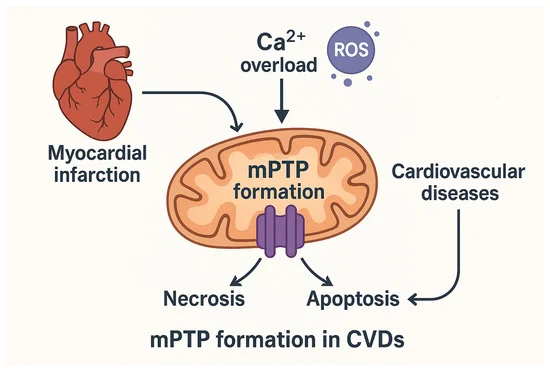 Fig.1 Opening of the mitochondrial permeability transition pore (mPTP).1
Creative Biolabs provides a robust analytical framework to evaluate the induction or inhibition of the mPTP, a critical checkpoint in cell death pathways. Whether you are developing cardioprotective agents to prevent ischemia-reperfusion injury or oncology drugs designed to trigger apoptosis via mitochondrial collapse, our service delivers quantitative evidence of pore status. We eliminate the ambiguity of traditional assays by providing high-resolution kinetic data that distinguishes between transient flickering and permanent pore opening. Our service helps you:
Researchers receive high-quality experimental data and analytical interpretation to accelerate decision-making in mitochondrial research. Discover How We Can Help – Request a Consultation.
| Calcium Retention Capacity Analysis | Fluorescence-Based mPTP Detection |
| Measures mitochondrial calcium uptake capacity and determines the threshold at which mPTP opening occurs, providing a sensitive indicator of mitochondrial resilience to calcium stress. | Utilizes mitochondrial fluorescent probes to monitor permeability changes and mitochondrial depolarization in real time, enabling quantitative analysis in intact cells. |
| Mitochondrial Swelling Assay | Membrane Potential Monitoring |
| Detects osmotic swelling caused by pore opening through optical density measurements, allowing rapid assessment of permeability transition in isolated mitochondrial preparations. | Combines permeability transition analysis with mitochondrial membrane potential measurements to evaluate the functional consequences of mPTP activation. |
Required Starting Materials: To initiate the service, clients typically provide either cryopreserved or fresh primary cell cultures, isolated mitochondrial fractions from target tissues, or purified recombinant proteins associated with the pore complex.
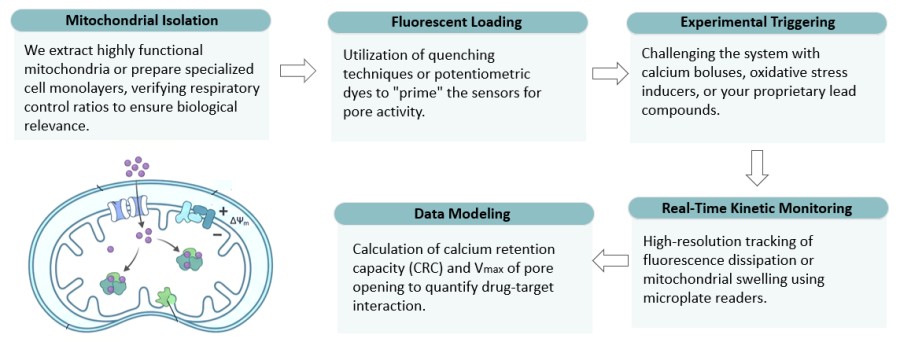
Final Deliverables: Clients receive a Bioenergetic Profile Report, including raw kinetic traces, statistically analyzed EC50/IC50 values for your compounds, and high-resolution representative imagery of mitochondrial morphology changes.
Creative Biolabs provides a specialized Mitochondrial Permeability Transition Pore (mPTP) Opening Assay Service that integrates advanced fluorescence detection, calcium retention capacity analysis, and high-resolution kinetic monitoring to evaluate mitochondrial permeability dynamics. Our platform supports both isolated mitochondria and live-cell models, enabling precise measurement of mPTP opening thresholds, membrane potential changes, and mitochondrial swelling responses. By combining optimized sample preparation workflows with robust quantitative analysis, we deliver reliable data to support mitochondrial toxicity studies, drug safety evaluation, and mechanistic research on cell death pathways. Contact us today to discuss your project and explore how our tailored assay solutions can support your research goals.
Reference
All listed services and products are For Research Use Only. Do Not use in any diagnostic or therapeutic applications.