Creative Biolabs is offering the most comprehensive services for antibody development projects. With strict regulation and effective execution, we are dedicated to providing the most valuable solutions to complete your projects.
HighlightsCreative Biolabs is offering the most comprehensive services for antibody development projects. With strict regulation and effective execution, we are dedicated to providing the most valuable solutions to complete your projects.
HighlightsCreative Biolabs has established a broad range of platforms for developing novel antibodies or equivalents. These cutting-edge technologies enable our scientists to meet your demands from different aspects and tailor the most appropriate solution that contributes to the success of your projects.
HighlightsWith deep understanding in antibody-related realms and extensive project experience, Creative Biolabs offers a variety of references to help you learn more about our capacities and achievements, including infographic, flyer, case study, peer-reviewed publications, and all kinds of knowledge that can assist your projects. You are also welcome to contact us directly for more specific solutions.
HighlightsGet a real taste of Creative Biolabs, one of the most professional custom service providers in the world. We are committed to providing highly customized comprehensive solutions with the best quality to advance your projects.
HighlightsAssessing mitochondrial respiratory chain complex activity is technically demanding due to the coordinated function of multiple enzymes, the unstable nature of membrane proteins, and the requirement for sensitive functional measurements in both health and disease. To tackle these challenges, we introduce our Mitochondrial Respiratory Chain Complex Activity Analysis Service, which enables accurate, high-throughput evaluation of complexes I through V. Using optimized biochemical assays under controlled conditions, the service generates robust and reproducible activity profiles from isolated mitochondria or tissue homogenates. With quantitative diagnostic data and in-depth functional assessments, we help researchers uncover metabolic abnormalities, validate therapeutic targets, and advance research in bioenergetics and mitochondrial medicine.
The mitochondrial respiratory chain complex, embedded in the inner mitochondrial membrane, is a multi-enzyme system critical for cellular energy transduction, coupling electron transfer to proton pumping across the membrane. Its activity directly determines oxidative phosphorylation efficiency, ATP production, and redox homeostasis, thereby serving as a fundamental parameter in both physiological metabolism and the pathogenesis of diverse mitochondrial disorders.
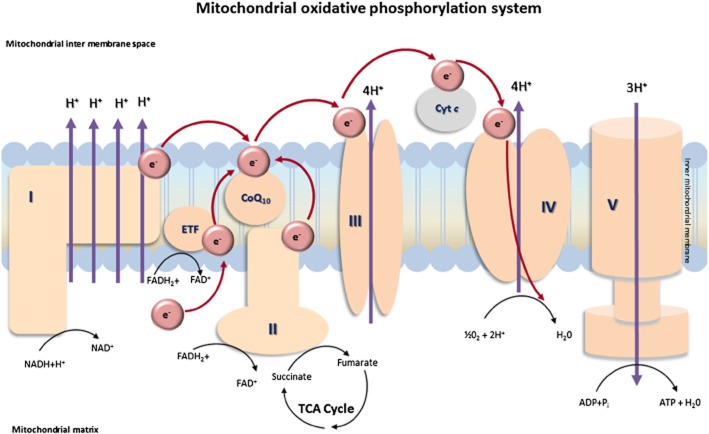 Fig.1 Mitochondrial respiratory chain complex.1
Our service delivers a thorough biophysical assessment of mitochondrial function, enabling precise localization of metabolic impairments or compound-related toxic effects. Through quantitative evaluation of each respiratory complex (I–V), both independently and in combination, we generate interpretable data on electron transfer efficiency and overall system integrity.
This service quantitatively assesses the activity of Complex I, the entry point of the electron transport chain, by measuring NADH oxidation coupled with ubiquinone reduction. It is essential for diagnosing mitochondrial dysfunction linked to Parkinson's disease, Leigh syndrome, and other oxidative phosphorylation disorders, as well as for evaluating drug effects on mitochondrial metabolism.
Focusing on the only membrane-bound enzyme in both the tricarboxylic acid cycle and the electron transport chain, this service measures succinate-driven reduction of artificial electron acceptors. It supports research on ischemia-reperfusion injury, tumor metabolism, and genetic defects causing mitochondrial complex II deficiencies.
This service evaluates the activity of Complex III by monitoring the reduction of cytochrome c coupled to ubiquinol oxidation. It is critical for studying conditions such as mitochondrial encephalomyopathy, aging-related oxidative stress, and the mechanism of respiratory chain inhibitors in both clinical and agricultural contexts.
Measuring the terminal oxidase of the respiratory chain, this service quantifies the oxidation of reduced cytochrome c to assess Complex IV function. Key applications include diagnosing COX deficiency manifesting as Leigh syndrome or cardiomyopathy, investigating hypoxic adaptation, and screening for neuroprotective or metabolic modulators targeting oxygen utilization.
This service analyzes ATP synthase activity by either measuring ATP production or the reverse hydrolysis reaction, providing insight into the final step of oxidative phosphorylation. It is invaluable for understanding mitochondrial myopathies, ATP synthase disorders, and for evaluating compounds that modulate energy coupling efficiency or proton leak.
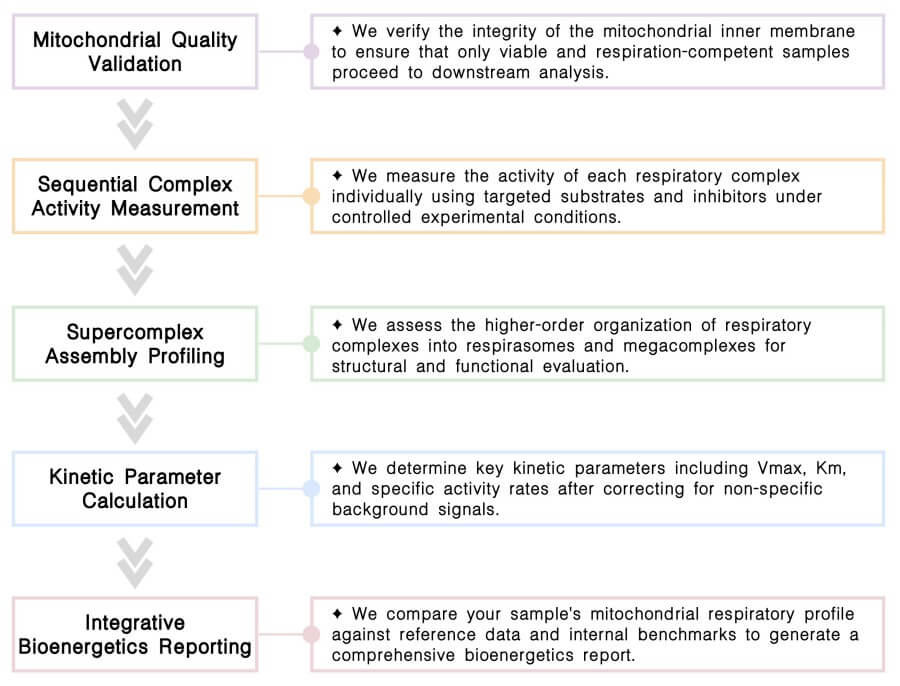
Final Deliverables:
With deep expertise in cellular immunology and mitochondrial bioenergetics, we deliver precise, reproducible analysis of respiratory chain complexes, from individual enzymes to megacomplex assemblies. Our integrated platform supports immunometabolism studies, disease modeling, and therapeutic targeting. Benefit from rigorous quality control, rapid turnaround, and 20 years of specialized experience.
Creative Biolabs offers a premium, full-scope solution for assessing mitochondrial respiratory chain complex function. Whether targeting isolated complex kinetics or visualizing supercomplex assemblies, our platform delivers high-accuracy data supported by two decades of hands-on scientific experience.
For in-depth project consultations or proposal requests, contact our technical specialists directly.
Reference
All listed services and products are For Research Use Only. Do Not use in any diagnostic or therapeutic applications.