Creative Biolabs is offering the most comprehensive services for antibody development projects. With strict regulation and effective execution, we are dedicated to providing the most valuable solutions to complete your projects.
HighlightsCreative Biolabs is offering the most comprehensive services for antibody development projects. With strict regulation and effective execution, we are dedicated to providing the most valuable solutions to complete your projects.
HighlightsCreative Biolabs has established a broad range of platforms for developing novel antibodies or equivalents. These cutting-edge technologies enable our scientists to meet your demands from different aspects and tailor the most appropriate solution that contributes to the success of your projects.
HighlightsWith deep understanding in antibody-related realms and extensive project experience, Creative Biolabs offers a variety of references to help you learn more about our capacities and achievements, including infographic, flyer, case study, peer-reviewed publications, and all kinds of knowledge that can assist your projects. You are also welcome to contact us directly for more specific solutions.
HighlightsGet a real taste of Creative Biolabs, one of the most professional custom service providers in the world. We are committed to providing highly customized comprehensive solutions with the best quality to advance your projects.
HighlightsUsing our High-Affi™ tech, Creative Biolabs offers custom antibodies that grab onto neddylated proteins with high specificity and strength. They reliably spot bound NEDD8 in cells and don't react much with other ubiquitin-like proteins.
Neddylation constitutes a specialized post-translational modification (PTM) utilizing the NEDD8 protein, functioning through enzymatic steps: precursor processing, E1 activation (UBA3-APPBP1 complex), E2 transfer (Ubc12), E3-mediated substrate attachment, and isopeptidase recycling. Distinct from ubiquitination's degradation signaling, this pathway principally modulates substrate functionality. Cullin proteins, their primary targets, require neddylation for proliferation regulation through CRL complex activation. The modification's biological reach extends to cell cycle coordination and signaling pathways. Clinically, neddylation dysregulation manifests dual pathological roles—CRL hyperactivity in malignancies correlates with elevated NEDD8 and disordered cullin modifications, prompting therapeutic targeting. Simultaneously, Alzheimer's disease exhibits disrupted NEDD8 localization patterns, notably cytoplasmic accumulation in hippocampal neurons, implicating regulatory failures in neurodegeneration. Mechanistic studies continue investigating neddylation's spatiotemporal control across disease states.
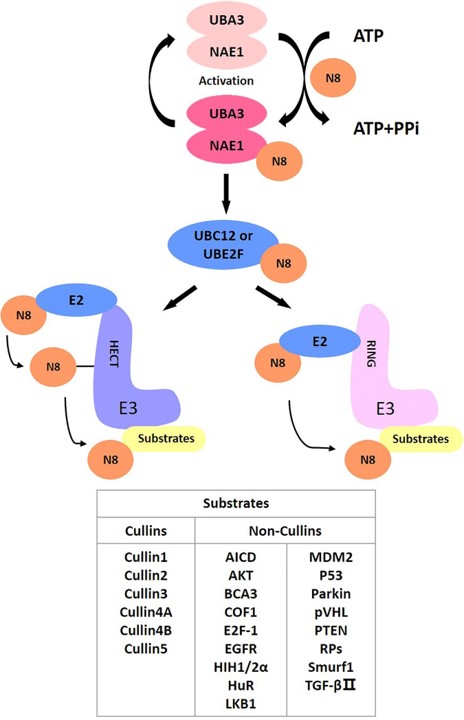 Fig.1 The main steps of the neddylation pathway.1
Neddylation can change how proteins work by altering their 3D shape in a few ways:
A) It can make them change shape (like how neddylation of cullins makes their tail end and Rbx1 active).
B) It can stop them from interacting with their usual partners or interfere with other modifications (for instance, neddylated cullins can't bind CAND1).
C) It can create new spots on the protein that allow it to bind to new partners (neddylated EGFR might recruit endocytic proteins such as Eps15 or Hrs).
Creative Biolabs' High-Affi™ neddylation antibodies are great for different kinds of immunoassays. Their excellent performance shows they really target neddylated proteins specifically. We also offer custom services to create unique antibodies that target specific neddylation events, depending on our clients' needs.
We offer a wide range of antibodies, and customizing the antibody type to your specific needs is available here.
Polyclonal Antibodies: Generated through animal immunization using defined neddylated peptides, these antibodies exhibit broad binding capacity across multiple antigenic determinants. Their utility lies in identifying conjugated NEDD8 forms, making them practical tools for initial screening of NEDD8 presence across experimental systems.
Monoclonal Antibodies: Derived from single B-cell clones, these reagents demonstrate singular epitope specificity on the neddylated peptide or proteins. molecule. Their uniform binding characteristics provide enhanced analytical precision relative to polyclonal variants, particularly in applications requiring minimal cross-reactivity.
Site-specific Anti-Neddylation Antibodies: These specialized tools enable precise mapping of neddylation events on specific-site of target proteins. Researchers can employ them to dissect pathway-specific regulatory mechanisms involving PTM.
Pan Anti-Neddylation Antibodies: These antibodies are designed to detect the neddylation states, when NEDD8 is bound to proteins, allowing researchers to specifically assess the general landscape of protein neddylation within a cell or tissue.
Monospecific Anti-Neddylation Polyclonal Antibody Production
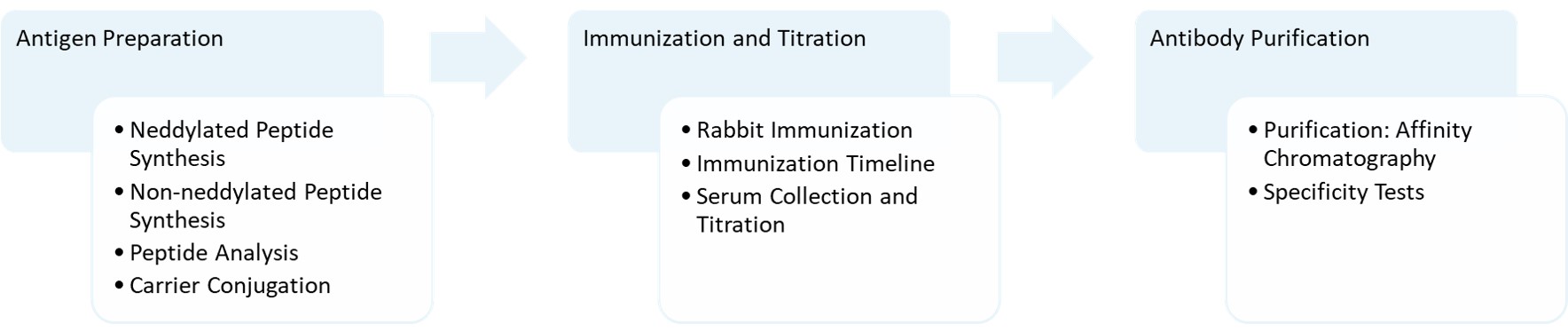
These antibodies can be produced by immunizing animals with immunogens designed around known neddylation sites and NEDD8-modified structures. Post-immunization serum undergoes sequential purification: initial removal of antibodies binding unmodified proteins followed by isolation of those targeting neddylated forms. The resulting polyclonal mixture benefits from diverse epitope engagement, enhancing detection sensitivity for neddylation events while remaining both time-efficient and economically viable.
Phage Display Strategy for Anti-Neddylation Monoclonal Antibody Discovery
Phage display is a powerful in vitro selection technique for discovering anti-neddylation monoclonal antibodies. This method involves displaying antibody fragments (like scFv or Fab) on the surface of bacteriophages. Researchers can screen both immune libraries, derived from immunized animals to enrich for antigen-specific antibodies, and non-immune, pre-made antibody libraries offering a broader diversity. A key advantage is the ability to perform stringent selection and amplification steps entirely in vitro, allowing for the isolation of high-affinity antibodies against a specific NEDD8-conjugated target.

Hybridoma Strategy for Anti-Neddylation Monoclonal Antibody Discovery
In this classic approach, spleen cells obtained from animals immunized with neddylated peptides or proteins are fused with immortal myeloma cells to create antibody-producing hybridomas. Post-fusion screening identifies clones secreting target-specific antibodies, which are then expanded for continuous production. While yielding monoclonal antibodies with superior specificity and binding strength for diverse experimental needs, the method demands greater time investment and animal resources.

Targeted Epitope Design for Neddylation Specificity: We engineer immunogens (peptides/proteins) to highlight structural changes caused by neddylation, promoting antibodies that distinguish modified from unmodified proteins.
Neo-Epitope Targeting for Site-Specific Antibodies: Our methods identify antibodies binding exclusively to lysine residues altered by site-specific NEDD8 attachment, enabling precise mapping of modification sites.
Customized Screening for Neddylation-Dependent Binding: Specialized assays verify antibody binding to neddylated targets while excluding interactions with unmodified proteins or unrelated UBLs.
Stringent Cross-Reactivity Mitigation: Robust validation eliminates antibodies reacting with ubiquitin/UBLs, ensuring neddylation-specific recognition.
Pan-Neddylation Motif Antibody Generation: We develop antibodies targeting conserved NEDD8-induced features across substrates for broad neddylation analysis.
Antibody Engineering for Enhanced Specificity and Affinity: Advanced optimization techniques refine antibody performance for reliable neddylation detection in complex samples.
Q: My target protein degrades easily, complicating large-scale production for antibody development. Can you create Neddylation-specific antibodies under these conditions?
A: Our team regularly handles unstable targets through adaptive strategies. When working with fragile proteins, we often utilize stabilized peptide fragments containing critical neddylation sites rather than full-length proteins. Alternative approaches include optimized expression protocols enhancing protein longevity and phage display systems requiring minimal antigen quantities. We'll co-design solutions aligned with your target's unique degradation patterns and experimental requirements.
Q: How do your antibodies differentiate between normal and abnormal neddylation levels?
A: Our customization extends to distinguishing modification states. Immunogen design might incorporate controlled NEDD8 valency, comparing singly versus multiply modified peptides. Screening incorporates cellular models with titrated neddylation activity, while validation includes parallel testing against physiological and hyperneddylated samples. This tiered approach ensures selected antibodies meet your diagnostic thresholds for normal versus pathological states.
Q: Can you develop antibodies that inhibit neddylation rather than just detect it?
A: While detection remains our core service, we can pursue functional antibodies through specialized screening. Assays would evaluate interference with NEDD8 conjugation machinery, monitoring disruption of E1 activation or E2-E3 substrate recognition. Success rates depend on target accessibility and mechanism, requiring extended characterization. Let's discuss feasibility based on your intended blocking mechanism.
Q: What are the intellectual property considerations for antibodies discovered through your service?
A: IP ownership follows industry-standard practices: clients maintain exclusive rights to project-specific antibodies. Our contracts explicitly outline invention ownership and confidentiality terms. We welcome early discussions about licensing needs or patent filing strategies to protect your discoveries.
Q: What if initial antibodies lack required performance?
A: Our process anticipates iterative refinement. Should first-generation candidates underperform, we initiate optimization protocols: adjusting immunization regimens, implementing affinity maturation via chain shuffling, or conducting counter-screening against cross-reactive epitopes. Continuous collaboration ensures final deliverables meet your specifications, with transparent communication about any necessary protocol adjustments or cost implications.
Reference
All listed services and products are For Research Use Only. Do Not use in any diagnostic or therapeutic applications.