Creative Biolabs is offering the most comprehensive services for antibody development projects. With strict regulation and effective execution, we are dedicated to providing the most valuable solutions to complete your projects.
HighlightsCreative Biolabs is offering the most comprehensive services for antibody development projects. With strict regulation and effective execution, we are dedicated to providing the most valuable solutions to complete your projects.
HighlightsCreative Biolabs has established a broad range of platforms for developing novel antibodies or equivalents. These cutting-edge technologies enable our scientists to meet your demands from different aspects and tailor the most appropriate solution that contributes to the success of your projects.
HighlightsWith deep understanding in antibody-related realms and extensive project experience, Creative Biolabs offers a variety of references to help you learn more about our capacities and achievements, including infographic, flyer, case study, peer-reviewed publications, and all kinds of knowledge that can assist your projects. You are also welcome to contact us directly for more specific solutions.
HighlightsGet a real taste of Creative Biolabs, one of the most professional custom service providers in the world. We are committed to providing highly customized comprehensive solutions with the best quality to advance your projects.
HighlightsCysteine, with its unique and highly reactive thiol (sulfhydryl) group, represents the gold standard for site-specific protein modification. However, harnessing this reactivity—especially for complex molecules like antibodies—is a profound scientific challenge. For over two decades, Creative Biolabs has been at the forefront of bioconjugation technology. We are not just a service provider; we are veteran biologists, chemists, and problem-solvers. Our Cysteine Modification Services are built on a deep understanding of protein chemistry and proprietary technology platforms designed to overcome the field's most complex hurdles. We deliver the precision-engineered molecules you need to accelerate your research, from discovery to pre-clinical validation.
While other amino acids like lysine are abundant, their modification often results in a heterogeneous mixture of products with variable conjugation sites and numbers. This heterogeneity is a critical liability, leading to unpredictable pharmacokinetics (PK), reduced efficacy, and potential toxicity.
Cysteine modification solves this problem. The thiol group (R-SH) is the most nucleophilic functional group in a protein, but it is also relatively rare. In its deprotonated thiolate form (R-S⁻), it readily reacts with specific electrophilic linkers, providing a precise chemical handle for bioconjugation.
This level of precision is the driving force behind next-generation Antibody-Drug Conjugates (ADCs), advanced diagnostic imaging agents, and novel protein-based research tools.
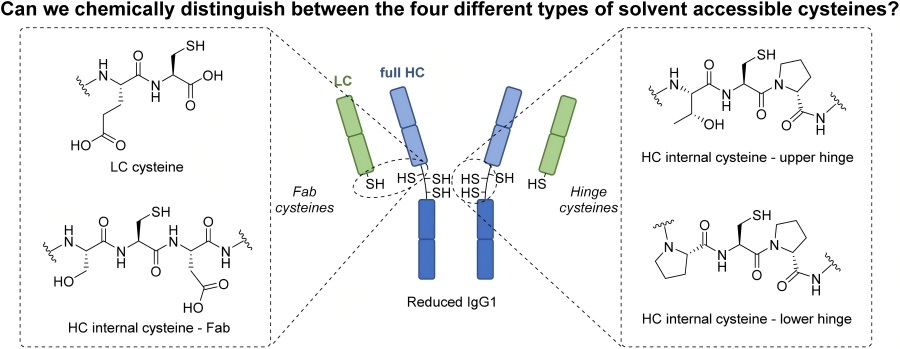 Fig. 1 This work seeks to explore the possibility of distinguishing between the four different types of solvent accessible cysteines found on a typical IgG1 antibody as a conduit to exploring a fundamentally novel way to modify antibodies.1
We offer a suite of state-of-the-art platforms for cysteine modification in antibody and other proteins. Our strategies are tailored to your specific molecule and application, moving beyond "one-size-fits-all" catalog approaches.
For projects demanding absolute control, we can generate a de novo antibody or protein with cysteine residues engineered at optimal locations.
This is our flagship platform for modifying native antibodies. Instead of irreversibly breaking the inter-chain disulfide bonds, we use them as anchors.
We have mastered and optimized a portfolio of conjugation chemistries far beyond standard maleimides to ensure your conjugate remains intact.
We provide end-to-end solutions, from conceptual design to final purified conjugate, as well as standalone fee-for-service options.
Don't have an engineered antibody? We will make it for you. This service integrates our antibody engineering expertise with our conjugation platforms.
You provide the Cys-engineered protein; we provide the conjugation expertise.
Leverage our platform for your native IgG1, IgG2, or IgG4 antibodies.
Our services extend beyond antibodies. We routinely perform cysteine modification on:
Our medicinal chemistry division can support your project with:
Our cysteine modification services enable cutting-edge research and development across multiple scientific disciplines.
Partnering with Creative Biolabs for your cysteine modification project provides you with a distinct competitive advantage.
To fully support your research pipeline, Creative Biolabs offers a comprehensive suite of related services:
Let Creative Biolabs provide the site-specific, stable, and homogenous cysteine-modified conjugates your research demands. Our expert team is ready to discuss your project, from initial design to final validated molecule.
Q: What is the main difference between cysteine modification and lysine modification?
A: The primary difference is specificity. A typical antibody has 80-100 lysine residues, and modifying them results in a highly heterogeneous mixture. In contrast, free cysteines are rare. By engineering cysteines at specific sites or by targeting the 4 inter-chain disulfide bonds, we can achieve highly specific, controlled conjugation with a uniform DAR.
Q: Can you modify the native disulfide bonds without fragmenting my antibody?
A: Yes. First, our platform uses bifunctional linkers to "re-bridge" the disulfide bond after selective reduction, maintaining the antibody's quaternary structure. Second, we can perform highly controlled partial reduction to target only the most accessible thiols, though our re-bridging platform is superior for creating stable, homogenous (DAR=4) conjugates.
Q: What is a "drug-to-antibody ratio" (DAR) and why is it critical for cysteine modification?
A: The DAR is the average number of drug (or payload) molecules attached to a single antibody. For traditional lysine conjugation, this is a broad average (e.g., DAR 3.5), representing a mix of molecules. For site-specific cysteine modification, we can produce a single, defined species (e.g., DAR=2 or DAR=4). This homogeneity is critical for a predictable dose-response, consistent manufacturing, and a safer therapeutic profile.
Q: I have a unique payload. Can you conjugate it to my antibody?
A: Absolutely. Our services are fully custom. We can either synthesize a linker-payload derivative for you or work with your provided material. Our chemistry team will assess the payload's structure and develop a custom conjugation protocol (e.g., via thiol-maleimide, thiol-ene, etc.) to attach it to the cysteine(s) on your protein.
Q: What is the main benefit of disulfide re-bridging technology?
A: The main benefits are speed, stability, and homogeneity without re-engineering. It allows you to take an existing, native IgG1 antibody and directly convert it into a highly stable and homogenous (DAR=4) ADC. This bypasses the time and expense of designing, expressing, and validating a new cysteine-engineered cell line.
Q: How do you ensure the stability of your thiol-maleimide conjugates?
A: Standard maleimide conjugates can reverse, leading to drug detachment. We solve this by using next-generation maleimides (e.g., dithiomaleimides or hydrolyzed maleimides) that "lock" the linkage, making it irreversible and highly stable in vivo. For applications demanding absolute stability, we may also recommend alternative chemistries like thiol-ene.
Q: What information do I need to provide to get a quote for a cysteine modification service?
A: To provide an accurate quote, we ideally need to know:
All listed services and products are For Research Use Only. Do Not use in any diagnostic or therapeutic applications.