Creative Biolabs is offering the most comprehensive services for antibody development projects. With strict regulation and effective execution, we are dedicated to providing the most valuable solutions to complete your projects.
HighlightsCreative Biolabs is offering the most comprehensive services for antibody development projects. With strict regulation and effective execution, we are dedicated to providing the most valuable solutions to complete your projects.
HighlightsCreative Biolabs has established a broad range of platforms for developing novel antibodies or equivalents. These cutting-edge technologies enable our scientists to meet your demands from different aspects and tailor the most appropriate solution that contributes to the success of your projects.
HighlightsWith deep understanding in antibody-related realms and extensive project experience, Creative Biolabs offers a variety of references to help you learn more about our capacities and achievements, including infographic, flyer, case study, peer-reviewed publications, and all kinds of knowledge that can assist your projects. You are also welcome to contact us directly for more specific solutions.
HighlightsGet a real taste of Creative Biolabs, one of the most professional custom service providers in the world. We are committed to providing highly customized comprehensive solutions with the best quality to advance your projects.
HighlightsThe adaptive immune system is characterized by its remarkable diversity, driven by the stochastic rearrangement of T cell receptors (TCR) and B cell receptors (BCR). Understanding this diversity is pivotal for deciphering immune responses in oncology, infectious diseases, and autoimmunity. However, when dealing with Small Lymphocytes populations—such as antigen-specific subsets, tissue-resident lymphocytes, or cells obtained via fine-needle aspirates—traditional sequencing methods often succumb to sampling bias and amplification artifacts. Creative Biolabs has pioneered the Quantitative Immune Repertoire Profiling Service for Small Lymphocytes, leveraging our proprietary MemDX™ platform. By integrating next-generation sequencing (NGS) with advanced molecular barcoding, we provide researchers with a high-resolution, truly quantitative map of the immune landscape even from minimal starting material.
Standard immune repertoire sequencing often provides a qualitative "snapshot," but fails to deliver absolute quantification. In small lymphocyte populations (typically <10,000 cells), every single cell represents a significant portion of the total repertoire. Traditional multiplex PCR approaches introduce significant "PCR bias," where certain clones are over-represented simply due to primer binding efficiency rather than biological abundance.
To overcome these hurdles, quantitative profiling of immune repertoires for small lymphocytes requires a shift from standard library preparation to a bias-free, high-fidelity methodology. Creative Biolabs addresses these challenges by ensuring:
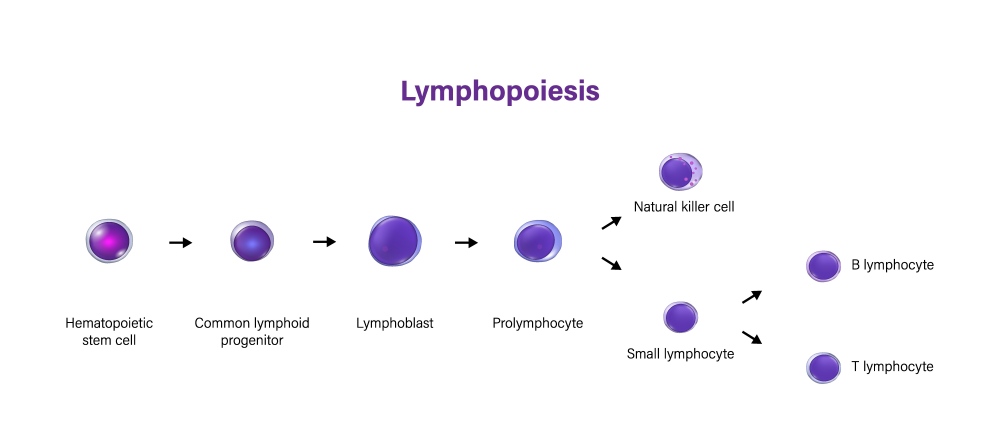 Fig. 1 The development of lymphocyte.
At the heart of our Quantitative Immune Repertoire Profiling Service for Small Lymphocyte is the MemDX™ technology suite. This platform combines the precision of high-throughput sequencing with innovative biochemical strategies to ensure that the data you receive is a faithful representation of the original biological sample.
Table 1. Comparison of Profiling Strategies for Small Lymphocytes
| Feature | Standard Multiplex PCR | Creative Biolabs MemDX™ (5' RACE + UMI) |
| Quantification Accuracy | Relative / Low | Absolute / High |
| Amplification Bias | High (Primer-dependent) | Minimal (Universal Primer) |
| Detection of Rare Clones | Prone to loss | Ultra-sensitive |
| Error Correction | Statistical modeling | Molecular-level (UMI) |
| Application Suitability | Bulk tissue / High input | Small Lymphocytes / Rare subsets |
The quantitative profiling of BCR/TCR repertoires for small lymphocytes follows a rigorous pipeline at Creative Biolabs. We understand that with small samples, there is no room for error.
We accept various inputs, including sorted cells, microdissected tissues, and low-input RNA. Our experts perform initial QC using capillary electrophoresis to ensure the integrity of the starting material.
During the first-strand cDNA synthesis, a unique molecular barcode (UMI) is incorporated into each transcript. This step is critical for preserving the quantitative information of the immune repertoire.
The cDNA is amplified using a nested PCR approach focused on the 5' end. This captures the complete V(D)J variable region, including the highly informative CDR3 (Complementarity Determining Region 3).
Libraries are sequenced on the high-throughput sequencing platforms. We offer customizable sequencing depths, typically ranging from 1M to 10M reads per sample, depending on the diversity of the target population.
Our proprietary pipeline handles the complex task of UMI deduplication, V(D)J gene assignment, and diversity metric calculation.
The ability to perform Quantitative Immune Repertoire Profiling on limited cell numbers has opened new frontiers in precision medicine and basic immunology.
With over 20 years of experience in repertoire analysis latest technology, Creative Biolabs stands at the intersection of immunology and data science.
Creative Biolabs offers a modular suite of repertoire analysis services tailored to address diverse research questions:
Contact Creative Biolabs today to discuss how our Quantitative Immune Repertoire Profiling Service for Small Lymphocyte can accelerate your discovery programs. Our experts are ready to provide the high-precision data your research deserves.
Reference
All listed services and products are For Research Use Only. Do Not use in any diagnostic or therapeutic applications.