Creative Biolabs is offering the most comprehensive services for antibody development projects. With strict regulation and effective execution, we are dedicated to providing the most valuable solutions to complete your projects.
HighlightsCreative Biolabs is offering the most comprehensive services for antibody development projects. With strict regulation and effective execution, we are dedicated to providing the most valuable solutions to complete your projects.
HighlightsCreative Biolabs has established a broad range of platforms for developing novel antibodies or equivalents. These cutting-edge technologies enable our scientists to meet your demands from different aspects and tailor the most appropriate solution that contributes to the success of your projects.
HighlightsWith deep understanding in antibody-related realms and extensive project experience, Creative Biolabs offers a variety of references to help you learn more about our capacities and achievements, including infographic, flyer, case study, peer-reviewed publications, and all kinds of knowledge that can assist your projects. You are also welcome to contact us directly for more specific solutions.
HighlightsGet a real taste of Creative Biolabs, one of the most professional custom service providers in the world. We are committed to providing highly customized comprehensive solutions with the best quality to advance your projects.
HighlightsMass Spectrometry is an analytical technique that measures the mass-to-charge ratio (m/z) of ions. It essentially "weighs" molecules, providing crucial information about their elemental composition, structural characteristics, and isotopic abundance. The core principle revolves around converting molecules into ions, separating these ions based on their m/z ratio, and detecting them.
The journey of a molecule through a mass spectrometer typically involves three key steps:
Tandem Mass Spectrometry, often referred to as MS/MS, takes the analysis a step further. Instead of just analyzing the ions from the initial ionization event (MS1), a selected "precursor ion" is fragmented into smaller "product ions." These product ions are then mass analyzed (MS2), providing more detailed structural information about the precursor ion. This fragmentation process is often achieved through techniques like Collision-Induced Dissociation (CID), Electron Transfer Dissociation (ETD), or Higher-Energy Collisional Dissociation (HCD).
The resulting MS/MS spectrum serves as a "fingerprint" for the original molecule, allowing for unambiguous identification and structural elucidation. This capability is paramount in protein and peptide analysis, as it enables the determination of amino acid sequences.
The application of mass spectrometry to the study of proteins has revolutionized biological research, enabling unprecedented insights into their identity, quantity, modifications, and interactions.
Protein Mass Spectrometry refers to the use of mass spectrometry techniques specifically tailored for the analysis of proteins and peptides. Its primary purpose is to characterize proteins on a large scale within research and development paradigms, addressing fundamental questions in biology, biochemistry, and drug discovery. This includes:
Proteins are macromolecules composed of amino acid chains linked by peptide bonds. Their mass is a fundamental physical property that can be precisely determined using mass spectrometry. The "protein mass" typically refers to the average molecular weight, which can be calculated from the sum of the atomic masses of all atoms in the protein. However, for precise measurements, especially for smaller peptides or highly resolved data, monoisotopic mass (the mass of the most abundant isotope) is often used.
The ability to accurately measure protein mass is crucial for several research applications:
While "mass spectrophotometry" is a term sometimes encountered, the correct and widely accepted nomenclature in the scientific community is "mass spectrometry." The "spectrometry" in mass spectrometry refers to the measurement of spectra (mass spectra), which are plots of ion abundance versus mass-to-charge ratio. This is distinct from "spectrophotometry," which involves the measurement of the absorption or emission of light. When applied to proteins, it specifically means utilizing mass spectrometry methodologies to analyze proteins and their derivative peptides.
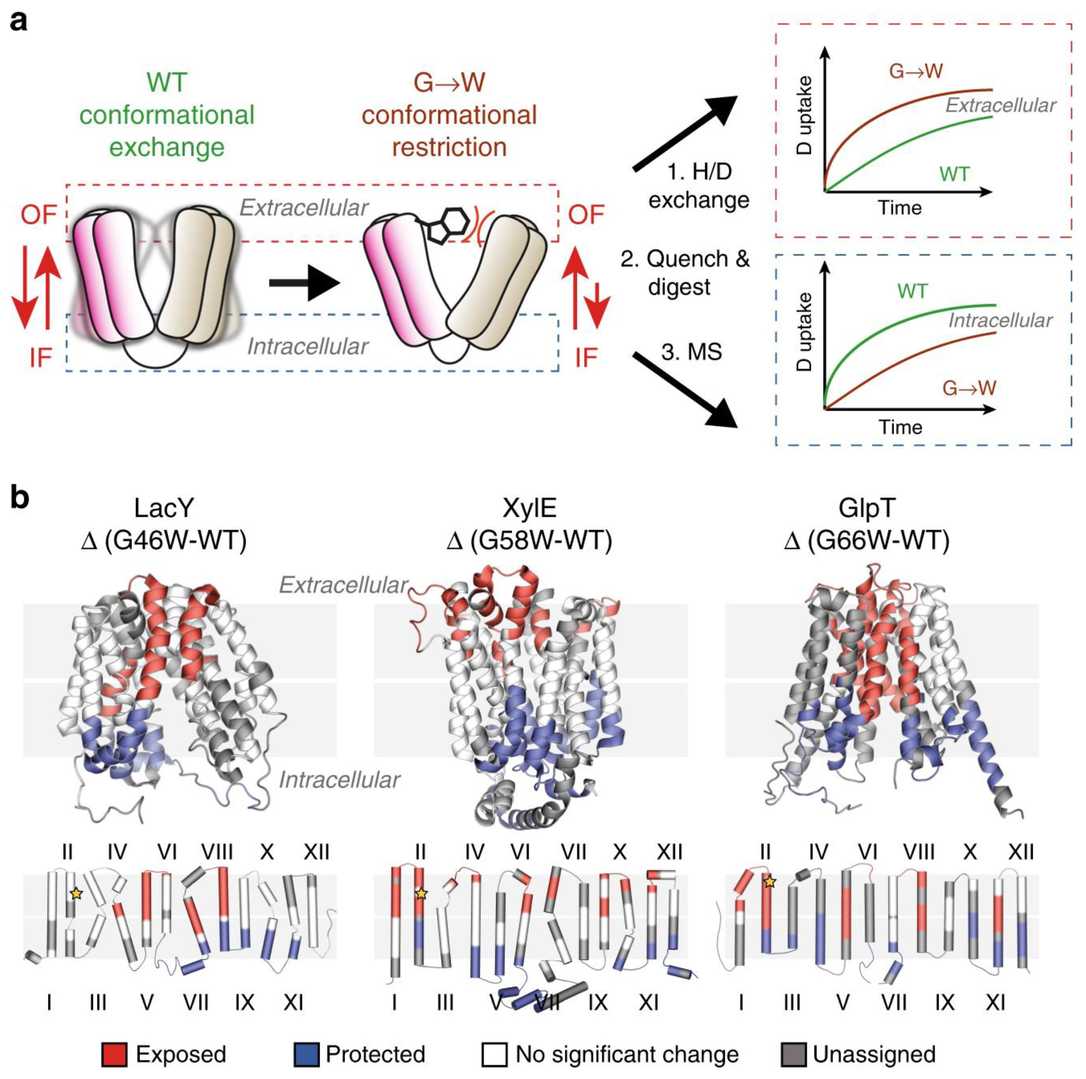 Fig. 1 Use of G-to-W mutants in HDX-MS to examine changes in a conformational equilibrium between IF and OF states.1
The diverse applications of mass spectrometry are enabled by a variety of instrument types and experimental techniques, each offering unique advantages.
LC-MS combines the powerful separation capabilities of liquid chromatography with the highly sensitive detection and identification capabilities of mass spectrometry. This hyphenated technique is invaluable for analyzing complex mixtures of analytes, including peptides and small molecules.
In LC-MS, the effluent from the LC column is directly introduced into the mass spectrometer's ion source. This online coupling minimizes sample handling and reduces potential contamination. For protein applications, reversed-phase LC is commonly used to separate peptides, followed by electrospray ionization (ESI) for efficient ion generation.
As previously discussed, MS/MS is a fundamental technique within mass spectrometry that provides structural information about selected ions. In the context of protein mass spectrometry, MS/MS is critical for:
Modern MS/MS instruments often employ various fragmentation techniques, such as CID, HCD, and ETD, each offering different advantages in terms of fragmentation efficiency and PTM preservation.
LC-MS/MS represents the gold standard for high-throughput and comprehensive protein analysis in proteomics. It integrates the robust separation power of LC with the detailed structural information provided by MS/MS.
The workflow for LC-MS/MS in proteomics typically involves:
Table 1. Comparison of Key Mass Spectrometry Techniques in Protein Analysis
| Technique | Primary Application | Advantages | Disadvantages |
| MS | Molecular weight determination, purity assessment | Simple, fast, non-destructive | Limited structural information, challenging for complex mixtures |
| MS/MS | Peptide sequencing, PTM localization, protein ID | Detailed structural information, high specificity | Requires precursor ion selection, lower throughput if not coupled with LC |
| LC-MS | Peptide separation, protein identification, small molecule analysis | Reduces sample complexity, improves sensitivity and coverage | Primarily for intact mass or peptide mapping; not ideal for de novo sequencing without MS/MS |
| LC-MS/MS | Comprehensive proteomics, PTM analysis, protein quantification | Gold standard for high-throughput proteomics, high sensitivity and specificity, deep proteome coverage | Requires extensive data processing and bioinformatics, instrument and method optimization can be complex |
The burgeoning field of proteomics - the large-scale study of proteins - owes much of its progress to the advancements in mass spectrometry. MS-based proteomics has become the cornerstone for global protein analysis.
Proteomics mass spectrometry encompasses a wide range of strategies aimed at identifying, characterizing, and quantifying the entire set of proteins (the proteome) expressed by a cell, tissue, or organism under specific conditions. Unlike genomics, which studies the relatively static genome, proteomics explores the dynamic proteome, reflecting the functional state of a biological system.
Key aspects of proteomics mass spectrometry include:
MS-based proteomics can be broadly categorized into "bottom-up" and "top-down" approaches.
Bottom-up proteomics workflows are widely adopted due to their robustness, sensitivity, and ability to handle complex biological samples. The workflow typically involves:
Liquid Chromatography-Mass Spectrometry (LC-MS) is a cornerstone technique in bottom-up proteomics. LC separates peptides based on their physicochemical properties (e.g., hydrophobicity) before they enter the mass spectrometer. This pre-separation significantly reduces sample complexity, leading to improved sensitivity, resolution, and dynamic range in the subsequent MS analysis. For proteomics, particularly large-scale studies, nano-LC (using very small column dimensions and flow rates) coupled to high-resolution mass spectrometers is frequently employed.
Protein mass spectrometry has evolved into an indispensable and highly sophisticated suite of technologies that drive innovation across biological research. At Creative Biolabs, we leverage these advanced capabilities to support a wide range of research endeavors, from fundamental protein characterization to comprehensive proteomic profiling. Meanwhile, we offer de novo antibody sequencing and de novo protein sequencing services, powered by our propriety DASS (Database Assisted Shotgun Sequencing) technology to meet the diverse protein research needs of our clients, driving innovation and advancement in the field of biomedical science.
Learn more about Creative Biolabs' de novo antibody sequencing services:
All listed services and products are For Research Use Only. Do Not use in any diagnostic or therapeutic applications.