
Creative Biolabs is offering the most comprehensive services for antibody development projects. With strict regulation and effective execution, we are dedicated to providing the most valuable solutions to complete your projects.
HighlightsCreative Biolabs is offering the most comprehensive services for antibody development projects. With strict regulation and effective execution, we are dedicated to providing the most valuable solutions to complete your projects.
HighlightsCreative Biolabs has established a broad range of platforms for developing novel antibodies or equivalents. These cutting-edge technologies enable our scientists to meet your demands from different aspects and tailor the most appropriate solution that contributes to the success of your projects.
HighlightsWith deep understanding in antibody-related realms and extensive project experience, Creative Biolabs offers a variety of references to help you learn more about our capacities and achievements, including infographic, flyer, case study, peer-reviewed publications, and all kinds of knowledge that can assist your projects. You are also welcome to contact us directly for more specific solutions.
HighlightsGet a real taste of Creative Biolabs, one of the most professional custom service providers in the world. We are committed to providing highly customized comprehensive solutions with the best quality to advance your projects.
HighlightsAt Creative Biolabs, we specialize in transforming your promising single domain antibody (sdAb) leads into high-performance candidates. With over 20 years of dedicated experience in antibody engineering, our Affinity Maturation Service is designed to significantly enhance the binding affinity of your VHHs, often achieving improvements from the micromolar to the picomolar range. Our bespoke strategies and state-of-the-art platforms empower the development of superior therapeutics, diagnostics, and research reagents.
Single domain antibodies—also known as VHHs or VNARs—offer remarkable advantages due to their small size, stability, and ability to access cryptic epitopes. However, the ultimate efficacy of an SdAb in any application is fundamentally linked to its binding affinity.
A higher affinity (i.e., a lower dissociation constant, KD) leads to:
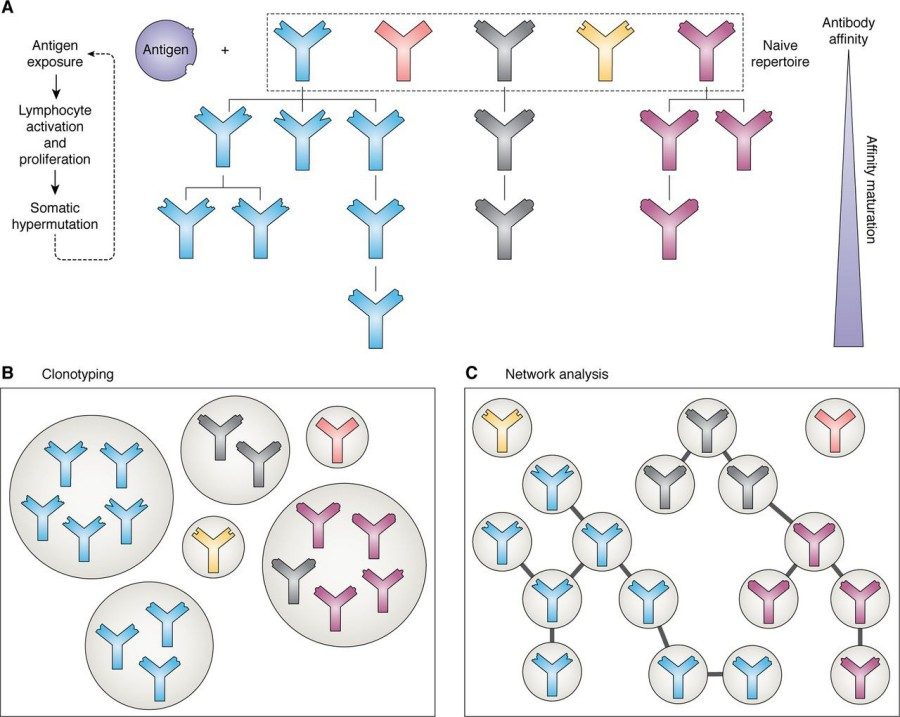 Fig. 1 The process of affinity maturation and methods of analyzing the resulting antibody repertoires.1
Creative Biolabs has pioneered a suite of sophisticated platforms to address any affinity maturation challenge. We do not believe in a one-size-fits-all approach. Instead, we tailor our strategy based on your project goals, the initial affinity of your SdAb, and its structural characteristics.
Our core technologies include advanced display platforms coupled with intelligent library construction methodologies.
Table 1. Advanced Display Technologies
| Technology | Description | Key Advantages |
| Phage Display | The industry gold standard for affinity maturation. SdAb variants are expressed on the surface of M13 bacteriophages. High-affinity binders are isolated through multiple rounds of stringent biopanning. | Robust, high-throughput, well-established, capable of generating vast libraries (1010). Ideal for significant affinity improvements. |
| Yeast Display | SdAb variants are displayed on the surface of Saccharomyces cerevisiae. This eukaryotic system ensures proper protein folding and allows for precise quantitative screening using Fluorescence-Activated Cell Sorting (FACS). | Eukaryotic expression, direct correlation between fluorescence and affinity, precise control over screening stringency, ideal for fine-tuning and ranking of high-affinity candidates. |
Intelligent Library Construction Strategies
The success of affinity maturation hinges on the quality and diversity of the mutant library. We employ several methods, often in combination, to maximize the probability of isolating ultra-high affinity variants.
We have optimized our service workflow for efficiency, transparency, and success. Our clients are kept informed at every stage of the project.
Step 1: In-depth Consultation and Strategy Design
Our PhD-level scientists work with you to understand your goals. We analyze your parent SdAb sequence and characterization data to design a bespoke affinity maturation strategy, selecting the optimal display platform and library construction method.
Step 2: High-Diversity Mutant Library Construction
Using the chosen strategy (e.g., error-prone PCR, SDM), we construct a high-diversity library of SdAb variants with a typical size of 108 to 1010. Rigorous quality control is performed to ensure library integrity and diversity.
Step 3: Stringent Multi-Round Biopanning or FACS Screening
The library is subjected to multiple rounds of selection under increasingly stringent conditions (e.g., reduced antigen concentration, increased washing times, addition of competing agents). This process enriches the population for binders with the highest affinity and slowest off-rates.
Step 4: High-Throughput Affinity Ranking and Sequencing
Individual clones from the enriched pool are screened and ranked using high-throughput methods. The top-performing candidates are sequenced to identify the mutations responsible for the affinity improvement.
Step 5: Recombinant Expression and In-depth Characterization
The most promising SdAb variants are recombinantly expressed and purified. We then perform rigorous biophysical characterization to precisely determine their affinity. Our standard analysis is performed using Surface Plasmon Resonance (SPR) or Bio-Layer Interferometry (BLI) to deliver accurate KD, kon, and koff values.
Step 6: Comprehensive Reporting and Deliverables
You will receive a detailed report including all methodologies, raw data, sequence information of the improved SdAbs, and full characterization results. Purified, high-affinity SdAbs are delivered according to your specifications.
The high-affinity SdAbs developed through our service are ideal for a wide range of cutting-edge applications:
Creative Biolabs offers a complete, end-to-end solution for single domain antibody development. Explore our related services to seamlessly advance your project from discovery to application.
Contact our team of experts today to discuss your project. Let us show you how our advanced single domain antibody discovery services can accelerate your research and development.
Q1: What is the typical fold-improvement in affinity you can achieve?
A: While results are project-dependent, it is common for us to achieve a 10- to 1000-fold improvement in affinity. We have successfully matured SdAbs from micromolar to low double-digit picomolar KD values.
Q2: What starting materials do I need to provide?
A: Typically, we require the amino acid or DNA sequence of your parent SdAb. If available, providing purified antibody and antigen can expedite the process, but it is not strictly necessary.
Q3: How long does the SdAb affinity maturation process take?
A: A standard project timeline is approximately 8-12 weeks, from strategy design to delivery of the final characterized antibodies. This can vary depending on the complexity of the project.
Q4: Can you work with SdAbs that have poor expression or stability?
A: Yes. Our platforms, especially when combined with our expertise in protein engineering, can often improve not only the affinity but also the expression and stability of challenging SdAbs. We can integrate stability screening into the selection process.
All listed services and products are For Research Use Only. Do Not use in any diagnostic or therapeutic applications.








