Creative Biolabs is offering the most comprehensive services for antibody development projects. With strict regulation and effective execution, we are dedicated to providing the most valuable solutions to complete your projects.
HighlightsCreative Biolabs is offering the most comprehensive services for antibody development projects. With strict regulation and effective execution, we are dedicated to providing the most valuable solutions to complete your projects.
HighlightsCreative Biolabs has established a broad range of platforms for developing novel antibodies or equivalents. These cutting-edge technologies enable our scientists to meet your demands from different aspects and tailor the most appropriate solution that contributes to the success of your projects.
HighlightsWith deep understanding in antibody-related realms and extensive project experience, Creative Biolabs offers a variety of references to help you learn more about our capacities and achievements, including infographic, flyer, case study, peer-reviewed publications, and all kinds of knowledge that can assist your projects. You are also welcome to contact us directly for more specific solutions.
HighlightsGet a real taste of Creative Biolabs, one of the most professional custom service providers in the world. We are committed to providing highly customized comprehensive solutions with the best quality to advance your projects.
HighlightsCreative Biolabs has developed a wide-ranging set of high-affinity antibodies targeting each sumoylated protein, using High-Affi™ tech. These antibodies spot the three main SUMO types (SUMO-1, -2, -3) and help find and measure sumoylated proteins. We've used these specific antibodies to help customers perform reliable sumoylation detection.
Sumoylation-specific antibodies are made by injecting animals with lab-made protein bits matching parts of SUMO-1 or a shared part in SUMO-2/3. The SUMO-1 antibody finds normal levels of lab-produced SUMO-1 when attached as single units to proteins like RanGAP, PML, p53, and IκB-α. The SUMO-2/-3 antibody finds SUMO chains on proteins like topoisomerase II and APP.
Sumoylation is a post-translational modification (PTM) where SUMO (small ubiquitin-like modifier) proteins attach to others via an enzyme process similar to ubiquitination. Humans have four SUMO types: SUMO-1, -2, -3, and -4. SUMO-2 and -3 are very similar but different from SUMO-1. They modify more proteins than SUMO-1 and can form chains. SUMO-4 is similar to SUMO-2/3 but has a different amino acid at one spot and mainly changes proteins under stress. Unlike ubiquitin, SUMO mainly affects protein function (interactions, location) rather than marking them for breakdown. Sumoylation is involved in gene control, nuclear transport, cell death, protein stability, stress response, and the cell cycle.
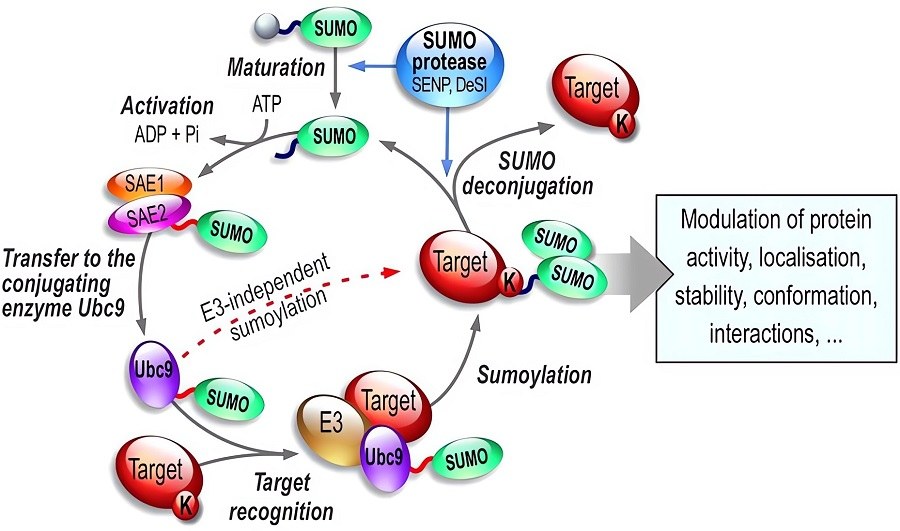 Fig.1 The catalytic cycle of sumoylation and desumoylation.1,3
Mature SUMO forms when a few building blocks are cut off one end, allowing it to bond with a lysine on the target protein. Usually, only some of the target protein gets sumoylated, and this is quickly reversed by desumoylase enzymes. This dynamic process is key in diseases like cancers, brain issues, diabetes, and heart problems. High sumoylation in cancer suggests it might be a good treatment target. Sumoylation also interacts with other protein changes; for example, tau sumoylation in Alzheimer's promotes its hyperphosphorylation and stops its breakdown.
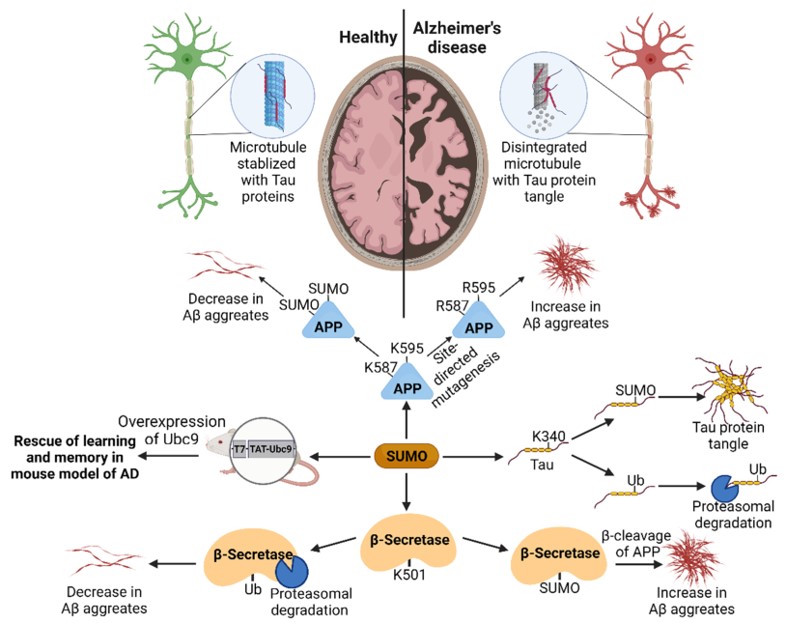 Fig.2 Sumoylation in Alzheimer's disease.2,3
Monoclonal Antibodies: These come from just one type of immune cell and are good at latching onto one specific spot (called an epitope) on the SUMO protein. Because they all come from the same source, you get very consistent results every time you use them.
Polyclonal Antibodies: These come from a mix of immune cells and can grab onto several different spots (epitopes) on the SUMO protein. They can sometimes bind more strongly overall (higher avidity) but might vary a bit more from batch to batch.
Anti-Pan-SUMOylation Antibodies: These can detect proteins that have been modified by sumoylation. They can spot proteins modified by different SUMO isoforms.
Anti-Site-Specific SUMOylation Antibodies: These are super precise; they're designed to find a very specific amino acid on a target protein, but only when a SUMO molecule is attached there. These let us accurately see and measure sumoylation at very specific locations on proteins.
Monospecific Anti-Sumoylation Polyclonal Antibody Production
Producing specific polyclonal antibodies against sumoylated proteins involves immunizing animals with a defined sumoylated peptide or protein, followed by affinity purification of the resulting serum. This often includes negative selection against the unmodified form and positive selection for the sumoylated form. Key advantages are high avidity and sensitivity from recognizing multiple epitopes. Polyclonal antibodies are also relatively quick and inexpensive to produce, useful for initial sumoylation detection and characterization.
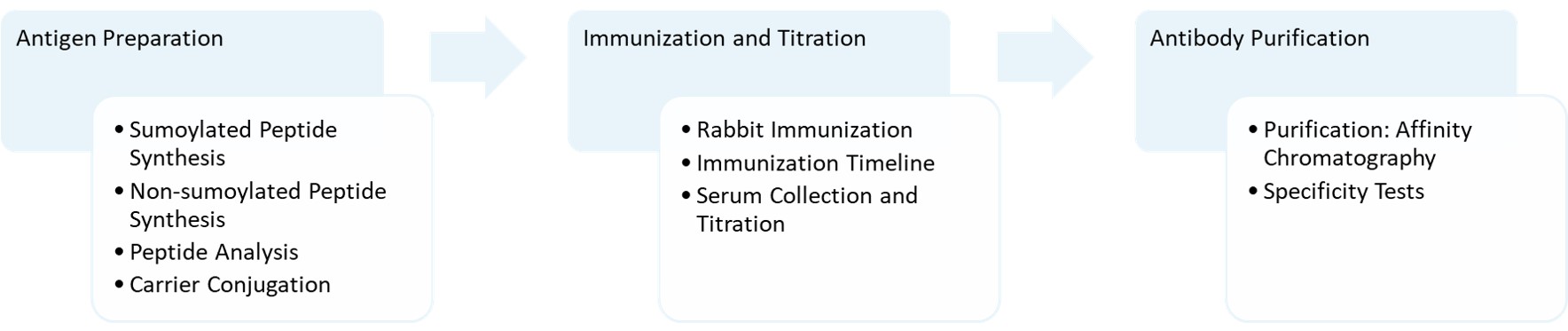
Phage Display Strategy for Anti-Sumoylation Monoclonal Antibody Discovery
Phage display is an in vitro method for selecting high-affinity monoclonal antibodies against sumoylated targets. Antibody fragment libraries on bacteriophages are incubated with the target, and high-affinity binders are selected through repeated washing and amplification. A major advantage is generating antibodies against diverse antigens, including poorly immunogenic ones. It also allows fine-tuning specificity and producing fully human antibodies for potential therapeutic use.

Hybridoma Strategy for Anti-Sumoylation Monoclonal Antibody Discovery
Hybridoma technology is a classic method for generating highly specific monoclonal antibodies for sumoylated antigens. It involves immunizing animals, fusing their antibody-producing spleen cells with immortal myeloma cells, and screening for hybridomas producing the desired antibodies. Positive clones are expanded for continuous production. Key advantages include generating high-quality, stable monoclonal antibodies that can be scaled up. These specific antibodies are invaluable for detailed mechanistic and diagnostic applications.

Creative Biolabs offers excellent anti-sumoylation antibodies that we make using our top-notch High-Affi™ technology. Besides these sumoylation-specific antibodies, we also provide a wide range of services to create antibodies that target other specific PTMs, and you can pick exactly what you need.
Smart Antigen Design for Sumoylation: We're really good at designing and making unique antigens, like peptides and lab-made proteins with SUMO attached at specific spots. This is key for getting super specific antibodies.
Targeting Specific SUMO Types and Modifications: We know how to develop antibodies that can tell the difference between the various types of SUMO and can specifically find proteins only when they've been modified by SUMO.
Way to Get the Right Antibodies: We use advanced methods to purify and screen antibodies, optimized to pick out only the ones that stick to sumoylated parts of proteins, so there's less unwanted binding.
Flexible Antibody Production for Sumoylation: We offer both traditional hybridoma and modern phage display methods, customized for SUMO targets. This means we can choose the best way to get the antibodies you need for your specific research.
Good at Finding Even Tricky Sumoylated Proteins: Our techniques are fine-tuned to produce antibodies sensitive enough to detect sumoylation events that might not happen very often or are present in small amounts.
Monospecific Anti-Sumoylation Polyclonal Antibody Production
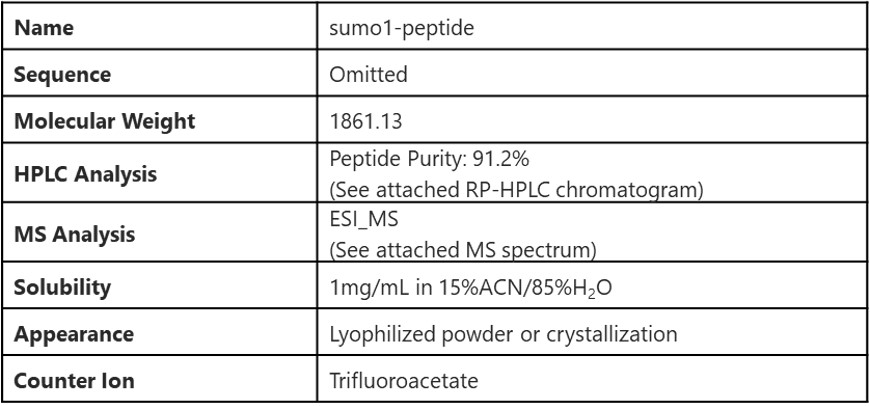
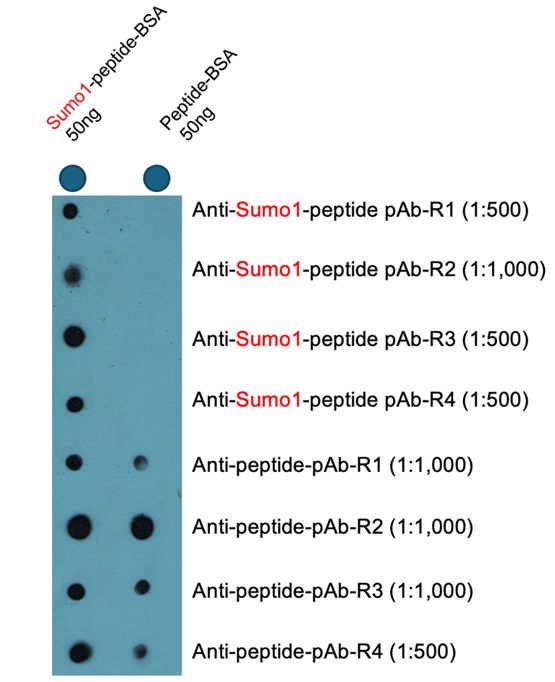
Q: Can you guarantee an antibody that specifically recognizes my protein only when it's sumoylated, and not the unmodified form?
A: Achieving absolute specificity can be challenging, especially with minimal conformational changes. We aim for high specificity, using thorough validation (e.g., dot blot, Western blot). We openly discuss cross-reactivity risks and optimize selection for your needs.
Q: My protein of interest has multiple potential sumoylation sites. Can you generate antibodies specific to sumoylation at a particular lysine residue?
A: Yes, using site-specifically sumoylated peptides is possible, but success depends on immunogenicity and site accessibility. Thorough screening is often required, potentially affecting timelines and costs.
Q: Sumoylation is often a low-abundance and transient modification. Can your antibody discovery process generate antibodies with sufficient sensitivity to detect these subtle changes?
A: We optimize protocols for enhanced sensitivity (e.g., adjuvants, sensitive screening). However, inherent low abundance can be a challenge, and final sensitivity will be evaluated. We may suggest larger campaigns or alternative detection methods.
Q: How do you ensure the quality and reproducibility of the antibodies you generate?
A: We follow strict quality control throughout. For polyclonals, we provide batch data. For monoclonals, we offer stable cell lines or recombinant clones. Rigorous validation assesses specificity, sensitivity, and consistency. We offer long-term storage and re-engineering options for reliability. Maintaining clone stability can present challenges, which we actively address through optimized storage and handling procedures.
References
All listed services and products are For Research Use Only. Do Not use in any diagnostic or therapeutic applications.