
Creative Biolabs is offering the most comprehensive services for antibody development projects. With strict regulation and effective execution, we are dedicated to providing the most valuable solutions to complete your projects.
HighlightsCreative Biolabs is offering the most comprehensive services for antibody development projects. With strict regulation and effective execution, we are dedicated to providing the most valuable solutions to complete your projects.
HighlightsCreative Biolabs has established a broad range of platforms for developing novel antibodies or equivalents. These cutting-edge technologies enable our scientists to meet your demands from different aspects and tailor the most appropriate solution that contributes to the success of your projects.
HighlightsWith deep understanding in antibody-related realms and extensive project experience, Creative Biolabs offers a variety of references to help you learn more about our capacities and achievements, including infographic, flyer, case study, peer-reviewed publications, and all kinds of knowledge that can assist your projects. You are also welcome to contact us directly for more specific solutions.
HighlightsGet a real taste of Creative Biolabs, one of the most professional custom service providers in the world. We are committed to providing highly customized comprehensive solutions with the best quality to advance your projects.
Highlights Loading...
All listed services and products are For Research Use Only. Do Not use in any diagnostic or therapeutic applications.
Aquaporin 1 (AQP1), the first discovered member of the aquaporin family, remains the most extensively studied water-transporting protein identified to date. This small protein, with a molecular weight of approximately 28 kDa, is embedded in cell membranes and does not function independently; it assembles into a homotetramer composed of four identical subunits. Each individual subunit folds into six transmembrane helices, which enclose a central hollow pore dedicated to the passage of water. On either side of the pore lies a conserved NPA sequence—an abbreviation for three fixed amino acids that remain preserved across homologous proteins and do not undergo random mutation. The two sequences converge, constricting the pore into the iconic hourglass-shaped narrow waist, narrow in the middle and wide at both ends, which aligns passing water molecules in an orderly arrangement. At the outer edge of the narrow waist, there is also a selectivity filter formed by aromatic amino acids and arginine. This filter has extremely high precision: protons, ions, and all other small-molecule solutes are barred from passage—only water molecules can line up in single file and pass through the cell membrane one after another, with all other molecules excluded entirely. Functionally, AQP1 is a core workhorse that maintains the body's fluid balance. It is present in large quantities at every site in the body that requires fluid transport: it is found in the segment of the kidney responsible for water reabsorption, endothelial cells of capillaries, tissues in the central nervous system that produce fluid, and red blood cells. It governs the rapid transmembrane flow of water, and this capacity forms the physiological basis for urine concentration, cerebrospinal fluid dynamics, and microvascular fluid exchange—these essential physiological processes in the body rely entirely on its fast water-transport capability to function normally.
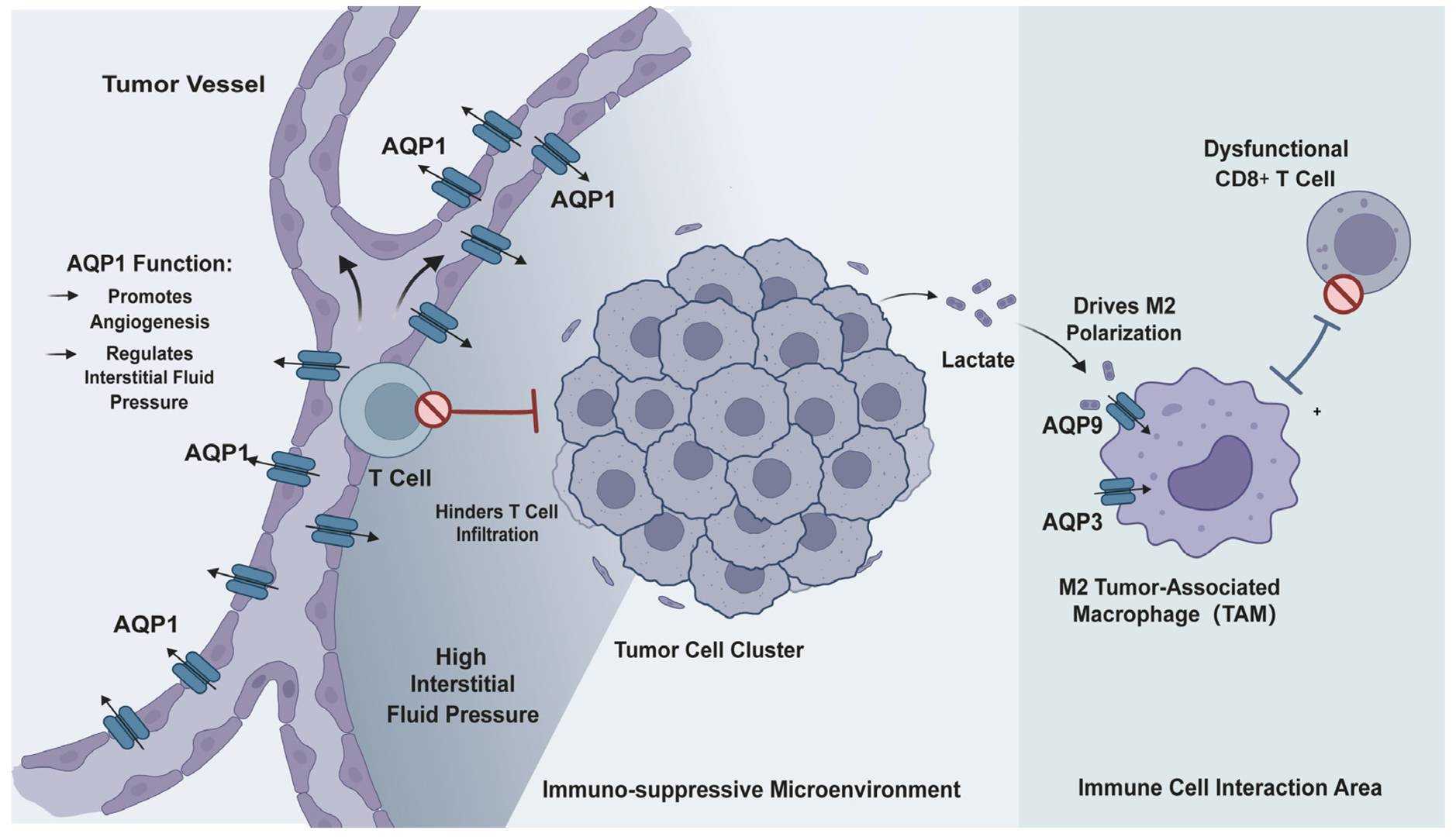 Fig.1 AQPs in remodeling the tumor immune microenvironment.1
Research on AQP1 continues to push across several interconnected frontiers:
Our AQP1 membrane protein product line has always adhered to one core principle: the complete structure of the protein must be preserved throughout the entire purification process. Only in this way can the channel properties determined by this structure produce stable, repeatable, and reliable research data. To put it plainly, if the structure of AQP1 is damaged during purification, all subsequent research related to it cannot proceed smoothly — after all, its function as a channel protein is entirely supported by its complete structure. Therefore, all full-length AQP1 products we provide are manufactured in an optimized eukaryotic expression system. This system was deliberately designed from the outset to retain these critical structural and functional properties, preventing the protein from losing the core attributes that support research during the production process. Every batch of products is first verified using multiple sets of independent quality control indicators, and only shipped after passing qualification checks. We never deliver non-compliant products to customers.
Not finding the membrane protein product you need? Contact us to start your one-stop custom service!
The biological activity of AQP1 is fully bound to and inseparable from the cell membrane environment it resides in. Without its original cell membrane, it cannot perform normal physiological functions. For this reason, cell platforms used for research must meet several rigid requirements: they must be able to regulate protein expression levels, avoiding incorrect overproduction, underproduction, or mismatched yields; they must allow the protein to be accurately localized on the cell surface, rather than remaining in incorrect locations; and they must enable the protein to correctly assemble into a tetrameric structure, preventing the formation of incorrect conformations. We can provide customers with customized stable cell lines that highly express AQP1. All these cell lines are prepared using sequence-optimized stable integration technology, which can maintain stable protein expression levels across generations, so that AQP1 production does not cease after several rounds of cell culture. Our existing cell line bank includes two types of strains: one can stably overexpress wild-type AQP1 at preset expression levels — that is, the normal AQP1 that naturally exists in nature, and can stably produce far more target protein than ordinary cells; the other carries AQP1 variants with engineered substitution mutations, which are special models with deliberately modified gene sequences, to meet diverse research needs. Every monoclonal cell line must first undergo comprehensive phenotypic validation, which thoroughly inspects all relevant characteristics such as the cell's growth status and protein expression level, and is only approved for delivery to customers after all required functional properties are confirmed to meet standards.
Not finding the stable cell line product you need? Contact us to start your one-stop custom service!
You can use our set of recombinant antibody panels to support your AQP1 research projects, reducing the time required for antibody screening and evaluation. These antibodies are developed for AQP1 recognition and can be applied to validated experimental applications where appropriate. High-affinity monoclonal and recombinant antibody clones are designed to recognize defined AQP1 epitopes. Although members of the aquaporin family share structural similarities, antibody specificity should be evaluated against relevant closely related family members under the intended experimental conditions. Each recombinant antibody clone is sequence-defined and produced from a defined recombinant construct, which supports improved lot-to-lot consistency and reproducibility. Depending on the validation data available for individual clones, these antibodies may support applications such as detection of AQP1 in cell or tissue lysates and staining of AQP1-expressing cells to assess cell-surface expression. Application suitability, specificity, and quantitative performance should be determined according to the validation data available for each antibody.
Not finding the recombinant antibody product you need? Contact us to start your one-stop custom service!
Extending well beyond our standard catalog, we deliver fully customizable discovery and manufacturing solutions meticulously tailored to the sophisticated demands of AQP1-targeted research and precompound development:
Yes. Full-length preparations are supplied in defined buffer systems that preserve native folding and assembly.
Both constitutive and inducible formats are available. Each clone ships with measured surface-density data, so expression tier can be matched precisely to your experimental design.
Yes. Clones are screened for selective AQP1 recognition and counter-screened against related family members using recombinant protein panels.
All AQP1 products and services are provided strictly for preclinical research. They are not designed, validated, or authorized for any use involving human subjects.









