
Creative Biolabs is offering the most comprehensive services for antibody development projects. With strict regulation and effective execution, we are dedicated to providing the most valuable solutions to complete your projects.
HighlightsCreative Biolabs is offering the most comprehensive services for antibody development projects. With strict regulation and effective execution, we are dedicated to providing the most valuable solutions to complete your projects.
HighlightsCreative Biolabs has established a broad range of platforms for developing novel antibodies or equivalents. These cutting-edge technologies enable our scientists to meet your demands from different aspects and tailor the most appropriate solution that contributes to the success of your projects.
HighlightsWith deep understanding in antibody-related realms and extensive project experience, Creative Biolabs offers a variety of references to help you learn more about our capacities and achievements, including infographic, flyer, case study, peer-reviewed publications, and all kinds of knowledge that can assist your projects. You are also welcome to contact us directly for more specific solutions.
HighlightsGet a real taste of Creative Biolabs, one of the most professional custom service providers in the world. We are committed to providing highly customized comprehensive solutions with the best quality to advance your projects.
Highlights Loading...
All listed services and products are For Research Use Only. Do Not use in any diagnostic or therapeutic applications.
FXYD domain-containing ion transport regulator 2 (FXYD2), also known as the Na⁺/K⁺-ATPase γ subunit or ATP1G1, is encoded by the FXYD2 gene on chromosome 11q23.3. The gene produces a small, single-span membrane protein of approximately 7–10 kDa that belongs to the FXYD family of ion transport regulators. All FXYD family members share a conserved 35-amino-acid signature domain that begins with the sequence PFXYD and contains seven invariant and six highly conserved amino acids. FXYD2 has a type III integral membrane topology, with its N-terminus on the extracellular side and its C-terminus on the cytoplasmic side of the membrane. The protein is expressed at highest levels in the kidney and spleen, where it is restricted to the basolateral membrane of renal epithelial cells and varies in expression along the nephron.
FXYD2 functions as a regulatory subunit of the Na⁺/K⁺-ATPase, the ubiquitous enzyme that maintains the electrochemical gradients of Na⁺ and K⁺ across the plasma membrane. Although the Na⁺/K⁺-ATPase does not require the γ subunit to be catalytically active, FXYD2 associates with the αβ heterodimer and modulates the enzyme's transport properties. The best-characterized effect of FXYD2 is a reduction in the apparent affinity of the Na⁺/K⁺-ATPase for intracellular Na⁺, which decreases pump activity under physiological conditions. FXYD2 expression is induced by hyperosmotic stress and other genotoxic stressors, and this induction is accompanied by reduced cell growth, suggesting an adaptive role in the cellular stress response. Alternative splicing generates FXYD2a and FXYD2b variants that differ at the N-terminus and have distinct effects on Na⁺/K⁺-ATPase kinetics. A recurrent heterozygous missense mutation in FXYD2 (p.Gly41Arg) that changes a conserved transmembrane glycine to arginine causes isolated dominant renal hypomagnesemia (HOMG2). This mutant behaves as an inward-rectifying cation channel when expressed in Xenopus oocytes, and wild-type FXYD2 has been proposed to mediate basolateral extrusion of magnesium from renal epithelial cells. These features make FXYD2 an important research target for studies of Na⁺/K⁺-ATPase regulation, renal ion transport, and magnesium homeostasis.
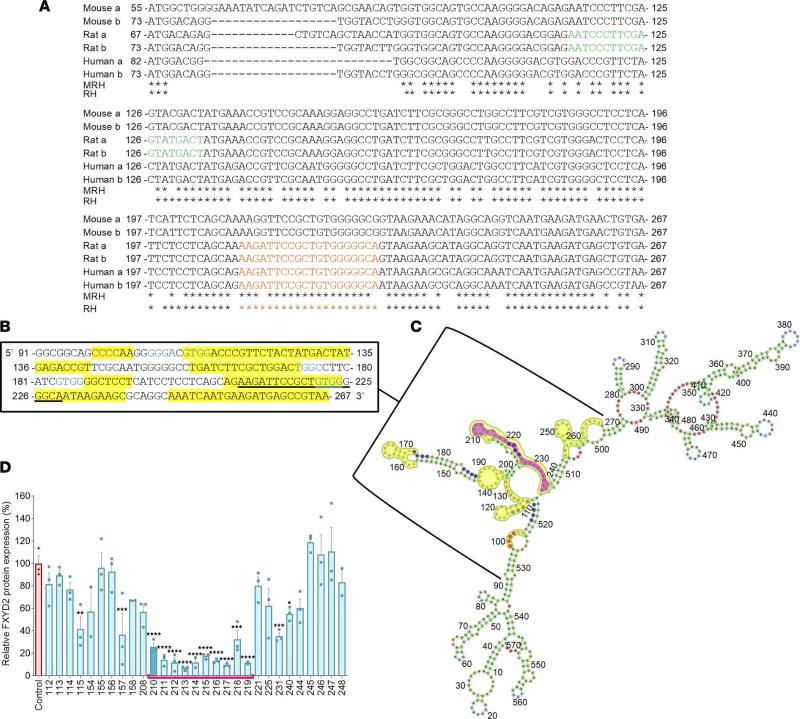 Fig. 1 Identification of antisense oligonucleotides (ASOs) directed against human FXYD2 mRNA in an experimental pain-research context; this does not depict Na⁺/K⁺-ATPase regulation or direct Mg²⁺ transport.1
FXYD2, encoded by the FXYD2 gene, functions as a regulatory subunit of the Na⁺/K⁺-ATPase that modulates enzyme kinetics and ion transport properties:
Creative Biolabs provides FXYD2 membrane protein products produced using optimized expression systems. These include full-length FXYD2 type III integral membrane protein that retains the native single-transmembrane topology, extracellular N-terminus, and cytoplasmic C-terminus, as well as isolated FXYD domain variants. The conserved FXYD signature domain mediates association with the Na⁺/K⁺-ATPase αβ heterodimer and modulation of ion transport activity, supporting FXYD2 structural and interaction studies; ion-pump activity requires an appropriately assembled Na⁺/K⁺-ATPase αβ complex with FXYD2 in a compatible cellular or reconstituted system. All FXYD2 proteins undergo strict quality control to support consistent performance across applicable research platforms.
Not finding the protein product you need? Contact us to start your one-stop custom service!
Creative Biolabs provides custom-engineered FXYD2 stable cell lines, including overexpression and knockdown models. These cell lines are optimized for studies of Na⁺/K⁺-ATPase regulation, stress-induced ion transport modulation, renal epithelial physiology, and FXYD2-associated hypomagnesemia mechanisms. Each cell line undergoes stringent validation to ensure stable expression profiles and consistent functional performance in diverse experimental contexts.
Not finding the stable cell line product you need? Contact us to start your one-stop custom service!
High-specificity recombinant antibodies targeting FXYD2 are developed using antibody engineering techniques for research applications involving FXYD2 expression and localization. These antibodies can be used in studies of FXYD2 distribution in renal epithelial cells and other tissues and may also support characterization of FXYD2-containing Na⁺/K⁺-ATPase complexes in combination with appropriate detection reagents.
Not finding the recombinant antibody product you need? Contact us to start your one-stop custom service!
Beyond catalog products, Creative Biolabs offers specialized custom services for FXYD2 research:
FXYD2 is the γ subunit of the Na⁺/K⁺-ATPase that modulates the enzyme's affinity for intracellular Na⁺ and its transport activity, functioning as a regulatory subunit that fine-tunes pump kinetics.
FXYD2 regulates Na⁺/K⁺-ATPase activity and is associated with renal magnesium homeostasis, although a direct Mg²⁺ transport mechanism remains under investigation. The recurrent p.Gly41Arg mutation causes isolated dominant renal hypomagnesemia, making FXYD2 important for studies of ion transport regulation and renal physiology.
No, all FXYD2 products and services are strictly for research use only, not intended for clinical diagnosis or treatment.
Offerings include full-length FXYD2 membrane proteins, FXYD domain variants, specific detection antibodies, and custom stable cell lines for Na⁺/K⁺-ATPase regulation and ion transport research.
FXYD2 proteins may support research on Na⁺/K⁺-ATPase association and ion transport activity, depending on protein format and experimental context.









