Exosome Characterization & Analysis Service for Targeted Drug Delivery
Unlock the full potential of your targeted delivery vehicles with high-fidelity profiling. At Creative Biolabs, we recognize that in the realm of nanomedicine, the vehicle is just as critical as the payload. Exosomes offer unparalleled potential for biocompatible delivery, yet their inherent heterogeneity presents a significant "black box" challenge that can stall clinical translation. We bridge the gap between biological complexity and therapeutic consistency by providing a comprehensive, multi-dimensional view of your formulations. Creative Biolabs specializes in validating the identity, purity, and functionality of complex Module Delivery Systems to ensure your targeted therapeutics meet the rigorous standards required for downstream success.
Request a Free Scientific Consultation
The Science of Exosomes
The Pivotal Role of Exosomes in Biological Communication
Exosomes are nanosized extracellular vesicles (30–150 nm) originating from the endosomal pathway. While initially considered cellular waste disposal units, they are now recognized as critical mediators of intercellular communication with diverse biological functions:
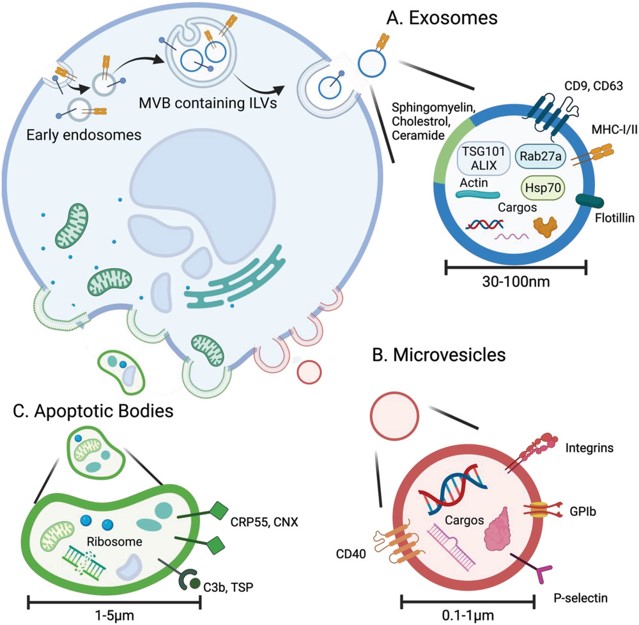 Fig. 1 The biogenesis pathways of A) exosomes, B) microvesicles, and C) apoptotic bodies.1,3
- Intercellular Cargo Transport: Traffics molecular payloads (proteins, lipids, nucleic acids) to regulate recipient cell phenotypes.
- Immune Regulation: Modulates immune responses via antigen presentation or immunosuppression.
- Tissue Regeneration: Promotes tissue repair, angiogenesis, and inflammation reduction.
- Biological Barrier Penetration: Crosses tight physiological barriers (e.g., BBB) for efficient delivery.
- Intrinsic Homing Capabilities: Exhibits natural tissue tropism for targeted therapeutic distribution.
However, these biological features also introduce significant heterogeneity. The precise characterization of exosomes is not merely a quality control step but a fundamental requirement to correlate physicochemical properties with biological function, safety, and therapeutic efficacy.
Exosome Characterization Methodologies
To ensure the successful translation of exosome-based therapies, a multi-faceted analytical approach is required. We categorize these techniques into four primary domains: physical & quantitative, morphological & qualitative, biochemical & molecular, and single-vesicle analysis.
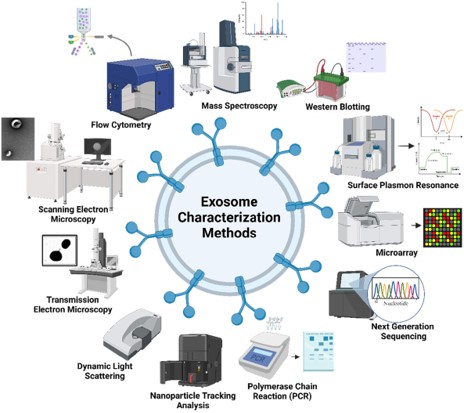 Fig. 2 Characterization and analysis methods of derived exosomes.2,3
Precise quantification of biophysical parameters is fundamental for standardization. We classify quantitative analysis into four distinct dimensions—Total Particle, Protein, Lipid, and RNA quantification—employing advanced instrumentation to ensure your samples meet defined physical specifications necessary for reproducible downstream applications.
| Total Exosome Count | Protein Count | Lipid Count | DNA/RNA Count | |
|---|---|---|---|---|
| Nanoparticle tracking analysis (NTA) | Electron Microscopy (Cryo-EM) | Mass Spectroscopy | Sulfophosphovanilin (SPV) Assay | PCR |
| Flow Cytometry (FCM) | Fluorescence Correlation Spectroscopy (FCS) | ELISA | Fluorescence microscopy with lipophilic dye | Microarray |
| Dynamic light scattering (DLS) | Tunable Resistive Pulse Sensing (TRPS) | Fourier-transform Infrared Spectroscopy (FTIR) | NGS | |
Comprehensive Exosome Characterization & Analytical Services
Creative Biolabs provides a modular suite of analytical services designed to validate every critical quality attribute (CQA) of your exosomes. We offer a core comprehensive characterization service alongside highly specialized ancillary services to support your entire development lifecycle.
Comprehensive Exosome Characterization & Profiling Services
This flagship service consolidates our complete range of analytical methodologies to provide a holistic view of your exosome formulations. Whether you need a simple purity check or a full IND-enabling data package, we tailor the following characterization modules to your specific needs:
- Quantitative Biophysical Analysis: Precise determination of particle size distribution, concentration, and zeta potential using orthogonal methods like NTA, TRPS, and DLS. We also quantify total protein, lipid, and RNA content to establish batch-to-batch consistency.
- Qualitative Identity and Purity Validation: Rigorous confirmation of biochemical identity via Western Blotting and ELISA, targeting canonical markers (CD63, CD9, TSG101) while verifying the depletion of cellular contaminants (Calnexin, Albumin).
- High-Resolution Microscopic Imaging: Direct visualization of vesicular morphology, integrity, and ultrastructure using TEM and Cryo-EM. We capture high-contrast images to detect aggregation and validate the native "cup-shaped" or spherical structure.
- Topology and Biomechanical Profiling: Advanced surface mapping using AFM to assess roughness and nanomechanical stiffness, offering insights into membrane elasticity and stability.
- Single Vesicle Phenotyping: High-sensitivity analysis of individual vesicles using Nano-Flow Cytometry (nFCM) to profile heterogeneity and quantify subpopulations expressing specific surface markers.
- Multi-Omics Cargo Analytics: Comprehensive profiling of the encapsulated payload through RNA-Seq (miRNA, mRNA), Quantitative Proteomics (LC-MS/MS), and Lipidomics to reveal the functional molecular signature of your exosomes.
Workflow
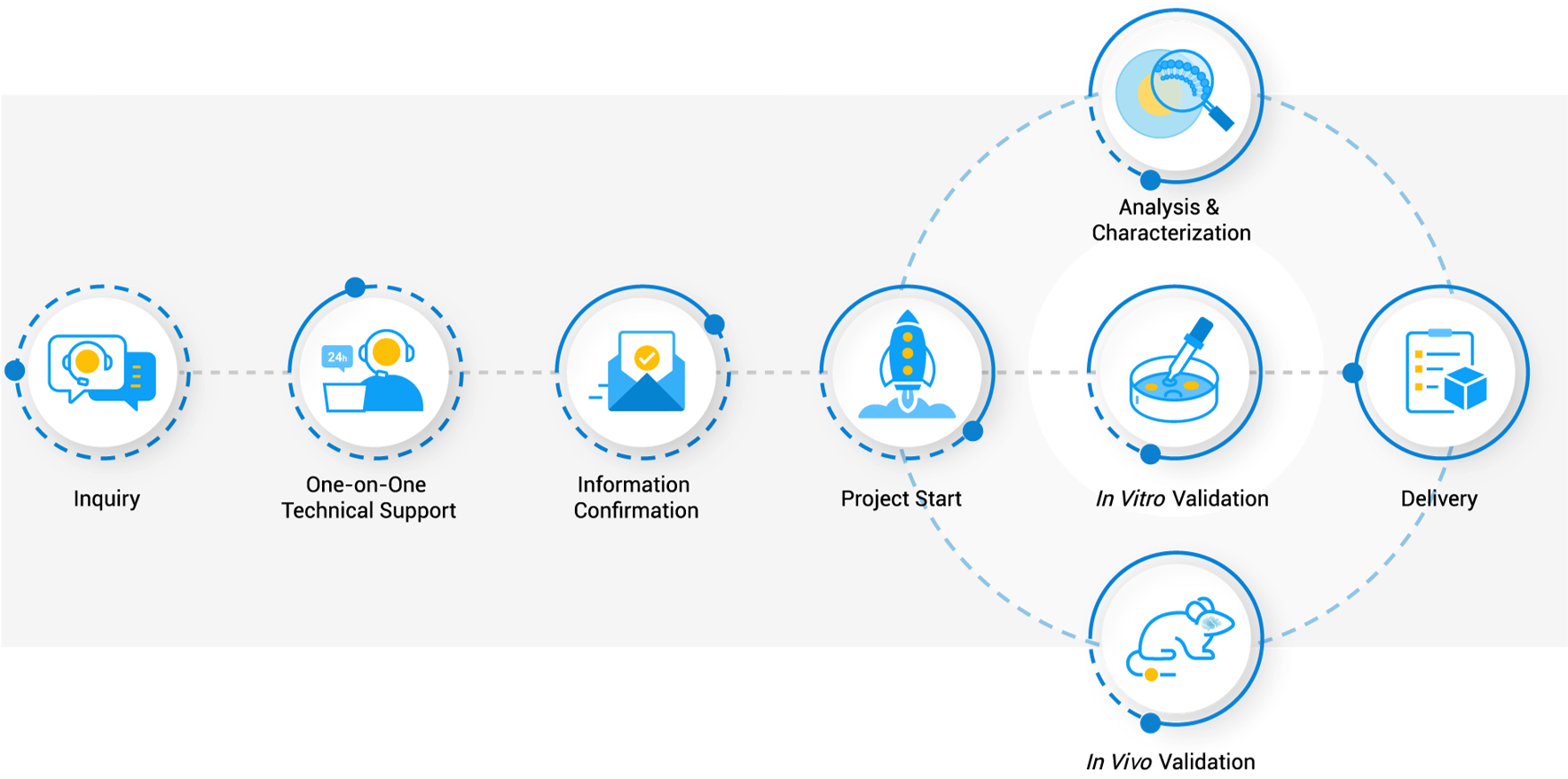
Applications in Exosomes Research
Our characterization services empower researchers to accelerate specific therapeutic goals across the drug development pipeline:
- Validation of Targeted Delivery Systems Definitively prove that your engineered exosomes are displaying functional targeting ligands (e.g., for the blood-brain barrier) and maintaining integrity post-modification.
- Manufacturing Process Optimization Monitor batch-to-batch consistency during the scale-up of isolation and purification protocols to ensure reproducible therapeutic product profiles.
- Biomarker Discovery and Validation Profile circulating EVs from patient biofluids (plasma, urine, CSF) to identify novel diagnostic, prognostic, or predictive biomarkers for oncology and neurodegenerative diseases.
- Mechanism of Action (MoA) Elucidation Correlate specific physicochemical properties (such as size, charge, or protein corona composition) with cellular uptake efficiency and downstream therapeutic effects.
Why Choose Creative Biolabs?
- Specialized Target-Centric Expertise: Unlike generalist analytical labs, we focus specifically on the interaction between Module Delivery Systems and biological targets, providing unique insights into functionalization efficiency.
- Orthogonal High-Fidelity Data: We employ a multi-methodological approach (e.g., combining NTA with TRPS and TEM) to provide the most accurate and validated representation of sample purity and heterogeneity.
- Regulatory-Ready Reporting: Our data reporting standards are designed to support regulatory filings, ensuring that all methods, controls, and analyses are documented with full traceability.
- Integrated Upstream & Downstream Solutions: We offer a seamless workflow that connects characterization with our upstream isolation services and downstream formulation stability and lyophilization capabilities.
Creative Biolabs is dedicated to advancing your research through precision analytics and targeted delivery solutions. Whether you need a single assay or a comprehensive characterization partnership, our team of experts is ready to assist you.
Related Services & Products
Related Services
Nucleic Acid Synthesis Services
Related Products
| Product Name | Description | Inquiry |
|---|---|---|
| Exosome Fluorescent Dye (DiR) | Near-infrared fluorescent membrane dye for in vivo biodistribution tracking. | |
| Exosome Fluorescent Dye (PKH26) | Red fluorescent cell linker kit for general membrane labeling and tracking. | |
| Exosome Fluorescent Dye (PKH67) | Green fluorescent cell linker kit for general membrane labeling and tracking. | |
| WB Exosome Identification Kit (TSG101) | Detection kit for the canonical exosome marker TSG101. | |
| WB Exosome Identification Kit (CD63) | High-sensitivity detection kit for the tetraspanin marker CD63. | |
| WB Exosome Identification Kit (CD81) | Specific detection kit for the tetraspanin marker CD81. |
FAQs
How does your service differentiate between exosomes and other extracellular vesicles?
We strictly adhere to MISEV guidelines. We utilize a combination of size determination (NTA/TRPS), positive marker identification (Tetraspanins, Alix), and negative marker exclusion (Calnexin, Albumin) to confirm the specific EV subpopulation and rule out cellular debris.
Can you quantify the number of targeting ligands attached to each exosome?
Yes, through our Advanced Single Particle Analysis services. We use high-sensitivity flow cytometry with quantitation beads or specialized fluorescent assays to estimate the ligand density per particle, which is crucial for optimizing targeting efficiency.
Can you support stability testing for my exosome formulation?
Yes. We offer accelerated and long-term stability studies where we periodically characterize size, concentration, and marker expression to determine the shelf-life and optimal storage conditions of your formulation.
References
- Lai, James J., et al. "Exosome processing and characterization approaches for research and technology development." Advanced Science 9.15 (2022): 2103222. https://doi.org/10.1002/advs.202103222.
- Akdeniz, Munevver, Zakarya Al‐Shaebi, and Omer Aydin. "A Solution for Exosome‐Based Analysis: Surface‐Enhanced Raman Spectroscopy and Artificial Intelligence." Advanced Intelligent Discovery (2025): 202500040.
- Distributed under Open Access license CC BY 4.0, without modification.