
Formulations like liposomal doxorubicin (an example of passive targeting) leverage the EPR effect for tumor accumulation.
Targeted Delivery System Solutions
The challenge of modern therapeutics is not just discovering potent molecules, but ensuring they reach their intended destination efficiently and safely. Our Targeted Delivery System (TDS) solutions help you accelerate drug development and maximize therapeutic efficacy by leveraging advanced nanocarrier platforms like liposomes, lipid nanoparticles (LNPs), and customized bioconjugates. This technology is critical for overcoming systemic barriers and minimizing off-target toxicity in promising candidates like nucleic acids, peptides, and traditional small-molecule drugs.
Targeted Delivery System
Targeted Delivery System (TDS) refers to the strategy of delivering a therapeutic agent to a specific site in the body—such as a diseased tissue, subcellular organelle, or cell type—while minimizing its distribution to non-target areas. This concept is the modern fulfillment of Paul Ehrlich's "magic bullet" theory. The core challenge TDS addresses is the array of biological barriers that drugs must navigate, including enzymatic degradation in the circulation, clearance by the reticuloendothelial system (RES), and the impermeability of tissue barriers like the Blood-Brain Barrier (BBB).
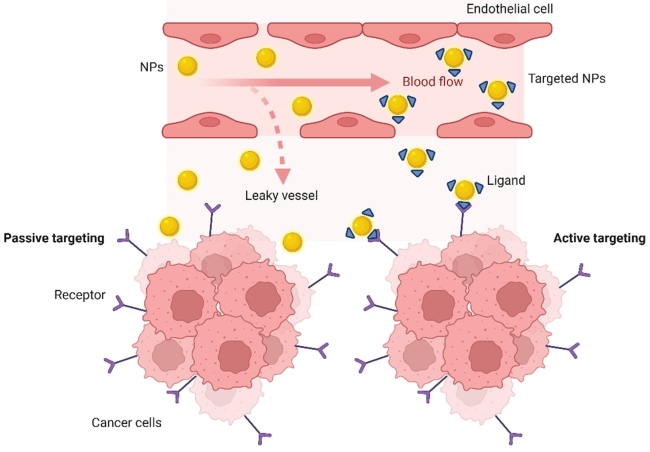 Fig.1 Active targeting vs. passive targeting of cancer cells by nano-delivery systems.1
TDS technologies typically involve encapsulating or conjugating the therapeutic payload (drug, gene, vaccine component) with a carrier system, which is commonly in the nanoscale range (nanocarriers). These nanocarriers, such as liposomes, solid lipid nanoparticles, polymeric nanoparticles, or protein conjugates, must exhibit high biocompatibility and low immunogenicity.
The two principal mechanisms of targeting are:
This mechanism relies on the natural pathophysiology of the disease site and the physicochemical properties of the nanocarrier. A classic example is the Enhanced Permeability and Retention (EPR) effect, where nanoparticles (typically sized 10-200 nm) exploit the leaky vasculature and poor lymphatic drainage common in many solid tumors. By extending the carrier's half-life in the bloodstream, passive targeting ensures preferential accumulation in the diseased tissue compared to healthy organs.
This strategy involves engineering the carrier surface for highly specific molecular recognition. We functionalize the carrier with specific ligands—such as antibodies, peptides, aptamers, or small molecules—that recognize and bind to receptors that are uniquely or highly overexpressed on the surface of target cells (e.g., specific tumor markers). This ligand-receptor interaction facilitates receptor-mediated endocytosis, leading to highly specific cellular uptake and localized therapeutic action inside the target cell.
The development of sophisticated TDS is vital, particularly for high-value biopharmaceuticals. These systems have demonstrated success in improving the solubility of poorly water-soluble drugs and protecting nucleic acids from nuclease-mediated degradation, thus validating their role as critical enablers for novel drug candidates.
Application of Targeted Delivery System
Targeted Delivery Systems are broadly applicable across therapeutic areas, but they offer transformative advantages in fields where specificity and cellular uptake are paramount.
Oncology
In cancer therapy, TDS aims to maximize the cytotoxic concentration within the tumor while sparing healthy tissues, thereby mitigating severe side effects like myelosuppression and cardiotoxicity.
Nanocarrier-Mediated Chemotherapy
Active Targeting in Cancer
Carriers decorated with ligands targeting receptors like Folate Receptor-alpha (overexpressed in ovarian and breast cancers) or Transferrin Receptor (TfR) facilitate specific drug uptake into malignant cells.
Multifunctional Nanomedicines
Developing systems that are both actively targeted and stimuli-responsive (releasing the drug in response to low tumor pH or high enzyme concentration) for precise temporal and spatial control of drug release.
Gene Therapy & Vaccines
The delivery of nucleic acids (mRNA, siRNA, plasmid DNA) is almost entirely dependent on robust TDS to protect the payload and facilitate successful delivery into the cytoplasm or nucleus.
Lipid Nanoparticles (LNPs)
LNPs are the cornerstone of many approved mRNA vaccines and represent the state-of-the-art for nucleic acid delivery due to their stability, ability to condense nucleic acids, and capacity for endosomal escape.
SiRNA Delivery
Targeted delivery of small interfering RNA (siRNA) using carriers to silence disease-related genes, such as those involved in inflammatory diseases or hepatic dysfunction.
Treatment of Central Nervous System (CNS) Disorders
The Blood-Brain Barrier (BBB) is one of the most formidable obstacles in drug development. TDS, using strategies like the Molecular Trojan Horse approach (e.g., utilizing antibodies to target endogenous transporters like TfR for transcytosis), offers a realistic pathway for delivering therapeutics across the BBB to treat neurological diseases and brain tumors.
What We Can Offer: Comprehensive Targeted Delivery Services
Creative Biolabs provides a full spectrum of customized services to design, develop, and characterize your ideal Targeted Delivery System, from concept through preclinical readiness. We offer a comprehensive portfolio of high-quality products to support your targeted drug delivery research.
Custom Nanocarrier Formulation
Development and optimization of liposomes, solid lipid nanoparticles (SLNs), nanostructured lipid carriers (NLCs), and polymer-based nanoparticles.
Targeting Ligand Conjugation
Expert conjugation of active targeting modules, including monoclonal antibodies, single-chain variable fragments (scFvs), peptides, and aptamers, onto carrier surfaces using robust, site-specific linkers.
Payload Encapsulation Optimization
High-efficiency encapsulation of various payloads, including small molecules, proteins, mRNA, siRNA, and plasmids, with detailed control over drug-to-lipid ratio.
Physicochemical Characterization
Complete analysis of key parameters: particle size, polydispersity index (PDI), zeta potential, morphology, and encapsulation efficiency (EE%).
Stability & Release Kinetics
Comprehensive in-vitro and in-vivo stability testing, including serum stability, and analysis of controlled or stimuli-responsive drug release kinetics.
Pre-clinical Evaluation
Design and execution of customized assays for cell-specific binding, cellular uptake (internalization), endosomal escape, and in vivo biodistribution studies.
FAQs
What is the primary barrier a nanocarrier must overcome after systemic administration, and how is this addressed?
The most significant challenge is avoiding rapid clearance by the body's immune surveillance system, particularly the phagocytic cells of the reticuloendothelial system (RES) in the liver and spleen. This is typically addressed by incorporating "stealth" polymers, most commonly polyethylene glycol (PEG), onto the carrier's surface. PEGylation creates a hydrophilic layer that minimizes protein adsorption, thereby extending the circulation half-life and allowing more time for the carrier to reach the target site.
How do passive and active targeting compare in terms of drug accumulation within a solid tumor?
Passive targeting, relying primarily on the Enhanced Permeability and Retention (EPR) effect, results in a relatively high but non-uniform accumulation of the carrier within the tumor microenvironment. Active targeting, which uses a specific ligand-receptor interaction, is intended to facilitate the binding and internalization of the carrier by the target cells themselves, leading to higher intracellular drug concentrations within those specific cells. Optimal systems often combine both passive accumulation and active cellular uptake for superior efficacy.
Can a delivery system simultaneously carry both hydrophobic and hydrophilic drugs, and what is the benefit?
Yes, carriers like liposomes and nanostructured lipid carriers (NLCs) are well-suited for this. Liposomes, being spherical lipid bilayers with an aqueous core, can encapsulate water-soluble drugs in the core and fat-soluble drugs within the lipid membrane. This ability allows for the co-delivery of synergistic drug combinations (e.g., a chemotherapeutic and a resistance-modulating agent) to the same target cell, potentially overcoming drug resistance and significantly boosting therapeutic effect.
What critical quality attributes (CQAs) should be measured and controlled when formulating a nanocarrier system?
The most critical CQAs relate to size, charge, and payload integrity. Particle size and its distribution (measured by Polydispersity Index, PDI) are crucial for biodistribution and membrane permeability. Surface charge (Zeta Potential) influences stability and cellular interactions. Additionally, the encapsulation efficiency (EE%) and the in vitro release profile of the drug are essential indicators of system performance and stability.
Is stability a major concern for these nanoscale delivery systems, particularly for gene therapy components?
Absolutely. Nanocarriers, especially those carrying fragile nucleic acids like mRNA, must maintain their physical and chemical integrity throughout manufacturing, storage, and circulation. Issues like aggregation, fusion, and payload leakage can severely diminish efficacy. Therefore, rigorous stability studies under various conditions (temperature, pH, serum presence) are mandatory to ensure the formulated product remains potent and safe until it reaches its biological destination.
Creative Biolabs is your trusted scientific partner for overcoming the complexities of drug delivery. Our comprehensive Targeted Delivery System platform offers custom development of nanocarriers, precise conjugation of active targeting modules, and rigorous characterization to ensure your therapeutic candidate achieves optimal biodistribution, cellular uptake, and efficacy. We transform formulation challenges into clinical opportunities.
Reference
- Spada, Alessandra, and Sandrine Gerber-Lemaire. "Surface Functionalization of Nanocarriers with Anti-EGFR Ligands for Cancer Active Targeting." Nanomaterials (Basel, Switzerland) vol. 15,3 158. 21 Jan. 2025, Distributed under Open Access license CC BY 4.0, without modification. https://doi.org/10.3390/nano15030158
Our services are For Research Use Only. We do not provide services to individuals.
Online Inquiry