Custom Targeted Ligand Synthesis Services
The therapeutic potential of novel payloads—from mRNA and siRNA to protein degraders—is often limited by one critical factor: delivery. Achieving specific accumulation at the site of action while sparing healthy tissue is the central challenge of modern pharmacology. A high therapeutic index is not just a goal; it's a requirement. Creative Biolabs provides the solution. We specialize in the rational design, development, and validation of custom targeting ligands, engineered to navigate complex biological environments and deliver your therapeutic payload precisely where it's needed.
Speak with Our Scientists About Your Project
The Science of Targeted Ligand
An Overview of Ligand-Mediated Targeted Delivery Strategies
Ligand-mediated targeted delivery transforms a therapeutic from a blunt instrument into a precision tool. This strategy functions on a simple "lock and key" principle:
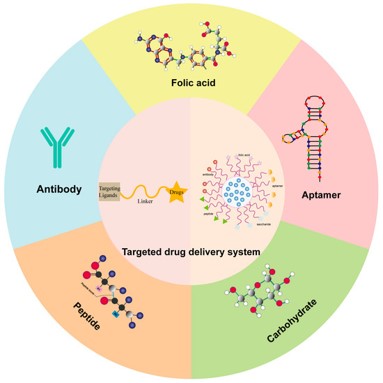 Fig. 1 Different targeting ligands-mediated drug delivery systems.1
- The Target (The "Lock"): Diseased cells (like cancer cells) often overexpress unique proteins, or "receptors," on their surface. These receptors act as specific locks that are not found, or are less common, on healthy cells.
- The Ligand (The "Key"): We engineer a specific molecule—the "ligand"—that is a perfect chemical match for that receptor. This ligand is the "key."
- The Delivery: By attaching this ligand "key" to a delivery vehicle (like an LNP) or directly to a drug, we create an intelligent system. This system circulates through the body, ignoring healthy cells, until it finds and binds to its specific "lock" on the target cell. This binding triggers uptake, ensuring the therapeutic payload is delivered precisely where it's needed most, leading to higher efficacy and lower systemic toxicity.
Creative Biolabs' services are focused on developing these high-precision ligands to enable superior active targeting.
Our Core Targeting Strategies
Creative Biolabs provides end-to-end support for the two primary architectures in targeted therapeutic development. Our expertise ensures your ligand is seamlessly integrated for maximum potency.
This is the optimal strategy for fragile payloads like nucleic acids (mRNA, siRNA) and certain proteins. The ligand is conjugated to the surface of a nanocarrier (e.g., LNP, liposome, or exosome) that encapsulates and protects the therapeutic. This modular system separates the functions of targeting and payload protection.
Comparative Guide to Targeted Ligands
Choosing the correct ligand is a critical, multi-parameter decision. The table below provides a high-level comparison to aid in your selection. Our experts are available to guide you to the optimal choice for your project.
| Antibodies | Peptides | Aptamers | Proteins | Small Molecules | Carbohydrates | |
|---|---|---|---|---|---|---|
| Structure | Immunoglobulins specifically binding to antigens | Short chain of 10-100 amino acids. | Folded single-strand DNA, RNA and short polypeptide. | Large, folded polypeptide chain. | Small molecule | Monosaccharide or oligosaccharide cluster. |
| Synthesis | Recombinant | Chemical | Chemical | Recombinant | Chemical | Chemical |
| Advantages |
Unmatched specificity & affinity Long serum half-life Good penetration |
Small size Low immunogenicity Good tissue penetration |
High specificity & affinity Lower immunogenicity |
Leverages robust natural uptake pathways High affinity, biocompatible |
Extremely small Lower immunogenicity |
Naturally occurring Good biocompatibility Structural diversity |
| Disadvantages |
High production cost Potential immunogenicity |
Rapid in vivo degradation | Susceptible to nucleases |
Large size Low stability |
Lower affinity/specificity than other ligands |
Complex structure Variations in targeting and affinity |
Our Custom Ligand Development Services
While we offer a portfolio of ready-to-use targeted modules, our core strength lies in custom development. Our scientific team partners with you to design, synthesize, and validate high-affinity ligands for virtually any cell surface receptor, organ, or tissue. For researchers needing to rapidly screen common targets, we also offer a wide selection of in-stock products. These ready-to-use products are ideal for accelerating proof-of-concept studies.

Peptides offer an excellent balance of high affinity, small size, and ease of synthesis, making them ideal for targeting tumor microenvironments and penetrating tissues. We provide a full-service pipeline from discovery to conjugation.
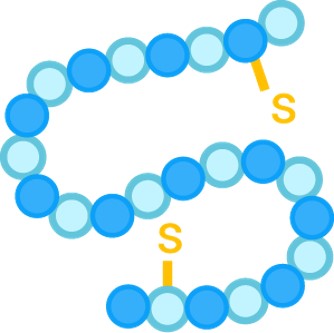
- Peptide Library Construction: In phage display to identify novel, high-affinity targeting sequences.
- High-Purity Peptide Synthesis: Synthesis of custom sequences with guaranteed purity (up to >95%) and scalability.
- Peptide Modification: Advanced modifications including cyclization, and N- or C-terminal modifications to enhance affinity and in vivo stability.
- Fluorescent Labeling: Covalent attachment of a wide range of fluorescent dyes (e.g., FITC, Cy3, Cy5, Cy7) for in vitro and in vivo tracking.
- Peptide Conjugation: Expert coupling of your targeted peptide to nanocarriers (LNPs, liposomes, polymers) or directly to your therapeutic payload.






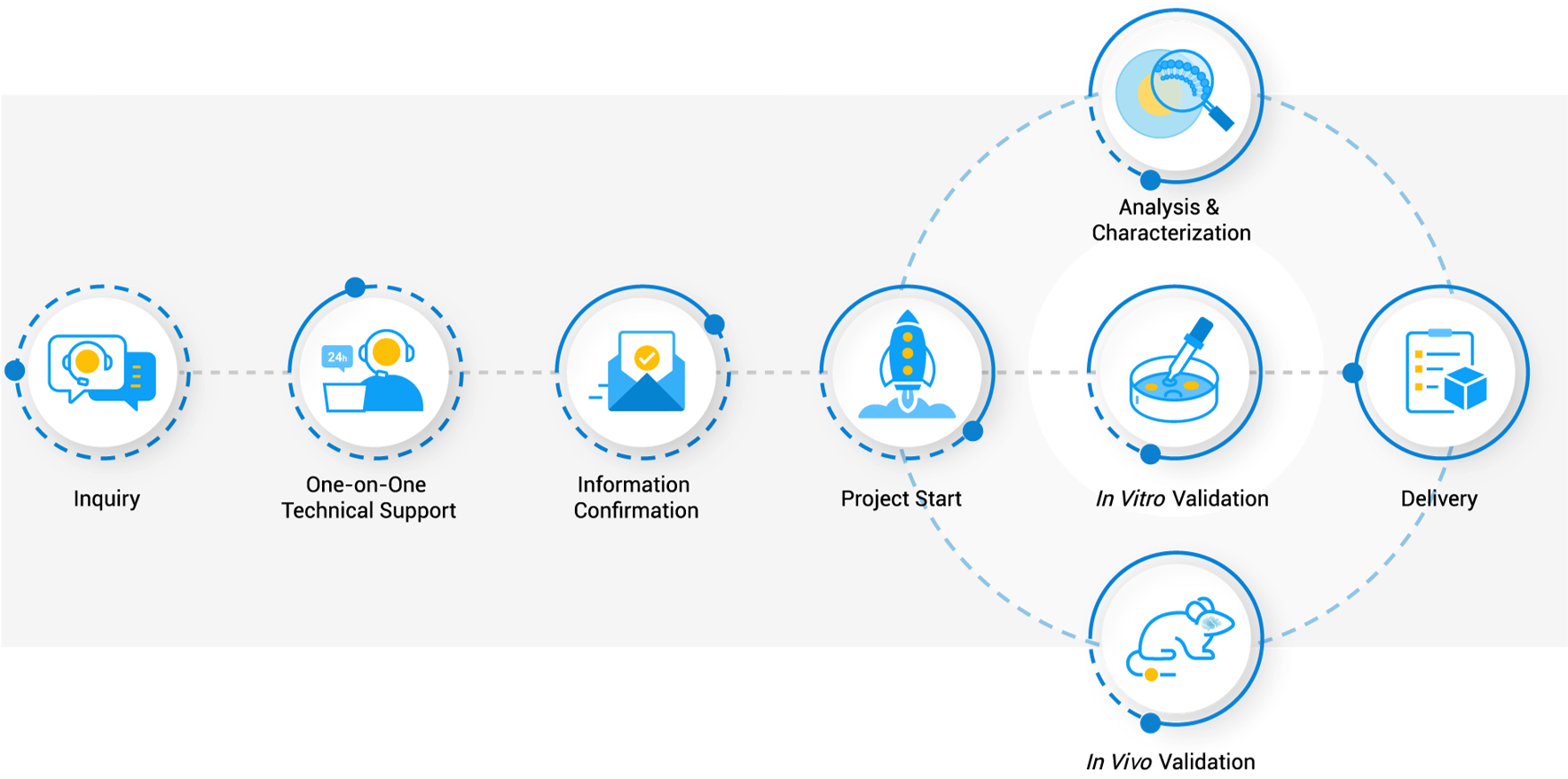
Workflow
Applications in Advanced Therapeutic Development
Our custom ligand services empower researchers to solve the most difficult delivery challenges across oncology, immunology, gene therapy, and neurology.
- Drug Delivery Systems: Encapsulating small molecule drugs, such as chemotherapeutics and anti-inflammatory agents, to improve solubility and reduce systemic toxicity.
- Gene Therapy: As a premier non-viral vector, liposomes provide a safe and efficient means to deliver a suite of nucleic acids—including siRNA, shRNA, mRNA, and RNA-guided gene editing systems components. This enables precise manipulation of cellular function, from targeted gene silencing and transient protein expression to sophisticated gene editing.
- Vaccine Development: Liposomes act as powerful adjuvants and delivery systems in next-generation vaccines. By enhancing antigen presentation and promoting its uptake by immune cells, they elicit a stronger, more durable, and targeted adaptive immune response.
- Cancer Research: Utilizing targeted liposomes to deliver payloads directly to tumor sites, improving efficacy while sparing healthy cells.
- Diagnostic Imaging: Encapsulating contrast agents and other diagnostic molecules to improve resolution and specificity in imaging techniques.
Creative Biolabs: Your Collaborative R&D Partner
Deep Scientific Expertise
Our team brings decades of combined experience in pharmacology, nucleic acid chemistry, peptide synthesis, and nanocarrier engineering.
True Customization
We don't force off-the-shelf solutions. We build the precise ligand and carrier combination that your unique project demands, fully optimized for your payload and target.
Accelerated Research
Leverage our established, optimized platform to de-risk your delivery strategy, bypass common development hurdles, and move from concept to in vivo validation faster.
End-to-End Support
We support you from initial ligand design and screening to final conjugation and comprehensive QC (including particle size, zeta potential, payload encapsulation efficiency, and endotoxin testing).
With decades of expertise, Creative Biolabs is your trusted partner for custom ligand development. We translate complex targeting challenges into clinical-ready solutions. Contact our specialists today to advance your research.
Related Services & Products
Related Services
Chemical Synthesis Services
Related Products
| Product Name | Description | Inquiry |
|---|---|---|
| LNP Formulation Kit | A research-use kit for optimizing LNP formulations. | |
| DSPE-PEG-Folate | A ready-to-use functionalized lipid for targeting the folate receptor. | |
| RGD Targeting Peptide | Enhance targeting avidity with our custom-synthesized RGD peptide. |
FAQs
What is the difference between a peptide ligand and an aptamer?
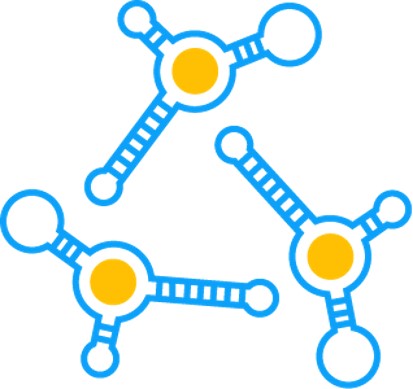
A peptide ligand is a short chain of amino acids, while an aptamer is a short, single-stranded DNA or RNA molecule. Both can be engineered for high-affinity binding to a target. Peptides are often smaller, while aptamers ("chemical antibodies") can offer exquisite specificity and are non-immunogenic. We can help you select the best option for your target.
Can you help me target a novel, uncharacterized receptor?
Yes. Our de novo discovery services, such as peptide phage display for aptamers, are designed to identify new high-affinity ligands for novel targets.
What information do I need to provide to start a custom ligand project?
Ideally, you will have a specific target (e.g., a cell surface receptor like EGFR or Transferrin Receptor) that is overexpressed on your cells of interest. Information about your payload and desired application (in vitro vs. in vivo) is also critical for the design.
Can you conjugate a ligand to a carrier I provide?
Yes. While we offer a full-service platform, we can also perform conjugation services to link your proprietary ligand to your proprietary carrier, or our ligand to your carrier, and vice-versa.
Reference
- Yan, Shuxin, et al. "Different targeting ligands-mediated drug delivery systems for tumor therapy." Pharmaceutics 16.2 (2024): 248. https://doi.org/10.3390/pharmaceutics16020248. Distributed under Open Access license CC BY 4.0, without modification.