
This is the most extensively studied application. HA-modified carriers are used to deliver chemotherapeutics, gene therapy agents (siRNA, plasmid DNA), and imaging probes directly to CD44-overexpressing tumors. The HA/CD44 interaction enhances accumulation via active targeting, complementing passive accumulation enabled by the Enhanced Permeability and Retention (EPR) effect.
Hyaluronic Acid based Targeted Drug Delivery Solution
The most critical challenge in modern therapeutics is ensuring that fragile payloads, from small molecules to complex nucleic acids, reach their site of action efficiently without causing systemic toxicity. Our Hyaluronic Acid based Targeting Delivery Solution helps you accelerate drug development and maximize therapeutic indices through active targeting mediated by the overexpressed CD44 receptor. By harnessing the natural affinity of Hyaluronic Acid (HA) for tumor cells and inflamed tissues, we offer customized nanocarrier systems that redefine precision medicine.
Click Here to View more about our Services and Products
Introduction of Vitamins based Targeting Delivery
Hyaluronic Acid (HA), or hyaluronan, is a naturally occurring, non-sulfated glycosaminoglycan, a major component of the Extracellular Matrix (ECM) in vertebrates. HA is a linear polysaccharide composed of repeating disaccharide units of D-glucuronic acid and N-acetyl-D-glucosamine. Its structure provides exceptional biocompatibility, non-immunogenicity, and a highly hydrophilic nature, enabling it to retain massive amounts of water and form viscoelastic gels.
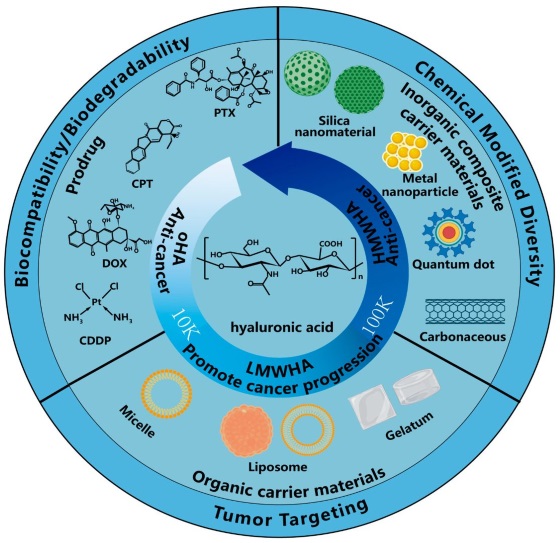 Fig.1 Chemical structure of HA and the hypothesized procancer and anticancer activity of HA with different molecular weights and its application.1
The CD44 Targeting Mechanism
The therapeutic potential of HA in drug delivery stems from its high affinity for the Cluster Determinant 44 (CD44) receptor.
CD44 Structure & Function
CD44 is a transmembrane glycoprotein involved in cell adhesion, migration, and signaling. It is highly abundant in the ECM and on the surface of various cells.
Disease Relevance
Critically, CD44 is significantly overexpressed in many aggressive tumors (including breast, lung, colon, and pancreatic cancers) and on inflammatory cells. The interaction between HA and CD44 often triggers signaling cascades (involving pathways like RhoA, Rac1, and MMP-9) that promote tumor progression and metastasis. This overexpression transforms CD44 into an ideal biomarker for active, site-specific delivery.
Targeting Strategy
By conjugating therapeutic agents or nanocarriers (liposomes, polymeric micelles, nanoparticles) with HA, we create a 'molecular key' that locks onto the 'CD44 lock' on diseased cells. This interaction facilitates receptor-mediated endocytosis, allowing the nanocarrier to be internalized by the target cell, thereby increasing the effective concentration of the drug payload and overcoming multidrug resistance mechanisms. Cited literature consistently demonstrates that HA-based nanocarriers exhibit superior therapeutic efficacy and tumor accumulation compared to free drugs in CD44-overexpressing malignancies.
Molecular Weight is Key
The biological behavior and targeting efficiency of HA are strongly dependent on its molecular weight (Mw). This critical factor dictates stability, tissue penetration, and the specific endocytic pathway engaged.
| HA Molecular Weight Range | Characteristics & Function in Drug Delivery | Primary Application Focus |
|---|---|---|
| Low Mw (< 10 kDa) | Highly resistant to enzymatic degradation; can trigger pro-inflammatory signaling (in some contexts). Useful for stable conjugation and better diffusion through dense tissues. | Topical delivery, deeper tissue penetration, enhanced drug release in the tumor microenvironment. |
| Medium Mw (10–100 kDa) | Optimal for CD44 receptor binding and subsequent cellular internalization (receptor-mediated endocytosis). Provides balance between stability and targeting affinity. | Active targeted delivery, conjugation to complex nanocarriers (liposomes, NPs). |
| High Mw (> 500 kDa) | Forms stable, highly viscous hydrogels. Exhibits anti-inflammatory and immunosuppressive properties. Poor penetration into solid tumors. | Viscosupplementation, tissue engineering, localized sustained release (e.g., ocular, intra-articular). |
Therapeutic Applications of HA Conjugates
The versatility of Hyaluronic Acid as a targeting ligand and material allows its application across a broad spectrum of therapeutic areas, vastly expanding the reach of previously challenging drug candidates.
Oncology (Cancer Therapy)
Inflammatory Diseases
HA receptors, including CD44, are upregulated in various inflammatory conditions (e.g., rheumatoid arthritis). HA-functionalized systems can be used for the targeted delivery of anti-inflammatory drugs directly into affected joints or inflamed tissues, providing localized therapeutic benefit and minimizing systemic immunosuppression.
Ocular Drug Delivery
HA's natural presence and mucoadhesive properties make it excellent for ophthalmic formulations. HA-coated systems can prolong drug residence time on the corneal and conjunctival surfaces, improving the bioavailability of drugs for conditions like dry eye or glaucoma, without the need for high-frequency dosing.
Dermal and Transdermal Delivery
Utilizing HA's inherent role in skin hydration and repair, HA-based carriers can enhance the localized delivery of cosmeceuticals and therapeutic compounds for wound healing, burns, and dermatological conditions.
Targeting Stem Cells
CD44 is often a marker for certain types of cancer stem cells (CSCs) and mesenchymal stem cells (MSCs). HA targeting can be instrumental in delivering agents specifically designed to modulate the behavior or eliminate these critical cell populations.
What We Can Offer: Comprehensive HA-Based Services
Targeted drug delivery is no longer a theoretical ideal—it is a mandatory requirement for next-generation therapies. Off-target toxicity, poor bioavailability, and rapid degradation of cargo often compromise promising drug candidates. Creative Biolabs addresses these critical bottlenecks by leveraging Hyaluronic Acid (HA) as a gold-standard targeting ligand.
Our HA-based solutions provide:
Active Cellular Uptake
We design HA conjugates and coated nanocarriers (liposomes, micelles, nanoparticles) that specifically bind to the CD44 receptor, which is frequently overexpressed on the surface of various cancer cells and inflamed tissues. This mechanism ensures enhanced receptor-mediated endocytosis, leading to significantly higher intracellular drug concentrations.
Reduced Systemic Toxicity
By preferentially accumulating the drug payload at the disease site, our systems minimize exposure to healthy, non-target tissues, thereby improving the overall therapeutic window and reducing dose-limiting side effects.
Enhanced Stability and Circulation
The hydrophilic nature of HA and its derivatives helps stabilize nanocarriers in circulation, protecting encapsulated or conjugated drugs from enzymatic degradation and clearance by the Reticuloendothelial System (RES).
Specific Deliverables: We provide fully characterized, optimized HA-nanocarrier complexes, including comprehensive in vitro validation (e.g., binding affinity, cellular uptake kinetics in CD44+ and CD44- cells) and in vivo biodistribution studies, giving you a clear pathway to preclinical success.
FAQs
What is the primary biological target that allows this delivery system to achieve specificity, particularly in oncology?
The primary mechanism relies on the strong, natural affinity of the delivery material for a cell-surface receptor called CD44. This receptor is frequently overexpressed on the membranes of various cancer cells and certain inflammatory cells. By designing the delivery vehicle to act as a ligand for CD44, the system actively seeks out and is internalized by these specific target cells through receptor-mediated endocytosis, effectively concentrating the therapeutic payload where it is needed most.
How does the size or structure of the therapeutic cargo affect the choice of the delivery vehicle?
The nature of the cargo is a key factor. For small, hydrophobic drugs, a carrier with a strong hydrophobic core, such as a polymeric micelle, is often preferred. For larger, complex molecules like proteins or nucleic acids (e.g., mRNA or siRNA), the protective capacity and larger internal volume of liposomes or structured nanoparticles are more suitable. The targeting material can be chemically linked directly to the drug (conjugate) or anchored to the surface of the nanocarrier, depending on the cargo's properties and the desired release kinetics.
Are there any challenges regarding systemic clearance or off-target uptake that this type of system must overcome?
Yes, all nanocarriers face challenges related to the body's natural defenses, primarily rapid clearance by the Reticuloendothelial System (RES), mainly in the liver and spleen. To overcome this, advanced formulations often incorporate structural modifications to achieve a 'stealth' effect, enabling longer circulation times. This ensures the carrier has enough time to passively accumulate in leaky tumor vasculature (EPR effect) before the active targeting mechanism takes effect at the disease site.
Why is the molecular weight of the targeting component a critical factor in the design and efficacy of the final system?
The molecular weight (Mw) is crucial because it governs the system's physicochemical properties, biodistribution, and cellular interaction. Different molecular weights of the targeting material can affect binding affinity for the receptor, the speed of clearance, and even the specific endocytic pathways utilized for cellular uptake. Careful optimization of Mw is essential to ensure the carrier remains stable in the bloodstream, achieves efficient tumor penetration, and rapidly internalizes upon reaching the target cell.
In what ways can this targeting system be engineered to respond to the unique microenvironment of a tumor or inflamed tissue?
Beyond simple receptor binding, these systems can be designed with environmental sensitivity. For example, the tumor microenvironment is often slightly acidic and rich in certain enzymes, such as hyaluronidase. By incorporating pH-sensitive linkages or enzyme-cleavable bonds into the carrier's structure, the system can be programmed to undergo a structural change or rapidly release its payload only after reaching the diseased tissue, thus enhancing local drug concentration and boosting therapeutic effect.
Creative Biolabs is your trusted partner in overcoming the final hurdle of therapeutic development: precision delivery. Our specialized expertise in Hyaluronic Acid based Targeting Delivery Solution offers an evidence-based, robust, and scalable platform for actively targeting CD44-overexpressing pathologies. We provide end-to-end support, from initial conjugate synthesis and carrier formulation to critical preclinical characterization, ensuring your therapeutic candidate achieves its maximum potential.
Reference
- Fu, Chao-Ping et al. "Hyaluronic Acid-Based Nanocarriers for Anticancer Drug Delivery." Polymers vol. 15,10 2317. 16 May. 2023, Distributed under Open Access license CC BY 4.0, without modification. https://doi.org/10.3390/polym15102317.
Our services are For Research Use Only. We do not provide services to individuals.
Online Inquiry