Cytosol Targeting Module Development Service
Are you currently facing challenges in delivering your therapeutic molecules to the cell cytosol? Do you struggle with poor drug bioavailability or off-target effects? Creative Biolabs Cytosol Targeting Module Development service empowers you to overcome these obstacles. We help you achieve efficient and specific delivery of your cargo through advanced module design and delivery systems.
Contact our team to get an inquiry now!
Overview
The cytoplasmic matrix serves as the primary site for metabolic cascades, signal transduction pathways, and pathogenic interactions implicated in multiple disease states. Viral genomic delivery occurs through envelope fusion at either plasma membranes or endosomal compartments. RNA interference mechanisms—including microRNA and siRNA-mediated regulation—operate within this subcellular environment, requiring precise subcellular localization of therapeutic RNA agents. To achieve cytosolic pharmaceutical deposition while evading lysosomal processing, three primary methodologies have emerged: 1) Cellpenetrating peptides (CPP) enabling direct bilayer penetration and cytosolic payload discharge, 2) Endosomal pH-activatable nanocarriers exploiting compartmental acidification gradients, and 3) Endosomolytic compounds facilitating vesicular membrane destabilization for payload liberation.
Cytosol Targeting Strategy
- CPPs that act directly at the plasma membrane
Cellular delivery via plasma membrane translocation can be achieved through cargo-CPP conjugation. The HIV-derived Tat protein's nuclear trafficking capability, demonstrated through autonomous membrane transit, catalyzed biomedical innovation in precision delivery systems. Subsequent identification of membrane-permeant viral (HSV VP22) and eukaryotic (Antennapedia transcription factor) proteins expanded therapeutic vectorization platforms. Functional domains driving cellular entry comprise either amphipathic helices (e.g., model amphipathic peptides/transportan) or polyarginine motifs (Tat/penetratin), typically spanning ~30 residues. While translocation dynamics through hydrophobic bilayers remain biophysically undefined, contemporary research indicates endocytic pathways dominate CPP-cargo internalization despite select peptides exhibiting direct membrane permeation capacity.
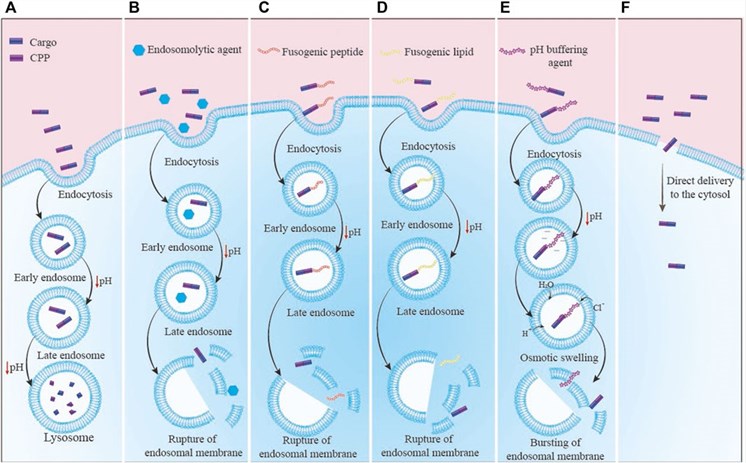 Fig.1 The different routes that the CPP-cargo complex enters the cytosol 1
- Peptide-mediated escape from early endosomes and the ER–Golgi network
To enable cytoplasmic transfer of endosomal payloads, two strategic paradigms are employed: 1) Membrane-fusion systems where vesicle-bound particles merge with endosomal bilayers for content extrusion (fusion-mediated release); or 2) Vesicle-rupture techniques where internalized agents breach compartment integrity, inducing cytotoxic dispersion (disruption-driven liberation). The influenza virus exemplifies the former via its pH-responsive HA glycoprotein, which reconfigures under acidic conditions to embed into and fuse with endosomal membranes, facilitating nucleocapsid release. This HA protein's N-terminal fusogenic domain has inspired synthetic analogs like GALA99 and KALA peptides for therapeutic cargo delivery. In contrast, adenoviral vectors and bacterial cytotoxins preferentially utilize membrane-disintegration strategies over fusion-dependent entry.
What We can Offer?
Creative Biolabs is equipped with well-established module delivery systems, enabling us to provide:
- Individual targeting modules
- Various module-payload/carrier conjugates specifically designed for cytosol targeting
We offer a wide spectrum of corresponding products to meet your specific research needs.
Building on years of dedicated effort, Creative Biolabs has:
- Developed a comprehensive collection of CPPs with diverse subcellular organelle targeting capabilities
- Refined and optimized the original sequences, resulting in our unique and proprietary CPP database
The flexible application of different delivery systems and CPPs in various combinations allows us to offer tailored delivery solutions for your cytosol targeting projects. We are committed to providing high-quality services and products to fulfill our client's specific requirements.
Experience the Creative Biolabs Advantage - Get a Quote Today
Why Choose Us?
Creative Biolabs stands out for its commitment to providing high-quality, customized solutions for cytosol targeting. We combine cutting-edge technology with extensive expertise to deliver exceptional results.
- Unparalleled Expertise: Our team comprises experienced scientists with a deep understanding of cell biology, drug delivery, and biomaterials.
- Customized Solutions: We understand that every project is unique. We work closely with you to tailor our services to your specific needs and requirements, ensuring optimal results.
- Advanced Technology: We utilize state-of-the-art technologies, including advanced peptide synthesis, nanoparticle engineering, and high-resolution imaging, to develop highly efficient and specific delivery systems.
- Rigorous Validation: We perform comprehensive in vitro validation to ensure the efficacy and safety of our delivery systems before they are used in your experiments.
- Proven Success: Our solutions have consistently delivered exceptional results for our clients, accelerating their research and development efforts.
Workflow

FAQs
How do I know if cytosol targeting is the right approach for my research?
Cytoplasmic delivery strategies prove essential when therapeutic compounds require precise localization to non-organelle cytoplasmic targets to achieve intended bioactivity. Our team guides therapeutic platform design through architecting precision-targeted transport systems aligned with unique pharmacological objectives.
Can you deliver large protein complexes to the cytosol?
Yes, we have experience in delivering a range of cargo sizes, including large protein complexes. Our optimized delivery systems and expertise in protein engineering enable us to handle challenging delivery scenarios.
Can you develop a delivery system for in vivo applications?
Yes, we offer solutions for both in vitro and in vivo applications. Our team has experience in developing delivery systems suitable for various animal models.
Creative Biolabs provides tailored targeted delivery solutions addressing unique research and therapeutic requirements. To explore these capabilities, contact our technical team for protocol specifications and collaborative development pathways.
Reference
- Hasannejad-Asl, Behnam, et al. "Cell penetrating peptide: A potent delivery system in vaccine development." Frontiers in Pharmacology 13 (2022): 4834. Distributed under Open Access license CC BY 4.0, without modification.