

Dual-Responsive Systems rely on the simultaneous or sequential presence of two stimuli for optimal drug release. For example, a system designed to be responsive to both low pH and elevated temperature (pH/thermo-responsive) ensures that the payload is released only when the carrier is accumulated in a slightly acidic tumor and an external heating source is applied. Similarly, combining an internal trigger (like redox potential, high GSH) with an external one (like near-infrared light) allows for passive accumulation followed by precise, clinician-controlled activation. This dramatically enhances spatial and temporal resolution, reducing the risk of premature release and systemic toxicity.
Stimuli-Responsive Delivery Solutions for Targeted Drug Delivery
Developing innovative treatments often encounters a critical barrier: achieving selective targeting. The challenges of stabilizing delicate nucleic acid payloads and directing therapies to their precise destination are pivotal to a project's success or failure. At Creative Biolabs, we transform this difficulty into an opportunity. Our Stimuli-responsive Delivery Systems are designed to accelerate drug discovery and enhance therapeutic efficacy by utilizing advanced formulation chemistry and refined molecular engineering, thereby maximizing the clinical potential of your therapeutic candidates.
Click Here to View more about our Service
Introduction of Stimuli-responsive Delivery Systems
Stimuli-responsive delivery systems, often referred to as "smart" drug carriers, represent the third generation of targeted drug delivery technology, moving beyond passive targeting (EPR effect) and ligand-mediated active targeting. These systems are defined by their ability to change their physicochemical properties (e.g., disassembly, membrane permeability, phase transition) in response to a specific trigger, thereby releasing the encapsulated therapeutic payload.
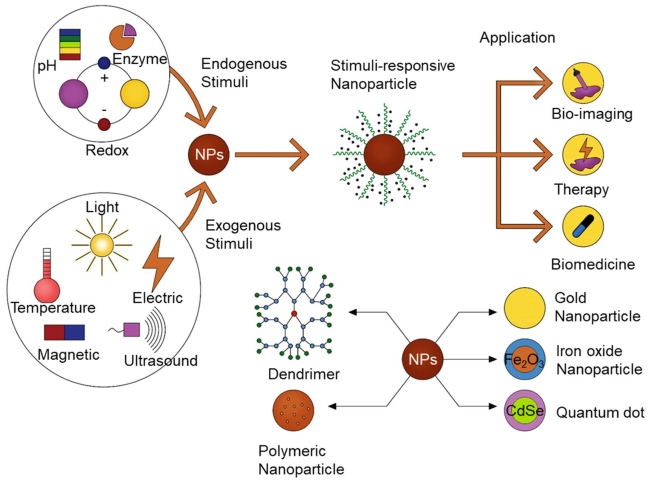 Fig.1 Stimuli-responsive nanomaterials used for bioimaging, therapy, and triggered drug release.1
The Mechanism of the "Smart Switch"
The core mechanism relies on incorporating sensitive components into the nanocarrier's structure. For instance, pH-responsive carriers utilize acid-labile bonds or polymers with pKa values near 6.5 (the typical pH of a tumor microenvironment) or 5.0 (endosomal pH). Upon protonation at the lower pH, these materials become destabilized or swell, leading to rapid drug release.
pH-responsive polymeric nanoparticles have shown promise in overcoming Multi-Drug Resistance (MDR) in cancer cells by facilitating endosomal escape and preventing drug efflux. Furthermore, the use of dual-responsive systems (e.g., pH and reduction-sensitive) is increasingly explored to achieve highly specific drug release, capitalizing on the unique biochemical profile of diseased tissues (low pH and high glutathione concentration in tumors). This precision fundamentally shifts the therapeutic window, making previously challenging compounds viable.
Explore the complete range of Stimuli-responsive Delivery Systems below to find the perfect match for your study.
pH-Responsive Light-Responsive Electric Field Responsive Ion-Responsive Temperature-Responsive ATP-Responsive Magnetic Field Responsive Glucose-Responsive Enzyme-Responsive Hypoxia-Responsive Ultrasound-Responsive Pressure Responsive ROS Responsive
Complex Response Strategies: Dual and Multiple Triggers
While single-stimulus carriers offer a significant advantage over passive systems, their specificity can sometimes be limited, as many biological environments share similar characteristics (e.g., low pH is present in both tumors and inflammatory tissues). To address this, Creative Biolabs specializes in complex response strategies that integrate two or more distinct triggers into a single nanocarrier.
Dual-Responsive Systems
Multi-Responsive Systems
Multi-Responsive Systems further advance this concept by utilizing three or more triggers (e.g., pH/temperature/light). These highly sophisticated platforms are essential for targeting complex, heterogeneous disease states where multiple unique biomarkers are present, such as targeting metastatic cascades or navigating blood-brain barrier penetration followed by intracellular delivery. By requiring a concurrence of multiple abnormal physiological conditions, these systems achieve the highest level of targeting precision currently available.
Application of Stimuli-Responsive Nanocarriers
The inherent specificity of these systems unlocks applications that conventional drug delivery technologies cannot address effectively.
Oncology: Overcoming Tumor Heterogeneity
The tumor microenvironment (TME) is characterized by physiological deviations, including low extracellular pH, elevated temperatures (localized hyperthermia), and high concentrations of reducing agents (GSH) and specific enzymes (e.g., matrix metalloproteinases, MMPs). Stimuli-responsive carriers can be designed to exploit one or multiple of these factors, ensuring payload release precisely where it is needed. This strategy is critical for:
- Targeting Deep Solid Tumors: External stimuli like ultrasound or magnetic fields can penetrate tissue to trigger release at the tumor core.
- Enhanced Intracellular Delivery: pH-responsive carriers promote the escape of DNA, RNA, and small molecules from the endolysosomal compartment into the cytosol, a necessity for effective gene therapy and cell signaling modulation.
Managing Chronic Inflammation and Infection
In conditions like rheumatoid arthritis or severe infection, the disease site is marked by elevated ROS levels and specific enzymatic activity.
- ROS-Responsive Systems: Nanocarriers incorporating ROS-cleavable moieties (e.g., thioketal, boronates) rapidly degrade in the presence of ROS, enabling on-demand drug release for potent anti-inflammatory effects exactly at the site of tissue damage, sparing healthy organs.
- Enzyme-Responsive Pro-drugs: Using linkers cleaved by overexpressed enzymes allows for drug activation, such as antibiotics or antivirals, only in the presence of the pathogen's unique enzymatic signature.
What We Can Offer
The central challenge in modern pharmacology is achieving a high therapeutic index—maximizing drug concentration at the diseased site while minimizing systemic exposure and toxicity. Our Stimuli-responsive Delivery Systems are engineered to solve this by transforming passively distributed nanocarriers into active, highly controllable drug depots.
We specialize in designing and characterizing nanocarriers (such as liposomes, polymeric micelles, and inorganic nanoparticles) that remain stable in the systemic circulation but undergo a predictable, rapid change—a "switch"—upon encountering a specific biological or external trigger. The result is the controlled release of the therapeutic payload exclusively at the target site (e.g., within a tumor, an infected cell, or an inflamed tissue).
Tailored Carrier Design
We deliver custom-synthesized nanocarriers designed to respond to internal stimuli like the low pH environment of solid tumors or endosomes, high concentrations of Reactive Oxygen Species (ROS) in inflammatory sites, or specific enzyme activity.
External Stimuli Integration
We provide systems engineered for external triggers such as focused ultrasound, localized heat (thermo-responsive), or specific light wavelengths (photo-responsive), offering unparalleled spatial and temporal control over drug release.
Robust In vitro and In vivo Validation
Our services include rigorous stability testing, stimulus-release kinetics, and in vivo targeting and efficacy studies to ensure the formulation meets preclinical standards.
By utilizing our expertise, clients receive a fully validated, intelligent delivery system ready for advanced preclinical investigation, drastically reducing formulation risk and accelerating the path to clinical trials. We also offer a comprehensive portfolio of high-quality products to support your targeted drug delivery research.
FAQs
How do I select the most appropriate stimulus for my therapeutic payload and target tissue?
The selection depends entirely on the pathology of your target site. For solid tumors, the pH and redox potential are often ideal internal triggers. For external control, light or ultrasound may be chosen if the target area is superficial or accessible to focused energy delivery. It is essential to first profile the unique microenvironment characteristics of your disease model. We recommend starting with the most robust and clinically translatable trigger (like pH or temperature) before moving to complex, multi-stimuli approaches.
Are these responsive systems inherently less stable than conventional, non-responsive carriers?
Not necessarily. While the responsive element is designed to destabilize, the overall nanocarrier is engineered with a stability-release threshold. It remains inert and highly stable at normal physiological conditions (neutral pH, 37°C). The inherent stability is a critical parameter in the design phase, and rigorous preclinical testing is performed to ensure premature drug leakage in the bloodstream is negligible.
Can I use these delivery systems for nucleic acids (e.g., mRNA or siRNA) instead of small molecule drugs?
Absolutely. Stimuli-responsive systems are particularly valuable for nucleic acid delivery. For mRNA and siRNA, endosomal escape is the primary bottleneck. pH-responsive materials are often utilized to destabilize the endosomal membrane once internalized, rapidly releasing the nucleic acid payload into the cytoplasm before it can be degraded by lysosomes.
What are the main regulatory considerations when using novel responsive polymers in a therapeutic formulation?
The regulatory path often centers on the biocompatibility and degradation products of the responsive material. It is crucial that the materials are either GRAS (Generally Recognized As Safe) or fully characterized to ensure degradation products are non-toxic and rapidly cleared from the body. We prioritize the use of established, biocompatible polymeric and lipid structures where possible to streamline the regulatory approval process.
How do responsive systems compare to simple passive targeting strategies (like PEGylation and the EPR effect) in terms of efficacy?
Passive targeting via PEGylation is a necessary first step to prolong circulation time and enhance accumulation via the EPR effect. However, it often leads to low intracellular concentrations. Responsive systems are designed to supplement passive accumulation by providing the active release mechanism. By combining accumulation (passive) with on-demand release (responsive), you achieve a significantly higher local concentration of active drug and improved cellular uptake, which generally leads to superior efficacy.
Creative Biolabs is your trusted partner for engineering the next generation of precision therapeutics. We offer end-to-end expertise in designing, formulating, and validating Stimuli-responsive Delivery Systems, ensuring your therapeutic molecule is delivered with optimal specificity, efficacy, and safety. Our platform transforms biological obstacles into precise targeting opportunities, accelerating your pipeline from concept to clinic.
Reference
- Pham, Son H et al. "Stimuli-Responsive Nanomaterials for Application in Antitumor Therapy and Drug Delivery." Pharmaceutics vol. 12,7 630. 4 Jul. 2020, Distributed under Open Access license CC BY 4.0, without modification. https://doi.org/10.3390/pharmaceutics12070630.
Our services are For Research Use Only. We do not provide services to individuals.
Online Inquiry