

Carbohydrate ligands, such as mannose, glucose, or sialic acid, are frequently used to target cancer cells that overexpress specific lectins or glucose transporters (GLUTs) due to their high metabolic rates. Functionalized nanocarriers accumulate specifically at the tumor site, maximizing local drug concentration and minimizing off-target toxicity to healthy tissues. Furthermore, responsive carbohydrate-based systems can be designed to release their payload only in the tumor microenvironment, which is often acidic or rich in specific enzymes.
Carbohydrate based Targeted Drug Delivery Solution
The bottleneck of modern therapeutics—delivering fragile payloads safely and precisely—demands specialized chemistry. Our Carbohydrates based Targeting Delivery Solution helps you accelerate therapeutic development and achieve unparalleled site-specific delivery through advanced glyco-conjugation, nanocarrier functionalization, and stimuli-responsive release engineering. Creative Biolabs transforms delivery complexity into high-impact clinical potential.
Click Here to View more about our Services and Products
Introduction of Carbohydrates based Targeted Delivery
Carbohydrates, ranging from simple monosaccharides to complex polysaccharides, are essential macromolecules in biology, playing crucial roles in cellular communication, energy storage, and structural integrity. In targeted drug delivery, these molecules are utilized as highly effective carriers and targeting ligands due to their inherent biocompatibility, low immunogenicity, and structural diversity.
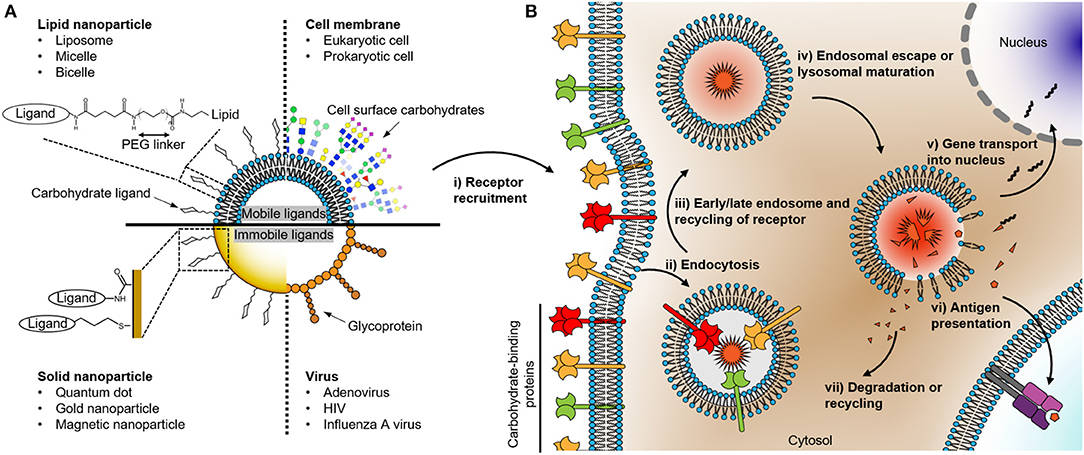 Fig.1 Nanoparticles coated with carbohydrates recognized by cell surface receptors.1
Carbohydrate-based delivery systems leverage the concept of glycotargeting, a mechanism that exploits the recognition between saccharide ligands and specific lectins or carbohydrate receptors on the cell surface. These receptors, which are often involved in receptor-mediated endocytosis (RME), are frequently upregulated in pathological states, particularly in cancer and inflammatory diseases. For instance, the high expression of the ASGPR on hepatocytes makes galactose-terminated carriers ideal for liver-specific targeting, while the mannose receptor (MR) on macrophages and dendritic cells provides a gateway for immune-modulating therapeutics. The immense density of information conveyed by carbohydrate structures allows for binding specificity that often surpasses simple ligand-receptor systems.
Leveraging this fundamental biological mechanism allows researchers to engineer delivery systems that shield sensitive payloads (like nucleic acids or unstable proteins) from enzymatic degradation while guiding them precisely to the intended site of action, thus fulfilling the original promise of the "magic bullet" concept in modern medicine.
Summary of Key Carbohydrate Ligands and Their Therapeutic Target Receptor:
| Carbohydrate Ligand | Target Receptor/Cell Type | Therapeutic Application Focus |
|---|---|---|
| Galactose | Asialoglycoprotein Receptor (ASGPR) on Hepatocytes | Liver-specific delivery (Gene therapy, Hepatitis) |
| Mannose | Mannose Receptor (MR) on Dendritic Cells (DCs), Macrophages | Vaccine delivery, Cancer immunotherapy, Inflammatory diseases |
| Glucose | Glucose Transporters (GLUTs) on Tumor Cells | Enhanced uptake in highly glycolytic tumor cells |
| Hyaluronic Acid (HA) | CD44 Receptor (often overexpressed in tumors) | Cancer targeting (Breast, Ovarian), Tissue engineering |
| Chitosan | Mucosal Surfaces, Lectins | Oral/Colon delivery, Permeation enhancement |
| Lactose | Galectins (often overexpressed on tumor cells) | Apoptosis induction, targeted delivery |
Diverse Applications of Carbohydrate-Based Targeting
The structural versatility and inherent bio-recognition properties of carbohydrates enable their application across a wide spectrum of therapeutic fields, offering solutions for traditionally challenging delivery scenarios.
Advanced Cancer Therapy
Immunomodulation & Vaccine Delivery
Carbohydrate receptors like the Mannose Receptor (MR) are highly expressed on Antigen-Presenting Cells (APCs), including dendritic cells and macrophages. By conjugating antigens or immunomodulators to mannosylated carriers, delivery can be focused directly to APCs, resulting in significantly enhanced antigen processing and presentation to T-cells. This strategy is critical for developing more potent glycoconjugate vaccines and next-generation immunotherapies.
Oral & Colonic Delivery
Polysaccharides like chitosan, pectin, and guar gum demonstrate stability in the harsh gastric environment but are biodegradable by bacterial flora in the colon. This makes them ideal matrices for oral drug delivery systems aimed at treating diseases like Inflammatory Bowel Disease (IBD) or enhancing the bioavailability of bioactive ingredients by achieving targeted release in the lower gastrointestinal tract.
Nucleic Acid & Biologic Protection
Carbohydrate-based polymers (e.g., cyclodextrins, chitosan derivatives) provide excellent encapsulation matrices for fragile therapeutics like siRNA, mRNA, and proteins. They shield the payload from nucleases and proteases in the bloodstream, ensuring the active ingredient remains intact until internalizing at the target cell.
What We Can Offer: Tailored Solutions for Targeted Delivery
At Creative Biolabs, we recognize that the success of a novel therapeutic, be it a small molecule, peptide, protein, or nucleic acid, often hinges entirely on its delivery system. Carbohydrate chemistry offers a versatile and highly specific pathway to address the systemic challenges of drug delivery, particularly non-specific distribution and premature degradation.
Our solution focuses on active targeting, exploiting the high density and specificity of endogenous carbohydrate-binding proteins (lectins) that are often overexpressed on the surface of diseased cells (a process known as glycotargeting). We provide:
Custom Glyco-Ligand Synthesis
Design and synthesis of high-affinity carbohydrate ligands (e.g., mannose, galactose, fucose derivatives) optimized for binding to specific receptors like the Asialoglycoprotein Receptor (ASGPR) on hepatocytes or the Mannose Receptor (MR) on antigen-presenting cells (APCs).
Nanocarrier Functionalization
Seamless integration of these targeting ligands onto various nanocarrier platforms, including liposomes, polymeric nanoparticles, and magnetic nanoparticles, enhancing stability and controlling surface density for optimal targeting.
Integrated PK/PD Evaluation
Comprehensive in vitro and in vivo testing to evaluate drug loading capacity, release kinetics, targeting efficiency, and improved pharmacokinetic profiles (such as prolonged circulation time and reduced systemic toxicity).
By partnering with Creative Biolabs, you receive a tailored delivery system that is biocompatible, highly selective, and optimized for clinical translation, moving your candidate from lab to clinic faster.
FAQs
How does utilizing carbohydrate ligands help my delivery system avoid rapid clearance by the body?
While some carbohydrate structures can be recognized by the immune system, the strategic design and functionalization of carriers significantly enhance their performance. We focus on optimizing the density and conformation of the ligands to achieve high affinity for the therapeutic target while simultaneously employing stability-enhancing techniques like PEGylation or lipid modification. This fine-tuning is crucial for increasing circulation time and achieving the necessary therapeutic window.
Can these systems effectively deliver highly water-insoluble or hydrophobic therapeutic agents?
Yes. Although carbohydrates themselves are often hydrophilic, they are used to functionalize sophisticated nanocarriers, such as liposomes or polymeric micelles, which have hydrophobic cores. The system acts as a hybrid: the core encapsulates the hydrophobic drug, and the surface conjugation with the carbohydrate ligand provides the highly specific targeting mechanism. This dual functionality is essential for improving solubility, bioavailability, and overall efficacy.
What is the primary benefit of a carbohydrate-targeted nanocarrier compared to simply using an antibody-drug conjugate (ADC)?
Carbohydrate targeting (glycotargeting) often offers a robust alternative to ADCs, especially for certain targets. While antibodies provide extremely high affinity, carbohydrates exploit naturally abundant, evolutionarily conserved lectin receptors that can allow for receptor multiplicity and cooperative binding, sometimes leading to higher avidity than single antibody binding. Furthermore, carbohydrate-functionalized carriers are typically less expensive to manufacture at scale and are inherently less immunogenic than protein-based conjugates.
How can a delivery system be designed to only release the drug at the diseased site?
This is achieved by engineering stimuli-responsive components into the carbohydrate matrix or nanocarrier structure. For example, systems can be designed to utilize acid-labile linkages that rapidly cleave the carbohydrate or release the drug payload only when encountering the lower pH found in tumor tissue or inflamed endosomes. Similarly, enzyme-responsive linkages can exploit the overexpression of specific glycosidases or proteases found only in diseased tissue, ensuring precise, spatiotemporally controlled release.
What are the main regulatory and scalability considerations when moving a carbohydrate-based delivery system toward clinical trials?
The main considerations revolve around defining and maintaining the consistent structure and purity of the carbohydrate component, which can be chemically complex. Demonstrating lot-to-lot reproducibility, especially in terms of glycan purity and conjugation efficiency, is paramount. The use of natural, biodegradable polymers often simplifies toxicity profiles, but the final formulation requires thorough analytical validation and rigorous quality control to meet regulatory requirements for clinical translation.
Creative Biolabs is your trusted partner for creating sophisticated, high-performance Carbohydrates based Targeting Delivery Solutions. We provide the unparalleled expertise in glycochemistry and nanocarrier engineering necessary to overcome critical delivery challenges for your most promising therapeutic candidates.
Reference
- Kim, Dongyoon et al. "Elucidating Carbohydrate-Protein Interactions Using Nanoparticle-Based Approaches." Frontiers in chemistry vol. 9 669969. 11 May. 2021, Distributed under Open Access license CC BY 4.0, without modification. https://doi.org/10.3389/fchem.2021.669969.
Our services are For Research Use Only. We do not provide services to individuals.
Online Inquiry