
Creative Biolabs leads the industry with advanced targeted delivery solutions, offering customized services to international clients.
Fibrosarcoma Targeting Module Development Service
Overview Fibrosarcoma Targeting Module Development What Can We Do for You? Workflow FAQs
Creative Biolabs develops advanced drug delivery systems that target fibrosarcoma treatment specifically. We specialize in developing delivery systems based on liposomes and LNPs that utilize targeting components like peptides, antibodies, and aptamers to improve drug effectiveness while reducing side effects. Our expert team develops tailored solutions which match your specific needs. You can reach us to obtain additional information about our services.
Contact our team to get an inquiry now!
Overview
Fibrosarcoma is an uncommon type of cancer that originates from fibrous tissue and most frequently manifests in the deep soft tissues of muscles, tendons, and ligaments. Adults are mainly affected by this condition although children may also develop the disease. The tumor shows abnormal growth patterns through fibroblast cells that produce collagen. Fibrosarcoma tumors cause patients to experience pain and swelling and restricted mobility which varies based on the tumor location. Treating fibrosarcoma is difficult because of its invasive nature and potential to metastasize. While fibrosarcoma treatment requires surgery and chemotherapy and radiation therapy medical professionals face obstacles because of treatment resistance and serious side effects. Medical researchers are exploring innovative strategies like targeted drug delivery systems to address current treatment limitations. Peptides and antibodies form targeting modules to work together with drug delivery systems such as liposomes and exosomes which deliver therapeutic agents directly to fibrosarcoma cells. This technique enhances treatment precision and effectiveness through protection of surrounding healthy tissues from damage.
 Fig.1 The endomembrane system.1,3
Fibrosarcoma Targeting Delivery Systems (TDDS)
The aggressive and metastatic nature of fibrosarcoma soft tissue cancer creates treatment difficulties because of its non-responsiveness to traditional therapies. TDDS hold potential as effective treatment options because they deliver therapeutic agents directly to fibrosarcoma cells while decreasing side effects. Below is a list of common TDDS delivery systems, showcasing their applications in the treatment of various diseases.
Table 1. The Primary Types of TDDS Utilized in The Treatment of Fibrosarcoma
| TDDS Type | Description | Targeting Mechanism | Applications |
|---|---|---|---|
| Nanoparticles | Small particles (1-1000 nm) designed to encapsulate drugs, improving their solubility and bioavailability. | Passive targeting (EPR effect) and active targeting via surface modifications with ligands. | Cancer therapy, gene therapy, RNA delivery. |
| Liposomes | Lipid-based vesicles that can carry both hydrophilic and hydrophobic drugs. | Surface modifications with antibodies or ligands for specific targeting. | Chemotherapy drug delivery, gene therapy, immunotherapy. |
| Polymeric Micelles | Amphiphilic copolymers that form micelles in aqueous environments, carrying drugs within their cores. | Active targeting through surface modification for specific receptor binding. | Cancer treatment, drug solubilization, gene therapy. |
| Dendrimers | Nanoscale, highly branched polymers that can hold a large payload of drugs or genetic materials. | Active targeting via receptor-specific ligands on the surface. | Gene therapy, drug delivery, RNA interference. |
| Antibody-Drug Conjugates (ADCs) | Monoclonal antibodies linked to cytotoxic drugs, enabling selective drug delivery to cancer cells. | Targeting specific tumor antigens (e.g., EGFR or HER2) using antibodies. | Targeted chemotherapy for tumors like fibrosarcoma. |
| RNA Delivery Systems | Delivery of small interfering RNA (siRNA) or messenger RNA (mRNA) to cells for gene silencing or expression. | Targeting by utilizing specific RNA sequences or ligands for cell uptake. | Gene silencing, gene therapy, RNA interference therapies. |
Targeting ligands play a crucial role in targeted drug delivery systems. By specifically binding to receptors on the surface of cells, they guide drugs to the intended site, thereby enhancing therapeutic efficacy and minimizing side effects. The choice of targeting ligands varies depending on the disease type and therapeutic needs. Below is a list of commonly used targeting ligands, covering various targets and applications.
Table 2. Targeting Ligands Used in Preclinical Studies for Fibrosarcoma
| Targeting Ligand | Target | Mechanism of Action | Research Focus |
|---|---|---|---|
| EGFR (Epidermal Growth Factor Receptor) | EGFR receptor | Monoclonal antibodies or small molecules targeting EGFR | Inhibits EGFR signaling, reducing cell proliferation and survival in fibrosarcoma. |
| VEGF (Vascular Endothelial Growth Factor) | VEGF receptor | Antibodies or small molecules targeting VEGF/VEGF-R | Inhibits angiogenesis to reduce blood supply to the tumor and limit growth. |
| PD-L1 (Programmed Death-Ligand 1) | PD-1/PD-L1 interaction | PD-L1 blocking antibodies to enhance immune response | Enhances T-cell mediated immune response against fibrosarcoma cells. |
| CD44 (Cluster of Differentiation 44) | CD44 receptor | Monoclonal antibodies or small molecules targeting CD44 | Targeting cancer stem cell markers to reduce tumor recurrence and metastasis. |
| Integrins (αvβ3, α5β1) | αvβ3, α5β1 integrins | Peptide-based ligands or antibodies targeting integrins | Disrupts tumor cell adhesion, migration, and invasion. |
| Trop-2 (Trophoblast antigen 2) | Trop-2 receptor | Antibody-drug conjugates (ADCs) targeting Trop-2 | Delivers cytotoxic drugs selectively to Trop-2 expressing fibrosarcoma cells. |
Experience the Creative Biolabs Advantage - Get a Quote Today
What Can We Do for You?
Industry Leadership in Targeted Delivery Solutions
Expert Precision-Targeted Services
Our core goal is to provide precision-targeted services that accelerate your research development projects, supported by high-quality scientific expertise.
Specialized Delivery Systems for Fibrosarcoma
We have developed specialized delivery systems that specifically target fibrosarcoma, aiming to improve treatment outcomes for this challenging disease.
Global Collaborations for Cancer Treatment Advancements
Through collaborations with academic institutions, pharmaceutical companies, and biotech firms worldwide, we create tailored solutions that drive cancer treatment innovations.
Dedicated Support for Your Projects
Our team is committed to providing clear answers to all your inquiries and ensuring the success of your projects with focused, expert support.
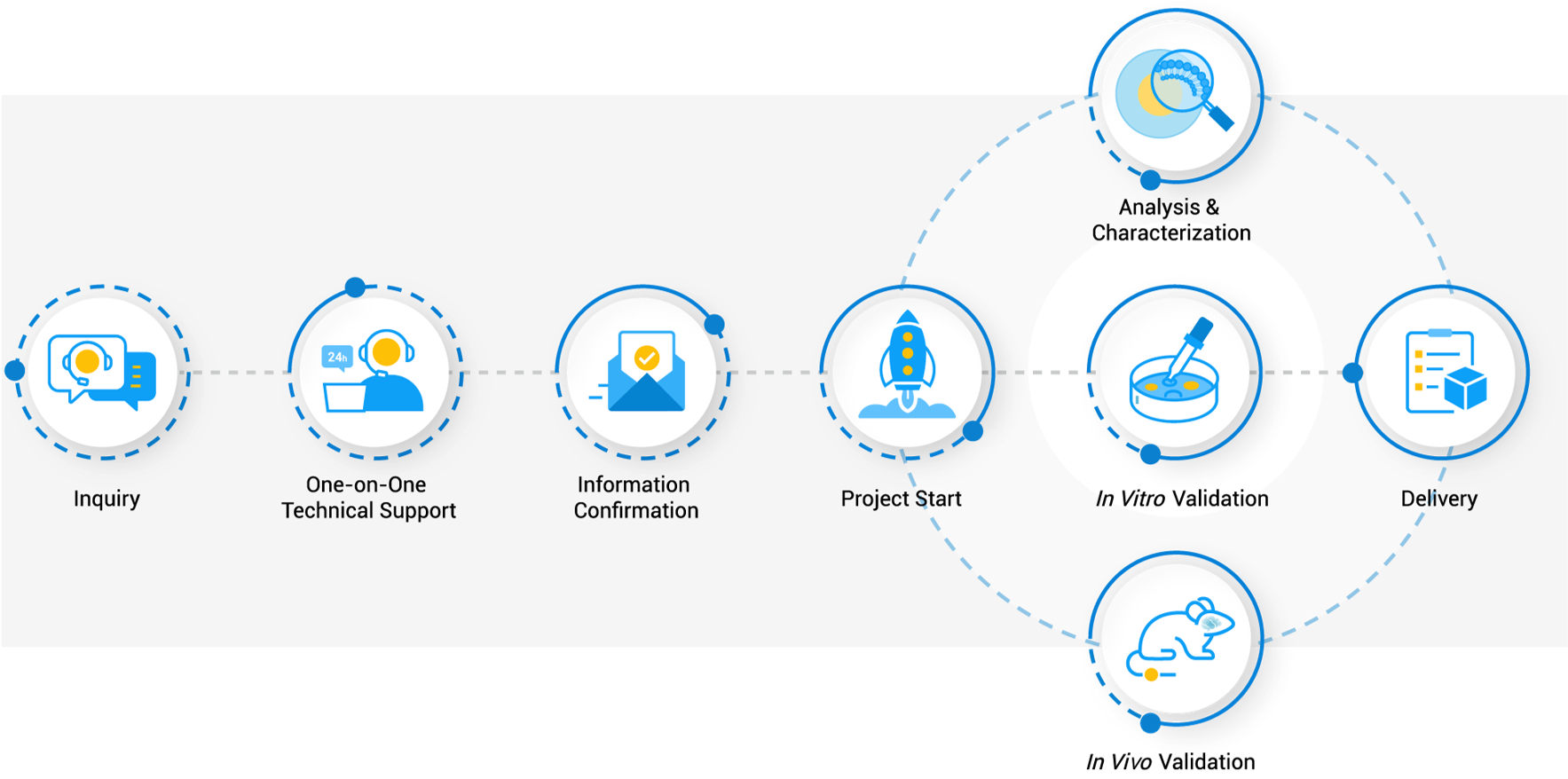
Workflow
FAQ
Q: What is a Fibrosarcoma Targeting Module?
A: A drug delivery system that specifically targets fibrosarcoma cells to enhance drug effectiveness and minimize side effects.
Q: How is targeting achieved?
A: By using agents like peptides, antibodies, or aptamers that bind to fibrosarcoma-specific markers, often delivered via nanoparticles.
Q: How is specificity tested?
A: Through cell binding assays, flow cytometry, in vivo imaging, and histopathology to ensure accurate targeting of fibrosarcoma cells.
Our services are For Research Use Only. We do not provide services to individuals.
Online Inquiry