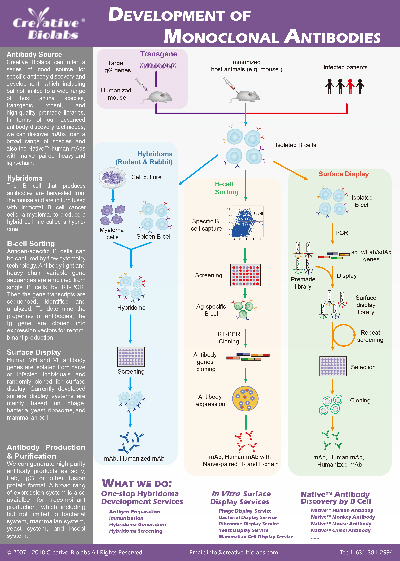
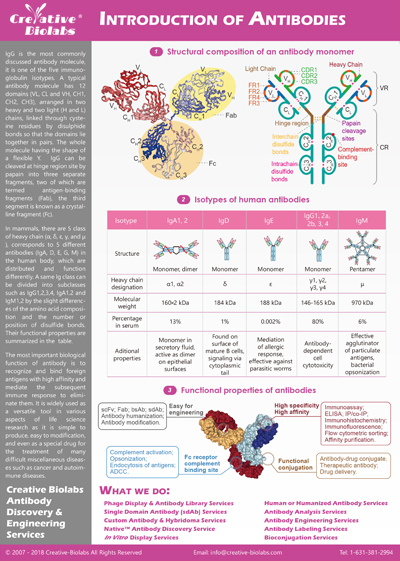
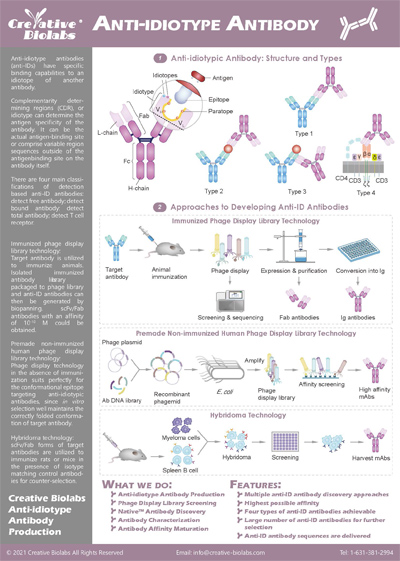
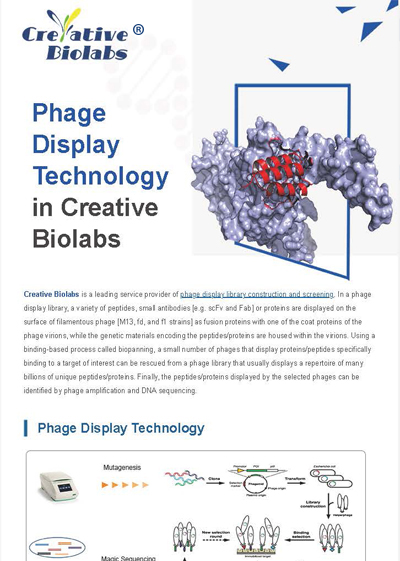
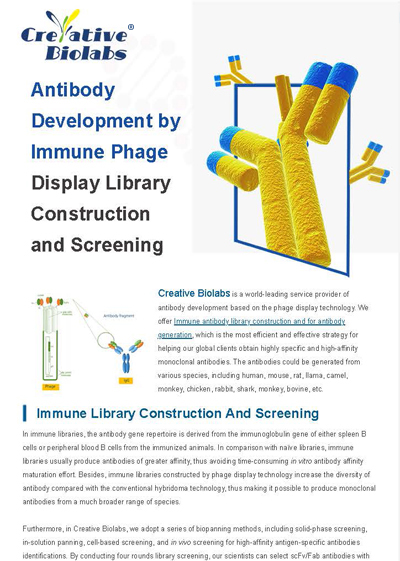
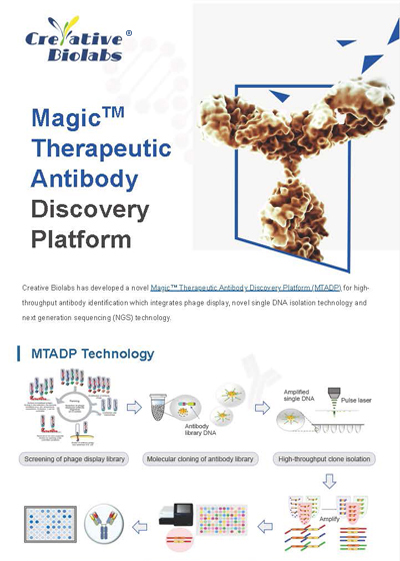
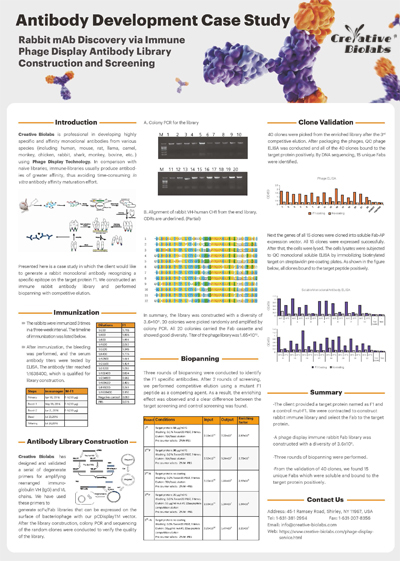
Creative Biolabs is offering the most comprehensive services for antibody development projects. With strict regulation and effective execution, we are dedicated to providing the most valuable solutions to complete your projects.
HighlightsCreative Biolabs is offering the most comprehensive services for antibody development projects. With strict regulation and effective execution, we are dedicated to providing the most valuable solutions to complete your projects.
HighlightsCreative Biolabs has established a broad range of platforms for developing novel antibodies or equivalents. These cutting-edge technologies enable our scientists to meet your demands from different aspects and tailor the most appropriate solution that contributes to the success of your projects.
HighlightsWith deep understanding in antibody-related realms and extensive project experience, Creative Biolabs offers a variety of references to help you learn more about our capacities and achievements, including infographic, flyer, case study, peer-reviewed publications, and all kinds of knowledge that can assist your projects. You are also welcome to contact us directly for more specific solutions.
HighlightsGet a real taste of Creative Biolabs, one of the most professional custom service providers in the world. We are committed to providing highly customized comprehensive solutions with the best quality to advance your projects.
HighlightsThe complexity and heterogeneity of tumor microenvironments present major challenges to the development of precise cancer-targeting therapies and diagnostics. At Creative Biolabs, we harness the power of in vivo phage display to overcome these challenges, enabling the identification of peptides that home selectively to tumor tissues in living models. Unlike in vitro methods that often fail to replicate the real-time biodistribution and cellular interactions of tumor biology, our approach ensures that only biologically viable and functionally relevant candidates are selected.
With extensive expertise in oncology-targeted molecular screening, Creative Biolabs offers specialized services designed to support preclinical therapeutic design, companion diagnostics, and tumor-targeted delivery vehicles. We help you identify what works—not just in theory, but in the living system.
Our tumor-targeting in vivo phage library screening services are designed for researchers pursuing specific tumor tropism in the following applications:
Each screening campaign is fully customizable based on tumor type, xenograft model, administration route (i.v., i.p., etc.), and downstream goals such as therapeutic targeting or biomarker discovery. We'd be happy to discuss customized solutions tailored to your needs.
Our refined workflow includes:





For a personalized quote, please reach out to us.
Creative Biolabs' tumor-targeting phage display platform is engineered to replicate real-life complexity. It doesn't stop at affinity—it also evaluates biodistribution, tumor penetration, and interaction with the tumor stroma and vasculature.
This comprehensive screening framework is capable of accommodating libraries of over a billion unique clones per experiment, maximizing the chance of discovering unique, disease-relevant ligands. Importantly, our in vivo screen respects physiological barriers such as immune clearance, non-specific retention, and metabolic breakdown—ensuring that the identified ligands are not only selective but stable and deliverable.

Our screens occur in live models, not petri dishes—capturing the true behavior of peptide candidates under physiological conditions.
Every project is customized to your tumor model, research objectives, and preferred analysis method.
Libraries containing >10⁹ clones increase the probability of discovering novel tumor-specific ligands.
Integration of sequencing, statistical enrichment analysis, and motif clustering ensures you receive results that are actionable, not just descriptive.
If you're interested in tailored solutions, don't hesitate to get in touch.
At the completion of your tumor-targeting in vivo phage display campaign, Creative Biolabs provides a comprehensive data and materials package designed to support both immediate follow-up experiments and long-term translational goals. You will receive:
Follow-up consultation with Creative Biolabs scientists is included to help interpret the results and plan your next steps. Let Creative Biolabs help you uncover peptides that make a difference—in the lab and beyond. Reach out today for a custom quote or free consultation with one of our scientists.
Use the resources in our library to help you understand your options and make critical decisions for your study.

All listed services and products are For Research Use Only. Do Not use in any diagnostic or therapeutic applications.