Creative Biolabs is offering the most comprehensive services for antibody development projects. With strict regulation and effective execution, we are dedicated to providing the most valuable solutions to complete your projects.
HighlightsCreative Biolabs is offering the most comprehensive services for antibody development projects. With strict regulation and effective execution, we are dedicated to providing the most valuable solutions to complete your projects.
HighlightsCreative Biolabs has established a broad range of platforms for developing novel antibodies or equivalents. These cutting-edge technologies enable our scientists to meet your demands from different aspects and tailor the most appropriate solution that contributes to the success of your projects.
HighlightsWith deep understanding in antibody-related realms and extensive project experience, Creative Biolabs offers a variety of references to help you learn more about our capacities and achievements, including infographic, flyer, case study, peer-reviewed publications, and all kinds of knowledge that can assist your projects. You are also welcome to contact us directly for more specific solutions.
HighlightsGet a real taste of Creative Biolabs, one of the most professional custom service providers in the world. We are committed to providing highly customized comprehensive solutions with the best quality to advance your projects.
HighlightsIn the development of antibody-based therapeutics and high-sensitivity diagnostics, binding affinity is a critical determinant of success. A lead antibody candidate, while specific, may possess insufficient affinity to achieve the desired potency, efficacy, or limit of detection.Creative Biolabs, a 20-year veteran in antibody engineering, provides an industry-leading Antibody Affinity Maturation service. We employ a sophisticated suite of in vitro evolution and rational design strategies to dramatically increase the affinity of your antibody, often by 10- to 100-fold or more, driving your project from a promising lead to a best-in-class candidate.Our services refine the antigen-binding sites (CDRs) to achieve significantly enhanced on-rates and, most critically, slower off-rates, resulting in antibodies with picomolar or even femtomolar binding affinities.
The journey of antibody discovery often yields "hit" antibodies with micromolar to nanomolar affinities. While functional, this level of binding may be insufficient for demanding applications:
Antibody Affinity Maturation is the targeted in vitro process that breaks this performance ceiling.
Affinity maturation is a process that mimics the body's own immune response—specifically, somatic hypermutation (SHM) and clonal selection within the germinal center. Our in vitro platforms replicate this natural evolution on an accelerated timeline.
The core principle involves two steps:
Diversification: Introducing a large spectrum of mutations, typically within the Complementarity-Determining Regions (CDRs) that form the antigen-binding pocket (paratope).
Selection: Applying stringent selection pressure to isolate only those rare mutant antibodies that exhibit improved binding kinetics to the target antigen.
By iterating this process, we can "evolve" an antibody toward picomolar affinity.
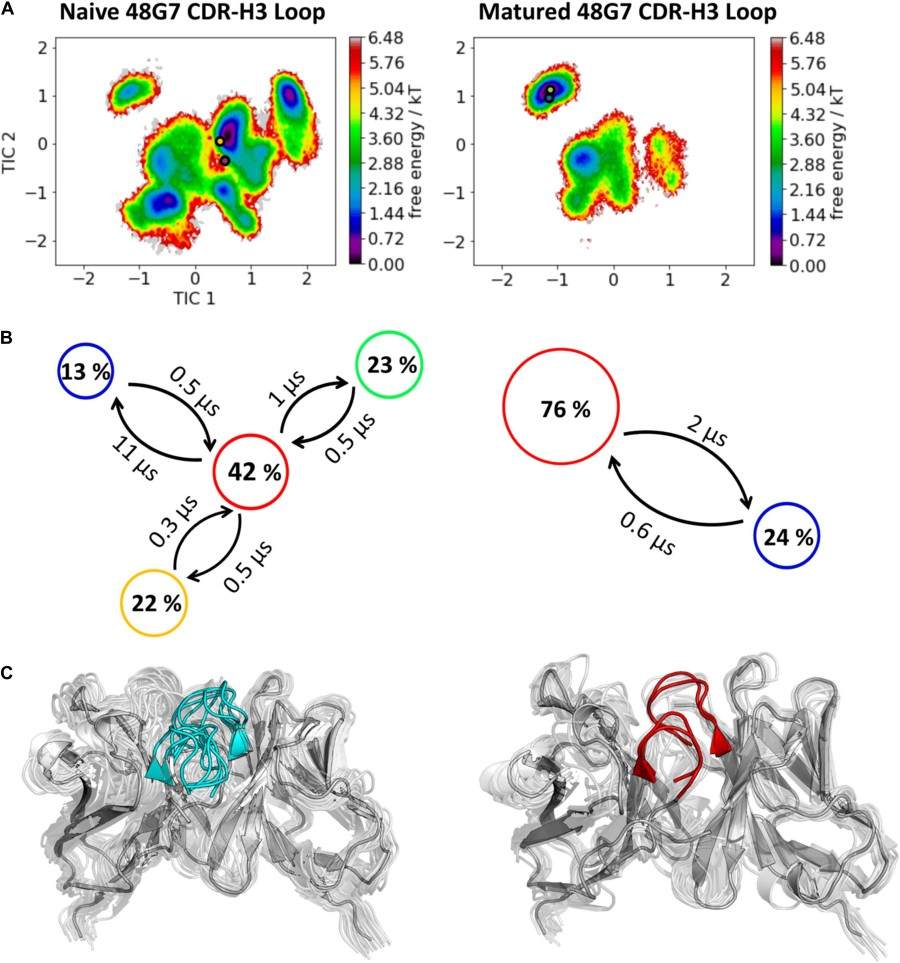 Fig. 1 Kinetic, thermodynamic and structural analyses of the CDR-H3 loop ensemble in solution upon affinity maturation.1
Creative Biolabs does not believe in a one-size-fits-all solution. We tailor our strategy to your project's specific goals, antigen type, and starting antibody format. Our technological portfolio is comprehensive and integrates the latest advancements in molecular biology and computational design.
Phage display remains a robust and highly effective workhorse for affinity maturation. By displaying antibody fragments (scFv or Fab) on the surface of M13 bacteriophages, we can construct libraries of immense diversity (up to 10^11 unique variants).
Strategy: We generate diversity through targeted mutagenesis of key CDRs (often H3, L3, or all six) using methods like:
Selection Process (Biopanning): Libraries are panned against the target antigen under increasingly stringent conditions. To specifically select for high affinity, we employ:
NGS Integration: We utilize Next-Generation Sequencing (NGS) to analyze the enriched phage pools, providing deep data on sequence convergence and identifying promising candidate families beyond just the dominant clones.
Yeast display offers unparalleled precision. The antibody fragment (scFv or single-chain Fab) is expressed on the yeast cell surface as a fusion to the Aga2p protein. This eukaryotic system provides superior protein folding and quality control.
For therapeutic antibodies, screening in the final format (full-length IgG) and in a mammalian system is the gold standard. Our proprietary mammalian display platform expresses full-length IgGs on the surface of HEK293 or CHO cells.
Leverage the power of computational biology to accelerate your project. This "rational design" approach minimizes library size and maximizes success rates.
We manage your project with full transparency and a milestone-based approach.
Creative Biolabs offers an end-to-end solution for your antibody program. Explore our related services to complement your affinity maturation project:
Don't let suboptimal affinity hold back your research. Partner with Creative Biolabs to engineer antibodies with the potency and sensitivity your project demands. Our team of experts is ready to design a custom affinity maturation strategy to meet your precise specifications.
Q: How much can you improve my antibody's affinity?
A: A typical antibody affinity maturation project at Creative Biolabs yields a 10- to 100-fold improvement in binding affinity. In many cases, we have successfully achieved improvements of over 1,000-fold, pushing antibodies from the nanomolar range well into the picomolar range.
Q: What materials do I need to provide to start a project?
A: The ideal starting material is the sequence (FASTA format) of the parental antibody's heavy and light chain variable regions. Alternatively, we can start with a hybridoma cell line, purified antibody protein (for sequencing), or DNA constructs. You will also need to provide the target antigen (protein, peptide, etc.) or its sequence for us to produce.
Q: What is the difference between phage display and yeast display for affinity maturation?
A: Phage display uses biopanning, a selection-based method that is excellent for screening massive libraries (>10^10) and isolating binders. Yeast display uses FACS, a quantitative screening method. This allows us to precisely measure the affinity of millions of individual clones and sort them, which is often superior for fine-tuning affinity and selecting for other properties like high expression simultaneously.
Q: Will the affinity maturation process compromise my antibody's specificity or stability?
A: This is a known risk in any mutagenesis process. However, our strategies are designed to mitigate this. We often avoid mutating residues in CDRs that are critical for specificity. Furthermore, we can incorporate counter-selection steps (screening against homologous proteins) to remove cross-reactive clones. Stability and expression are monitored, especially when using our yeast and mammalian display platforms. We also offer downstream Antibody Stability Improvement services if needed.
Q5: What is "off-rate selection," and why is it so important?
A: Affinity is the ratio of the off-rate to the on-rate. For most therapeutic and diagnostic applications, a slow off-rate (meaning the antibody stays bound to its target for a long time) is more critical than a fast on-rate. Off-rate selection is a technique used during biopanning where we introduce a competitor agent, ensuring that only the phage/yeast that "hold on" the tightest survive the selection.
All listed services and products are For Research Use Only. Do Not use in any diagnostic or therapeutic applications.