Creative Biolabs is offering the most comprehensive services for antibody development projects. With strict regulation and effective execution, we are dedicated to providing the most valuable solutions to complete your projects.
HighlightsCreative Biolabs is offering the most comprehensive services for antibody development projects. With strict regulation and effective execution, we are dedicated to providing the most valuable solutions to complete your projects.
HighlightsCreative Biolabs has established a broad range of platforms for developing novel antibodies or equivalents. These cutting-edge technologies enable our scientists to meet your demands from different aspects and tailor the most appropriate solution that contributes to the success of your projects.
HighlightsWith deep understanding in antibody-related realms and extensive project experience, Creative Biolabs offers a variety of references to help you learn more about our capacities and achievements, including infographic, flyer, case study, peer-reviewed publications, and all kinds of knowledge that can assist your projects. You are also welcome to contact us directly for more specific solutions.
HighlightsGet a real taste of Creative Biolabs, one of the most professional custom service providers in the world. We are committed to providing highly customized comprehensive solutions with the best quality to advance your projects.
HighlightsIn the rapidly evolving landscape of biotherapeutics and diagnostic development, the precision of lead identification is the cornerstone of success. Traditional solid-phase panning techniques, while foundational, often grapple with limitations such as target denaturation, restricted epitope accessibility, and high background noise. To transcend these barriers, Creative Biolabs has engineered a premier Solution-Sorting Strategy based Library Screening Service. Leveraging over two decades of prowess in antibody engineering and phage display technology, our platform transition screening from static surfaces to dynamic, native-like liquid environments. This Solution-phase Strategy based Phage Display ensures that the interaction between the library (be it scFv, Fab, VHH, or peptide) and the target protein mimics physiological conditions, yielding candidates with superior affinity, specificity, and developability.
The core philosophy of our Solution-Sorting Strategy based Library Screening lies in the thermodynamic and kinetic advantages of liquid-phase interactions. When a target is immobilized on a plastic surface (solid-phase), it often undergoes conformational changes, hiding critical "hot-spot" epitopes or exposing non-native hydrophobic patches that attract "sticky" non-specific phages. In contrast, our liquid-phase Strategy based Library Screening allows the target molecule to remain in a fully soluble, correctly folded state. By performing the binding step in solution, we can precisely control the concentration of both the target and the library, allowing for the selection of binders based on specific Kd requirements.
Table 1. Comparison of Solid-Phase and Solution-Sorting Strategy
| Feature | Solid-Phase Panning | Solution-Sorting Strategy |
| Target State | Immobilized/Denatured potential | Native/Soluble conformation |
| Epitope Accessibility | Restricted (Steric hindrance) | Full 360° Accessibility |
| Kinetics Control | Limited | Highly Precise (Time & Conc.) |
| Background Noise | High (Plastic binding) | Low (Specific capture) |
| Selection Stringency | Fixed | Tunable for High-Affinity |
| Target Complexity | Simple Proteins | GPCRs, Ion Channels, Large Complexes |
Creative Biolabs has integrated several advanced modules into our Solution-Sorting Strategy based phage screening platform. We don't just "run a protocol"; we design a selection ecosystem tailored to the unique biochemical properties of your target.
We utilize ultra-high diversity libraries (up to 1013 variants) including:
The "Sorting" in our Solution-Sorting library screening is achieved through sophisticated capture systems. Once the phage-target complex is formed in the liquid phase, it must be separated from the non-binders. We employ:
To identify the "best of the best," our Solution-Sorting Strategy based Library utilizes off-rate koff selection. By adding an excess of unlabeled target or changing the incubation time, we can selectively enrich clones that stay bound to the target longer, effectively "sorting" out high-affinity binders from the vast population of medium-affinity candidates.
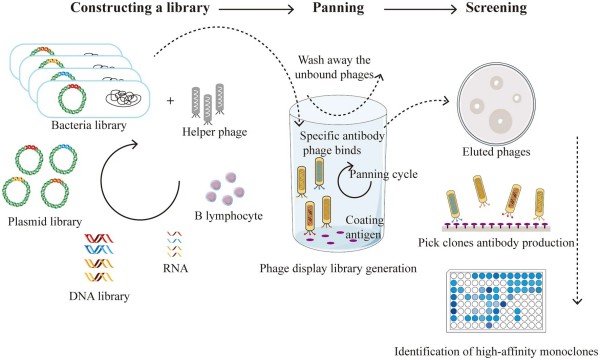 Fig. 1 The basic steps of phage display technology are as follows.1
Our liquid-phase Strategy based Phage Display follows a rigorous, data-driven pipeline designed to maximize the enrichment of positive clones while minimizing the loss of rare, high-potency sequences.
Before initiating the Solution-Sorting Strategy Screening, we conduct a thorough "biophysical audit" of the target. This includes checking for solubility, biotinylation efficiency (if applicable), and conformational integrity via SEC-MALLS or CD spectroscopy.
The library and target are mixed in a optimized buffer system. Unlike solid-phase methods, we can adjust the molar ratio to favor rare binders. This is the hallmark of the Solution-phase Strategy based Library Screening, where the law of mass action is utilized to its full potential.
The phage-target complexes are captured using functionalized micro-beads. Our liquid-phase Strategy Screening employs "negative sorting" or "subtractive panning" during this stage. By pre-incubating the library with non-target proteins or empty beads, we eliminate non-specific binders.
We offer multiple elution strategies:
Enriched phages are amplified in E. coli. Unique to Creative Biolabs, we integrate Sanger Sequencing or Next-Generation Sequencing (NGS) to monitor the enrichment profile after each round. This "Digital Biopanning" allows us to identify promising clones that might be missed by traditional colony picking.
The versatility of the Solution-Sorting Strategy based Library Screening makes it the preferred choice for challenging targets that are incompatible with surface immobilization.
GPCRs are notoriously difficult due to their requirement for lipid environments. We utilize Solution-Sorting Strategy based Library Screening in conjunction with:
If you require an antibody that only binds to the "Active" or "Inactive" state of a protein, our Solution-phase Strategy based Library allows for the addition of small-molecule activators or inhibitors directly into the screening buffer, locking the target into the desired state.
For diagnostic applications, we can perform the liquid-phase library screening directly in diluted serum or other biological matrices, ensuring that the selected binders function effectively in the final application environment.
Upon completion of your screening campaign, Creative Biolabs provides:
Customized deliverables such as large-scale clone expression or peptide synthesis are also available upon request.
As a global leader in Solution-phase Strategy based phage screening platform services, we offer unparalleled expertise:
Learn more about other Phage Display Library Screening Services:
By choosing Creative Biolabs, you are not just selecting a service provider; you are partnering with a team of experts dedicated to the success of your discovery program. Our Solution-Sorting Strategy based Library Screening Service is the bridge between a vast library of possibilities and the one perfect molecule that will drive your research forward.
Reference
All listed services and products are For Research Use Only. Do Not use in any diagnostic or therapeutic applications.