Creative Biolabs is offering the most comprehensive services for antibody development projects. With strict regulation and effective execution, we are dedicated to providing the most valuable solutions to complete your projects.
HighlightsCreative Biolabs is offering the most comprehensive services for antibody development projects. With strict regulation and effective execution, we are dedicated to providing the most valuable solutions to complete your projects.
HighlightsCreative Biolabs has established a broad range of platforms for developing novel antibodies or equivalents. These cutting-edge technologies enable our scientists to meet your demands from different aspects and tailor the most appropriate solution that contributes to the success of your projects.
HighlightsWith deep understanding in antibody-related realms and extensive project experience, Creative Biolabs offers a variety of references to help you learn more about our capacities and achievements, including infographic, flyer, case study, peer-reviewed publications, and all kinds of knowledge that can assist your projects. You are also welcome to contact us directly for more specific solutions.
HighlightsGet a real taste of Creative Biolabs, one of the most professional custom service providers in the world. We are committed to providing highly customized comprehensive solutions with the best quality to advance your projects.
HighlightsThe adaptive immune system depends on antibodies as core components which scientists have transformed into essential biomedical research instruments and revolutionary therapeutic solutions. The specific amino acid sequence is what entirely determines the exquisite specificity and potent effector functions of antibodies. Antibody sequencing determines the primary structure which includes the sequential arrangement of amino acids in variable and constant regions of heavy (H) and light (L) chains.
Antibody sequencing determines both the genetic blueprint and protein structure which establish an antibody's identity and function. Antibody sequencing reveals both the complementarity-determining regions (CDRs) in variable domains (VH and VL) that define antigen specificity and binding strength and the constant regions (Fc) that enable effector functions and antibody isotype determination.
Specialized services become necessary because antibody sequencing combines complexity with vital importance. Creative Biolabs employs advanced technologies and extensive knowledge to deliver custom sequencing solutions which meet the requirements of diverse antibody categories and research requirements. Our sequencing services provide multiple methods including both gene-level hybridoma sequencing and advanced de novo antibody sequencing through mass spectrometry to achieve complete coverage and precise identification of essential post-translational modifications (PTMs).
The approach to sequencing varies depending on the nature of the antibody sample.
Monoclonal antibodies (mAbs) originate from a single B-cell clone and thus possess a single, defined amino acid sequence for their heavy and light chains. They bind specifically to a single epitope on an antigen. Sequencing mAbs typically involves:
MAbs represent a dominant class of biotherapeutics. Accurate monoclonal antibody sequencing is paramount for:
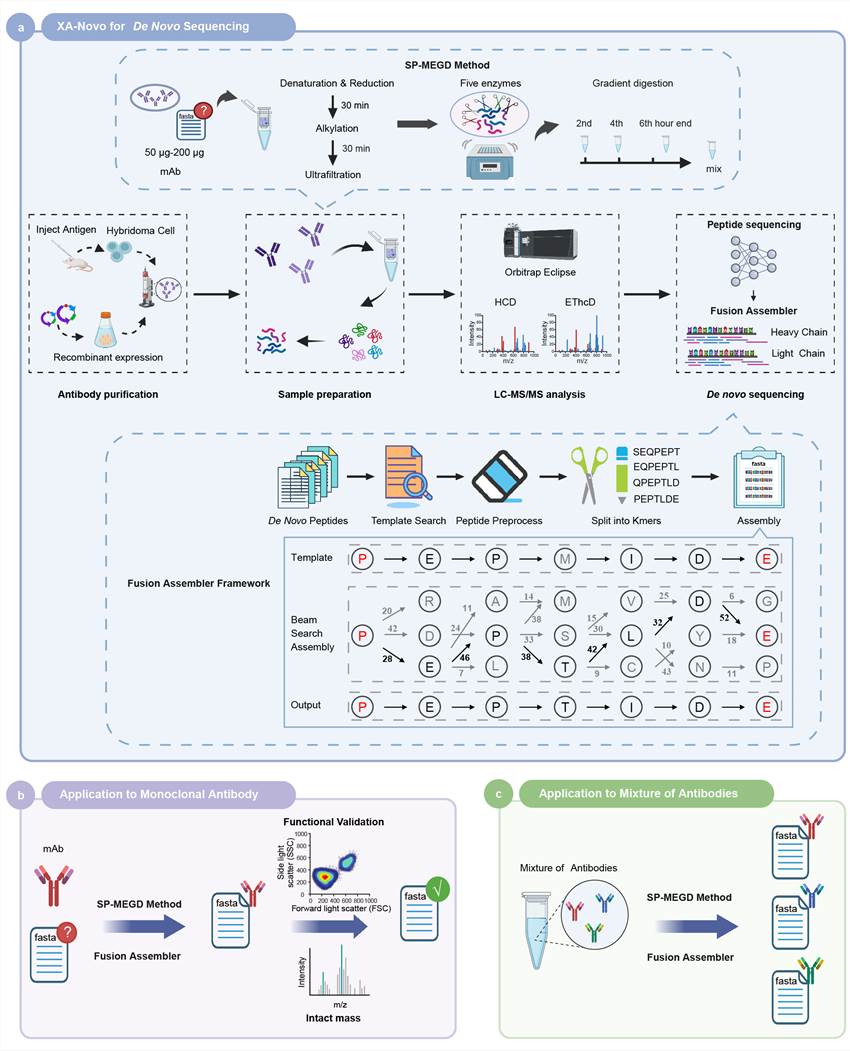 Fig. 1 MS-based de novo sequencing solution of monoclonal antibodies.1
Polyclonal antibodies (pAbs) are derived from multiple B-cell clones and represent a heterogeneous mixture of antibodies targeting various epitopes on a single antigen. This inherent heterogeneity makes them distinct from mAbs.
Sequencing pAbs is inherently complex due to the mixture of sequences. Traditional methods aiming for a single sequence are not applicable. Advanced techniques, primarily NGS of antibody variable region genes from the source B-cell population or sophisticated mass spectrometry combined with bioinformatics, are used to:
Biosimilar medicines represent biologic drugs that share a high degree of similarity with a pre-approved reference (originator) product. Demonstrating analytical similarity to the reference product forms the foundational element of biosimilar development. The comparability exercise requires comprehensive antibody sequencing as its essential element. This process seeks to verify that the biosimilar candidate has the same primary amino acid sequence as the original monoclonal antibody.
Biosimilar sequencing relies on precise side-by-side evaluations through high-resolution techniques such as mass spectrometry. The goal is to:
These methods translate the antibody protein sequence based on its nucleic acid sequence.
Antibody-coding genes are sequenced by extracting mRNA from cells that produce antibodies (such as hybridomas and B cells), creating cDNA through reverse transcription (RT), and amplifying the variable genes VH and VL using PCR with specific or degenerate primers.
The traditional "gold standard" sequencing technique known as Sanger sequencing provides high accuracy for sequencing individual DNA fragments from defined clones such as monoclonal antibodies from hybridomas yet suffers from low sequencing throughput. Next-generation sequencing (NGS) represents a massively parallel sequencing platform that achieves high-throughput analysis. This method works best when dealing with complex samples (pAb repertoires) and when deep sequencing is needed to find rare variants.
Preserving mAb sequences derived from hybridoma cell lines is essential because these sequences are susceptible to instability and loss. The process involves: Perform RNA extraction from hybridoma cells to start the sequencing process. The RT-PCR amplification process specifically targets conserved framework regions that surround variable domains. The amplified VH and VL products undergo sequencing and often require Sanger sequencing for confirmation. Execute bioinformatic analysis to determine functional in-frame sequences of VH and VL gene segments.
These methods directly determine the amino acid sequence from the purified antibody protein itself, providing definitive confirmation and capturing PTMs.
Liquid Chromatography combined with tandem Mass Spectrometry (LC-MS/MS) stands as the leading technique for protein sequencing. Specific proteases are used to break down the antibody into smaller peptide fragments. LC separates the peptide mixture before MS/MS performs the analysis. The mass spectrometer process starts with peptide ionization followed by MS1 mass-to-charge ratio selection before proceeding to fragmentation and subsequent measurement of fragment ion masses (MS2). MS2 spectra provide the necessary data to determine the sequence of peptides. Advantages of MS-based method include high sensitivity, high accuracy, ability to identify PTMs and sequence variants, confirmation of disulfide bond linkages.
This method uses mass spectrometry to identify peptide sequences straight from MS/MS fragmentation patterns without needing to reference an established sequence database. This is crucial for: a) Sequencing antibodies that lack any genetic data through this method. b) Confirming sequences obtained via genetic methods. The method allows scientists to analyze antibodies from unknown sources and complex mixtures. d) Identifying unexpected modifications or sequence variants.
An older chemical method that sequentially removes N-terminal amino acids for identification. Limitations of Edman Degradation: Require relatively large amounts of pure protein, is slow and low-throughput, struggles with PTMs and blocked N-termini, largely superseded by MS techniques for comprehensive antibody sequencing.
Table 1. Comparison of Genetic vs. Protein Sequencing Approaches
| Feature | Genetic Sequencing (DNA/RNA) | Protein Sequencing (MS-based) |
| Analyte | DNA / mRNA | Protein / Peptides |
| Primary Information | Coding sequence (inferred protein sequence) | Actual amino acid sequence |
| PTM Detection | No | Yes (Glycosylation, Oxidation, Deamidation, etc.) |
| Isoform/Variant Detection | Limited (alternative splicing) | Yes (Sequence variants, modifications) |
| Confirmation of Protein | Indirect | Direct |
| Typical Starting Material | Cells (Hybridoma, B-cells, expression host) | Purified antibody protein |
| Key Technique(s) | PCR, Sanger, NGS | LC-MS/MS (de novo, database search) |
| Main Advantage | Access sequence without protein, high-throughput (NGS) | Definitive protein confirmation, PTM analysis |
| Main Limitation | No PTM info, assumes accurate transcript/translation | Requires purified protein, complex bioinformatics |
Sequence knowledge is the starting point for tailoring antibodies for specific purposes:
The creation of biologic drugs starts with sequencing which supports all stages from initial discovery and lead selection through process development and manufacturing control (CMC) to regulatory submission.
Ensuring the reliable performance of antibodies in in vitro diagnostic (IVD) kits requires sequence confirmation for batch consistency and binding characteristics validation.
Sequence information validates the identity of commercial or in-house antibody reagents, combating the reproducibility issues caused by poorly characterized binders. It ensures researchers are using the correct tool for their experiments.
Hybridoma cell lines have potential instability issues that include the loss of antibody production and contamination problems. By sequencing the VH and VL genes researchers can "rescue" and store the antibody sequence for recombinant production which protects research resources and therapeutic candidates.
Whether dealing with monoclonal, polyclonal, or biosimilar antibodies, determining the precise amino acid sequence provides critical information for ensuring identity, functionality, safety, and regulatory compliance. At Creative Biolabs, by integrating cutting-edge technologies with decades of experience, we provide robust and accurate antibody sequencing services, empowering our clients to accelerate their discovery pipelines.
Learn more about Creative Biolabs' de novo antibody sequencing services:
All listed services and products are For Research Use Only. Do Not use in any diagnostic or therapeutic applications.