
Creative Biolabs is offering the most comprehensive services for antibody development projects. With strict regulation and effective execution, we are dedicated to providing the most valuable solutions to complete your projects.
HighlightsCreative Biolabs is offering the most comprehensive services for antibody development projects. With strict regulation and effective execution, we are dedicated to providing the most valuable solutions to complete your projects.
HighlightsCreative Biolabs has established a broad range of platforms for developing novel antibodies or equivalents. These cutting-edge technologies enable our scientists to meet your demands from different aspects and tailor the most appropriate solution that contributes to the success of your projects.
HighlightsWith deep understanding in antibody-related realms and extensive project experience, Creative Biolabs offers a variety of references to help you learn more about our capacities and achievements, including infographic, flyer, case study, peer-reviewed publications, and all kinds of knowledge that can assist your projects. You are also welcome to contact us directly for more specific solutions.
HighlightsGet a real taste of Creative Biolabs, one of the most professional custom service providers in the world. We are committed to providing highly customized comprehensive solutions with the best quality to advance your projects.
HighlightsCreative Biolabs provides world-class hybridoma isotype identification and switching services, providing comprehensive solutions for antibody characterization and engineering based on cutting-edge technology and extensive expertise. With our services, customers can gain a deeper understanding of their antibodies' functions, optimize their development processes, and expand the potential of their antibody-based applications.
The immunoglobulin (Ig) isotype, or class, is intrinsically determined by the constant region of the Ig gene, which constitutes the antibody's Fc portion. This Fc region is pivotal, as the specific function of an antibody isotype is directly dictated by its selective binding to Fc receptor molecules expressed on various immune effector cells. Consequently, distinct isotype expression patterns serve as critical indicators, reflecting the diverse maturation stages characteristic of a B lymphocyte. Initially, naive B cells, characterized by their unmutated variable genes, co-express IgM and IgD isotypes primarily through a sophisticated process of alternative splicing. However, the subsequent expression of other antibody isotypes, such as the human IgG1-4, IgA1-2, and IgE subclasses, is stringently dependent upon a meticulously regulated process known as class-switch recombination (CSR), which is triggered following initial antigen exposure.
CSR represents a profoundly fundamental biological mechanism within the humoral immune response. Its core function is to facilitate a B cell's irreversible transition from producing one Ig isotype to another. A classic example is the switch from IgM production to IgG following the primary encounter with an antigen during immunization. Crucially, this intricate process involves a precise genetic rearrangement that specifically alters the constant region of the antibody heavy chain while rigorously preserving the variable region. This preservation ensures that the antigen specificity of the antibody remains entirely unaltered. Therefore, while the antibody maintains its original high affinity for the same antigens, it simultaneously acquires the capacity to interact with a diverse array of effector molecules. This remarkable adaptation allows the antibody to modulate its downstream immune functions, leading to different immunological outcomes tailored to the specific nature of the pathogen or immune challenge.
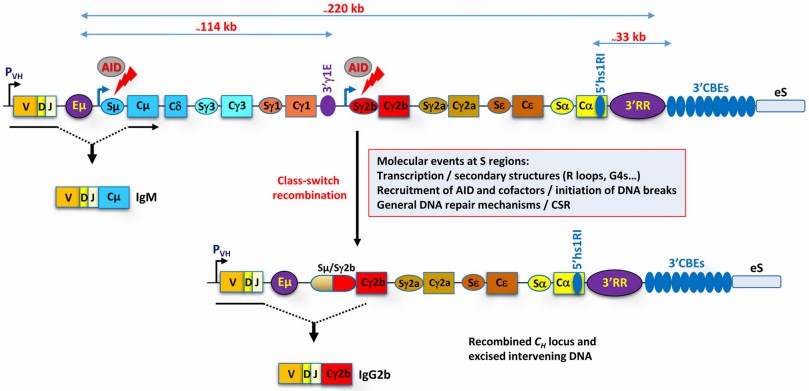 Fig.1 Rearranged the mouse IgH locus.1
Creative Biolabs provides isotype identification and switches among the five main Ig classes, in which IgG1, IgG2, and IgG4 have been used as engineering therapeutic antibodies. More recently, IgA, IgM, and IgE have been used to adjust the recombinant molecules better to the targeted application (e.g. regarding half-life, effector functions, etc.). Notably, we can produce chimeric antibodies with different Fc domains using our unique cloning cassettes for all antibody classes and subclasses of the human (IgA, IgD, IgM, IgE, IgG1, IgG2, IgG3, and IgG4) and mouse (IgA, IgD, IgM, IgE, IgG1, IgG2a, IgG2b, and IgG3) species.
Cloning Vectors Available:
| Species | Heavy Chain | Light Chain |
| Human | IgG1, IgG2, IgG3, IgG4 | Igκ, Igλ2 |
| Mouse | IgG1, IgG2a, IgG2b, IgG3 | Igκ, Igλ1, Igλ2 |
| Rabbit | IgG1 | Igκ1, Igκ2, Igλ |
| Rat | IgG2b | Igκ, Igλ |
Isotype identification is a fundamental step in antibody characterization, providing critical insights into its biological function. The isotype of an antibody directly influences its effector mechanisms, including complement activation, ADCC, and binding to Fc receptors on immune cells. Knowing the isotype allows researchers to select the most appropriate antibody for a specific application. For example, if the goal is to elicit a strong ADCC response, an IgG isotype might be preferred. Furthermore, accurate isotype identification is essential for developing reliable immunoassays and ensuring the quality control of antibody-based products.
Isotype switching plays a pivotal role in expanding the therapeutic potential of monoclonal antibodies. By changing the isotype of an antibody, it is possible to modify its effector functions and pharmacokinetic properties, thereby optimizing its efficacy and safety in clinical applications. For instance, switching an antibody to an isotype with a longer half-life can improve its therapeutic efficacy by reducing the frequency of administration. Additionally, isotype switching can be used to generate antibodies with enhanced ADCC activity for cancer immunotherapy or to create antibodies that are better suited for mucosal immunity.
As one of the most competitive biotechnology companies in the word, creative Biolabs has extensive expertise and experience to provide you with custom hybridoma and recombinant antibody development services. Our services are tailored for each project to ensure that the objectives are met or exceeded. For more information, please do not hesitate to for more details.
All listed services and products are For Research Use Only. Do Not use in any diagnostic or therapeutic applications.








