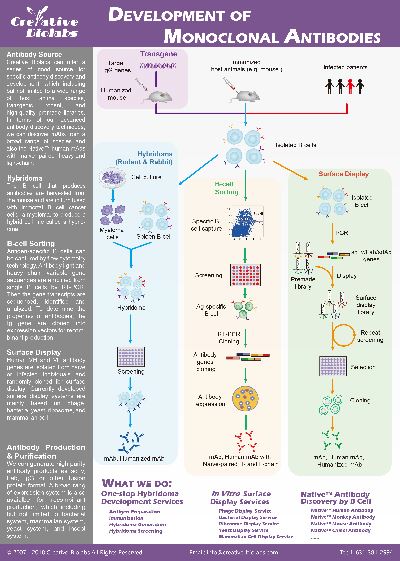
Creative Biolabs is offering the most comprehensive services for antibody development projects. With strict regulation and effective execution, we are dedicated to providing the most valuable solutions to complete your projects.
HighlightsCreative Biolabs is offering the most comprehensive services for antibody development projects. With strict regulation and effective execution, we are dedicated to providing the most valuable solutions to complete your projects.
HighlightsCreative Biolabs has established a broad range of platforms for developing novel antibodies or equivalents. These cutting-edge technologies enable our scientists to meet your demands from different aspects and tailor the most appropriate solution that contributes to the success of your projects.
HighlightsWith deep understanding in antibody-related realms and extensive project experience, Creative Biolabs offers a variety of references to help you learn more about our capacities and achievements, including infographic, flyer, case study, peer-reviewed publications, and all kinds of knowledge that can assist your projects. You are also welcome to contact us directly for more specific solutions.
HighlightsGet a real taste of Creative Biolabs, one of the most professional custom service providers in the world. We are committed to providing highly customized comprehensive solutions with the best quality to advance your projects.
Highlights
The domestic dog (Canis lupus familiaris) has emerged as an invaluable model in biomedical research, offering unique insights into a spectrum of human diseases, including cancers, autoimmune disorders, and inherited genetic conditions. Their outbred nature, shared environment with humans, and spontaneous disease development provide a translational bridge that is often more clinically relevant than traditional rodent models.
Unlock the Power of the Canine Immune System. Request a Quote Today.
| Advantage | Description |
| Outbred genetic diversity | Reflects the genetic heterogeneity seen in human populations. |
| Shared living environment | Enables study of environmental and lifestyle factors influencing disease. |
| Spontaneous disease occurrence | Naturally develops cancers and immune disorders similar to those in humans. |
| Translational relevance | Provides more predictive insights for human therapeutic development than rodent models. |
Central to understanding the canine immune response—whether to pathogens, autoantigens, or neoplastic cells—is a deep and quantitative characterization of the B-cell receptor (BCR) repertoire. The BCR repertoire represents the complete collection of B-cell receptors within an individual, a dynamic and diverse library of immunoglobulins (Igs) shaped by genetic recombination, somatic hypermutation (SHM), and antigen-driven selection.
 Immune system status and history
A molecular snapshot of past and ongoing immune events.
Clonal expansions
Identification of B-cell clones responding to vaccines, infections, or tumors.
Antibody diversity
Analysis of public (shared) vs. private (individual-specific) antibody responses.
Therapeutic monitoring
Tracking immune reconstitution following treatment or transplantation.
| Characteristic | Significance |
| IGHV1 subgroup dominance | Evolutionarily analogous to human IGHV3, influencing antibody architecture. |
| Distinct VH CDR3 patterns | Unique loop lengths and amino acid compositions affecting antigen binding. |
| Species-specific repertoire organization | Requires specialized analytical tools and bioinformatics pipelines. |
A comprehensive analysis is therefore critical for researchers aiming to develop novel canine therapeutics and vaccines, dissect mechanisms of autoimmune disease, or investigate B-cell malignancies. Creative Biolabs provides a sophisticated, end-to-end service to empower researchers to explore this complex immunological space with unprecedented depth and precision.
Explore the Depth of Canine BCR Diversity — Talk to Our Experts.
At Creative Biolabs, we offer a comprehensive, turnkey solution for Canine BCR Repertoire Profiling. Our service is designed to guide investigators from biological samples to actionable bioinformatics data, encompassing every critical step with rigorous quality control.
Workflow Overview
| Category | Description |
| Starting Materials | • Peripheral Blood Mononuclear Cells (PBMCs) — ideal for circulating B-cell repertoire analysis.• Bone Marrow Aspirates — provide access to developing and mature B-cell populations.• Spleen Tissue — rich source of antigen-experienced B lymphocytes.• Extracted Total RNA — suitable for cases where cell preservation is limited, pending QC validation. |
| Flexibility | Compatible with a broad range of experimental designs and research goals. |
| Low-Input Compatibility | Optimized for rare B-cell subsets or limited-volume samples without compromising repertoire diversity. |
| Core Amplification Workflow | Proprietary method targeting immunoglobulin heavy (IGH) and light (IGK/IGL) chain variable region transcripts. |
| Analytical Focus |
High-fidelity capture of Complementarity-Determining Region 3 (CDR3) diversity — the central determinant of antigen-binding specificity. The service provides a complete picture of the repertoire, including:
|
The final deliverable is a comprehensive data package containing raw sequencing data, processed files, and an in-depth bioinformatics report complete with publication-quality visualizations and statistical analyses.
Accelerate Your Research with Our Canine BCR Profiling Expertise. Get in Touch.

Our Canine BCR Repertoire Profiling service is powered by an integrated platform that combines state-of-the-art molecular biology with a robust bioinformatics pipeline — engineered for maximum accuracy, coverage, and reproducibility.
Transform Your Samples into Insightful Immunological Data. Contact Us Now.
The detailed insights generated by our Canine BCR Repertoire Profiling service have far-reaching applications across veterinary medicine and translational science.

Discover What the Canine Immune Repertoire Can Reveal. Schedule a Discussion.
Our expertise in immune repertoire analysis extends beyond the canine model. Creative Biolabs has established optimized platforms for a diverse array of species, reflecting their unique importance in basic and applied research. Our services include:

Choosing Creative Biolabs for your canine BCR repertoire analysis provides a distinct set of advantages rooted in deep scientific expertise and technological superiority.
As a global leader in immune repertoire sequencing, we possess years of dedicated experience specifically focused on the complexities of the canine immune system.
Every project is managed by our team of highly qualified scientists, who provide expert consultation from experimental design through to data interpretation, ensuring your project's scientific objectives are met.
Our commitment to using unbiased amplification techniques and a proprietary, species-specific bioinformatics pipeline guarantees data of the highest quality and accuracy.
We offer a seamless, one-stop solution that simplifies your research workflow, saving you time and resources while ensuring consistency and quality at every step.
Our optimized protocols allow for comprehensive repertoire analysis even from precious or limited biological samples.
From Sample to Discovery — See How Our Platform Delivers Unmatched Resolution.
Turn Data into Discovery — Learn More About Our Canine BCR Profiling Service.
Use the resources in our library to help you understand your options and make critical decisions for your study.

All listed services and products are For Research Use Only. Do Not use in any diagnostic or therapeutic applications.