
Creative Biolabs is offering the most comprehensive services for antibody development projects. With strict regulation and effective execution, we are dedicated to providing the most valuable solutions to complete your projects.
HighlightsCreative Biolabs is offering the most comprehensive services for antibody development projects. With strict regulation and effective execution, we are dedicated to providing the most valuable solutions to complete your projects.
HighlightsCreative Biolabs has established a broad range of platforms for developing novel antibodies or equivalents. These cutting-edge technologies enable our scientists to meet your demands from different aspects and tailor the most appropriate solution that contributes to the success of your projects.
HighlightsWith deep understanding in antibody-related realms and extensive project experience, Creative Biolabs offers a variety of references to help you learn more about our capacities and achievements, including infographic, flyer, case study, peer-reviewed publications, and all kinds of knowledge that can assist your projects. You are also welcome to contact us directly for more specific solutions.
HighlightsGet a real taste of Creative Biolabs, one of the most professional custom service providers in the world. We are committed to providing highly customized comprehensive solutions with the best quality to advance your projects.
HighlightspH-sensitive bioactive peptides have become powerful molecular tools for basic science investigations, especially in projects seeking to understand how environmental acidity modulates biomolecular activity, protein–membrane interactions, or compartment-specific signaling events. Unlike antibodies or protein scaffolds, peptides provide researchers with compact architecture, fast synthesis cycles, and highly tunable behavior—all characteristics that make them ideal for pH-responsive design.
Creative Biolabs has extensive experience mapping pH-triggered conformational changes, affinity transitions, and functional switches in short peptide sequences. By pairing this expertise with high-diversity phage display technologies, Creative Biolabs offers researchers an efficient pathway to explore peptide behaviors across defined pH gradients. This introductory page provides a structured overview of the scientific rationale, technology foundation, and practical benefits of discovering pH-sensitive peptides through phage display.
To explore how these insights can support your research, Creative Biolabs' scientific team welcomes inquiries.
Many biological systems—endosomes, lysosomes, plant vacuoles, inflammatory tissues—exhibit dynamic pH fluctuations. Peptides capable of responding precisely to these shifts serve as sensitive probes for these environments.
Peptides can fold, unfold, or alter charge states instantly with pH changes. Such properties allow direct observation of pH-dependent transitions without steric limitations typical of large protein domains.
Current research trends include interest in histidine-rich motifs, charge-reversal sequences, conditional α-helical transitions, and peptides that display differential binding to membranes or proteins under specific pH intervals.
Phage display enables highly selective recovery of peptides that exhibit reversible or irreversible pH-dependent conformational behavior, allowing researchers to "fish out" precise pH-triggered sequences from large pools.
If you're evaluating pH-responsive mechanisms in your system, Creative Biolabs is ready to discuss how tailored peptide panels can be integrated into your study design.
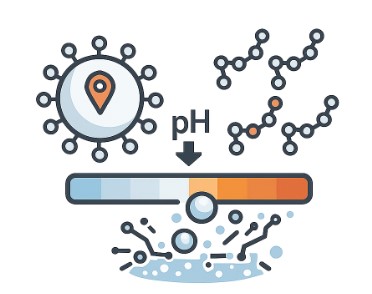
For investigators whose work involves peptides that disrupt membranes selectively under acidic conditions, Creative Biolabs provides a dedicated resource outlining how such pH-activated lytic sequences can be identified through phage display. This companion page highlights key sequence features associated with controlled lytic activity and explains the pH selection logic Creative Biolabs uses to isolate high-value candidates. |
If any of these discovery directions align with your research needs, Creative Biolabs can help you define a tailored screening plan—reach out to us to get started.



If you're tracking current trends and seeking a partner experienced in pH-regulated sequences, Creative Biolabs is ready to collaborate.
 Purpose-Built for Basic Science
Creative Biolabs designs every project for mechanistic discovery, not therapeutic development.
Highly Configurable Screening Conditions
Researchers can select the pH intervals, co-factors, membrane mimetics, ionic strengths, or protein targets used during phage selection.
Diverse Library Formats
Creative Biolabs offers synthetic, semi-synthetic, rationally biased, motif-enriched, and random peptide libraries.
Support for Multiple Peptide Classes
Linear peptides, constrained peptides, helical motifs, and environment-activated peptides are all compatible with Creative Biolabs' platform.
Transparent Experimental Tracking
Researchers receive detailed documentation describing behavior across screening rounds.
Integrated Pathway to Follow-Up Services
For deeper exploration, Creative Biolabs supports downstream optimization, pH-shift assays, and peptide behavior modeling.
Connect with Creative Biolabs to find out which advantages are most relevant to your research system.
pH-sensitive bioactive peptide discovery is a rapidly evolving field that offers new ways to explore environmental cues in biological systems. With high-diversity libraries, configurable selection parameters, and a strong foundation in phage display methodologies, Creative Biolabs enables researchers to access finely tuned molecular tools for studying acidity-driven phenomena. Whether your work involves biochemical mapping, intracellular tracking, membrane interaction analysis, or design of pH-responsive biomolecular systems, Creative Biolabs provides the scientific infrastructure needed to support your goals. Our team welcomes discussions regarding project planning, methodological options, and integration with downstream discovery workflows. Contact Creative Biolabs today to begin shaping your next pH-sensitive peptide research campaign.
All listed services and products are For Research Use Only. Do Not use in any diagnostic or therapeutic applications.








