Creative Biolabs is offering the most comprehensive services for antibody development projects. With strict regulation and effective execution, we are dedicated to providing the most valuable solutions to complete your projects.
HighlightsCreative Biolabs is offering the most comprehensive services for antibody development projects. With strict regulation and effective execution, we are dedicated to providing the most valuable solutions to complete your projects.
HighlightsCreative Biolabs has established a broad range of platforms for developing novel antibodies or equivalents. These cutting-edge technologies enable our scientists to meet your demands from different aspects and tailor the most appropriate solution that contributes to the success of your projects.
HighlightsWith deep understanding in antibody-related realms and extensive project experience, Creative Biolabs offers a variety of references to help you learn more about our capacities and achievements, including infographic, flyer, case study, peer-reviewed publications, and all kinds of knowledge that can assist your projects. You are also welcome to contact us directly for more specific solutions.
HighlightsGet a real taste of Creative Biolabs, one of the most professional custom service providers in the world. We are committed to providing highly customized comprehensive solutions with the best quality to advance your projects.
HighlightsIn the rapidly evolving landscapes of nanomedicine, biosensor engineering, and advanced materials, the biotic-abiotic interface remains the ultimate frontier of innovation. Historically, this interface gap has been defined by a lack of molecular precision where low chemical diversity and prohibitive discovery timelines stall progress. The Creative Biolabs Paradigm bridges this gap. By deploying our proprietary 1010 diversity libraries, we eliminate non-specific adhesion and environmental instability at the source. Whether you are functionalizing carbon nanotubes or engineering mineral-specific scaffolds, our platform delivers Clinic-Ready candidates with validated specificity and superior interface kinetics.
The challenge of material-binding discovery lies in the physicochemical heterogeneity of the target surface. Unlike well-defined protein pockets, material surfaces (polymers, metals, minerals) present repetitive lattices or amorphous topologies that require specific spatial orientations of amino acid side chains. Creative Biolabs specialize in identifying peptides that do more than just stick. We isolate sequences that recognize specific crystal planes, polymer architectures, and surface enthalpies. Our screening strategies utilize Advanced Subtractive Biopanning, effectively stripping away non-specific binders to isolate sequences with superior thermodynamic stability at the material interface.
We utilize proprietary blocking agents and tailored elution to isolate peptides that ignore background noise and lock onto your material’s unique electronic signature.
Our platform ensures orientation-specific attachment, preventing the masking of active sites and maximizing the performance of biosensors and hybrid nanostructures.

Targeting cellulose, chitin, lignin, and silk fibroin for sustainable biomaterials and green chemistry applications.
Developing binders for PEG, PLA, PLGA, and PCL to enhance drug delivery vehicle stability and tissue engineering scaffolds.

Isolating high-affinity ligands for organic dyes, toxins, and active pharmaceutical ingredients (APIs) for diagnostic and purification use.

Precision screening for gold, silver, silica, hydroxyapatite, and carbon-based nanomaterials (CNTs, Graphene) to drive bio-nano integration.
Specialized discovery for environmental sensing and filtration, targeting airborne particulates and microplastics.
Creative Biolabs operates on a rigorous, milestone-driven workflow designed to maximize hit rate while minimizing client risk. Our process transitions from raw library diversity to validated molecular leads in typically 4-8 weeks.

Our premade libraries are the engine of your discovery. Each library is meticulously quality-controlled to ensure uniform distribution and the absence of bias.
Discovering functional peptides that bind specifically to soft matter materials (e.g., polymers, hydrogels, biomaterials) is notoriously challenging due to their flexible structures and complex surface chemistries.
In this project, we demonstrate how our Premade Peptide Library Services combining our proprietary Premade TriCo-20 Peptide Library with an advanced, customized biopanning workflow, successfully identified high-affinity, material-specific peptide binders, bypassing the limitations of traditional screening methods.
We implemented an accelerated, data-driven screening and validation pipeline designed to maximize sequence diversity while ensuring ultra-high specificity.
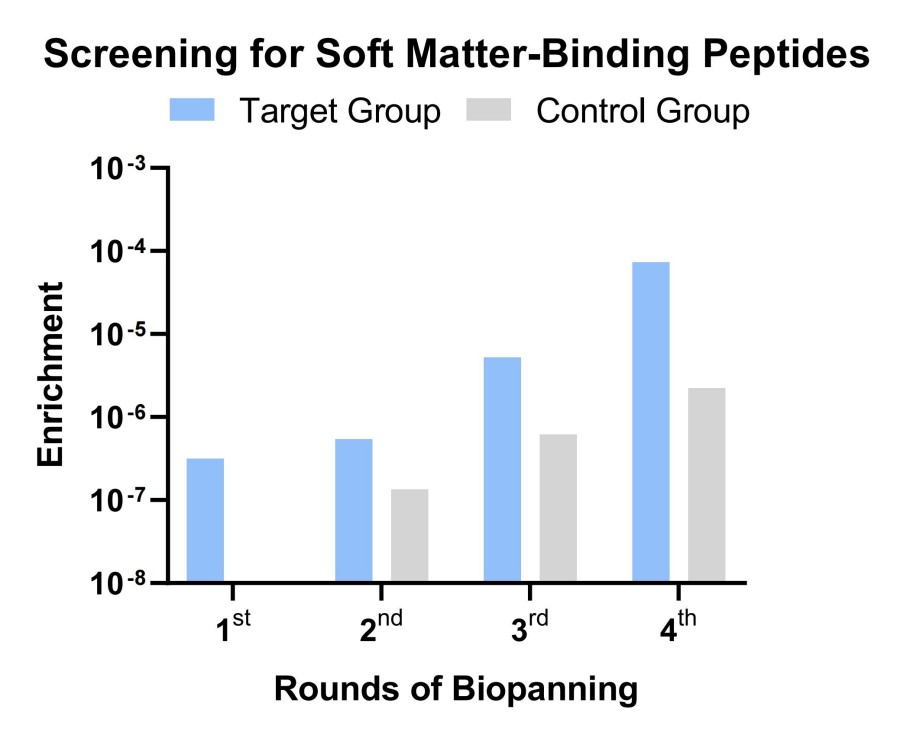
1. Precision Biopanning & Robust Enrichment
2. Dual-Validation Pipeline for Guaranteed Quality
To ensure our client received only the most viable candidates, we combined traditional functional assays with cutting-edge Next-Generation Sequencing (NGS)
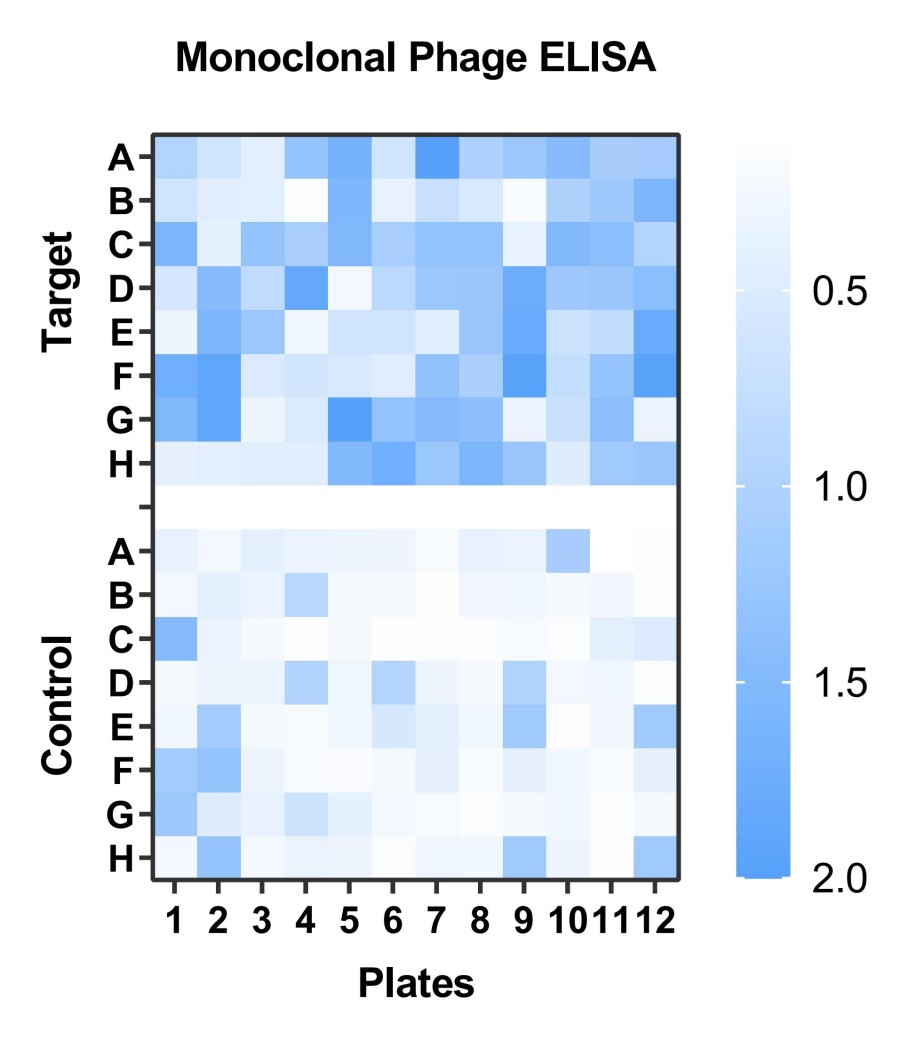
Monoclonal Phage ELISA of 92 randomly selected clones
50% Positive Binding Rate: Half of the screened clones exhibited strong binding activity, confirming the high efficiency of our enrichment process. Candidates were immediately sequenced for preliminary hit identification.
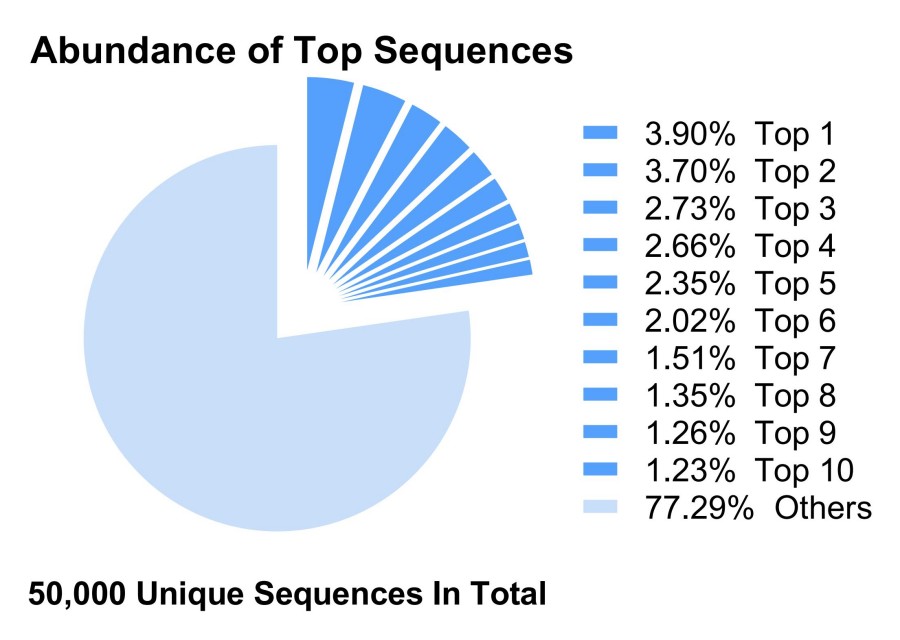
NGS Deep Sequencing of Round-2 Enriched Library
Global Sequence Landscape: By deep-sequencing the early-round pool, we captured millions of data points, mapping the entire enrichment trajectory and uncovering high-affinity motifs that traditional Sanger sequencing might miss.
The Outcome & Client Impact
By merging high-throughput screening with AI-ready NGS datasets, we delivered a curated shortlist of top-ranked peptide candidates directly to the client for internal validation.
Client Feedback & Success:
"The delivered peptides demonstrated exceptional affinity and target specificity, perfectly matching our criteria for soft matter material functionalization. The inclusion of NGS data provided invaluable insights for our downstream R&D."
Creative Biolabs stands at the forefront of phage display technology, offering a level of scientific depth that transcends standard CRO services. Our advantage lies in our combination of scale, precision, and executive scientific oversight.
 Unrivaled Library Diversity
Our 1010 total pool size ensures that even the most obscure surface epitopes are represented, providing a deep well of potential hits.
Proprietary Selection Technologies
We utilize specialized Differential Elution and Negative Subtraction techniques that isolate binders based on thermodynamic stability, ensuring your peptides perform in the field, not just the lab.
Validated Success Rate
We maintain the high success rate across diverse material targets, from industrial polymers to rare-earth oxides.
Scientist-Architected Discovery
Every project is conceptualized and steered by a Senior Principal Scientist. You gain an elite extension of your R&D team, providing high-level data interpretation and strategic troubleshooting that transforms raw sequences into actionable leads.
Expert-Driven Project Stewardship
We bypass the technician-only model by ensuring every campaign is managed by a Senior Principal Scientist. This ensures sophisticated oversight at every gate delivering not just raw data, but the strategic insights and troubleshooting expertise required for complex discovery.
All listed services and products are For Research Use Only. Do Not use in any diagnostic or therapeutic applications.