
Creative Biolabs is offering the most comprehensive services for antibody development projects. With strict regulation and effective execution, we are dedicated to providing the most valuable solutions to complete your projects.
HighlightsCreative Biolabs is offering the most comprehensive services for antibody development projects. With strict regulation and effective execution, we are dedicated to providing the most valuable solutions to complete your projects.
HighlightsCreative Biolabs has established a broad range of platforms for developing novel antibodies or equivalents. These cutting-edge technologies enable our scientists to meet your demands from different aspects and tailor the most appropriate solution that contributes to the success of your projects.
HighlightsWith deep understanding in antibody-related realms and extensive project experience, Creative Biolabs offers a variety of references to help you learn more about our capacities and achievements, including infographic, flyer, case study, peer-reviewed publications, and all kinds of knowledge that can assist your projects. You are also welcome to contact us directly for more specific solutions.
HighlightsGet a real taste of Creative Biolabs, one of the most professional custom service providers in the world. We are committed to providing highly customized comprehensive solutions with the best quality to advance your projects.
HighlightsPeptide mapping, often referred to as "peptide mass fingerprinting" or "peptide profiling," is a powerful analytical technique used to characterize proteins by generating a unique "fingerprint" of their constituent peptides. This fingerprint serves as a molecular signature, enabling comprehensive analysis of protein identity, primary structure, and modifications.
A peptide is a short chain of amino acids linked together by peptide bonds. These bonds form when the carboxyl group of one amino acid reacts with the amino group of another, releasing a molecule of water. Peptides are generally smaller than proteins, typically consisting of 2 to 50 amino acids.
While both proteins and peptides are polymers of amino acids, their primary distinction lies in their size and structural complexity.
| Feature | Peptide | Protein |
| Size | Generally smaller (2-50 amino acids) | Typically larger (>50 amino acids, often hundreds or thousands) |
| Structure | Primarily linear or simple folded structures | Complex 3D structures (primary, secondary, tertiary, quaternary) |
| Function | Diverse, often signaling molecules, hormones, or building blocks | Highly diverse, structural, enzymatic, transport, immune, etc. |
The term "polypeptide" is often used interchangeably with "protein," particularly when referring to a long chain of amino acids that has not yet adopted its final functional three-dimensional structure. Technically, a polypeptide is a polymer of many amino acids linked by peptide bonds. Proteins are essentially one or more polypeptides folded into specific, functional 3D structures.
Peptide mapping is paramount in the biopharmaceutical industry for several critical reasons, primarily focusing on the characterization and quality control of therapeutic proteins. Its importance stems from its ability to provide detailed structural information, which is crucial for ensuring the safety, efficacy, and consistency of biopharmaceutical products.
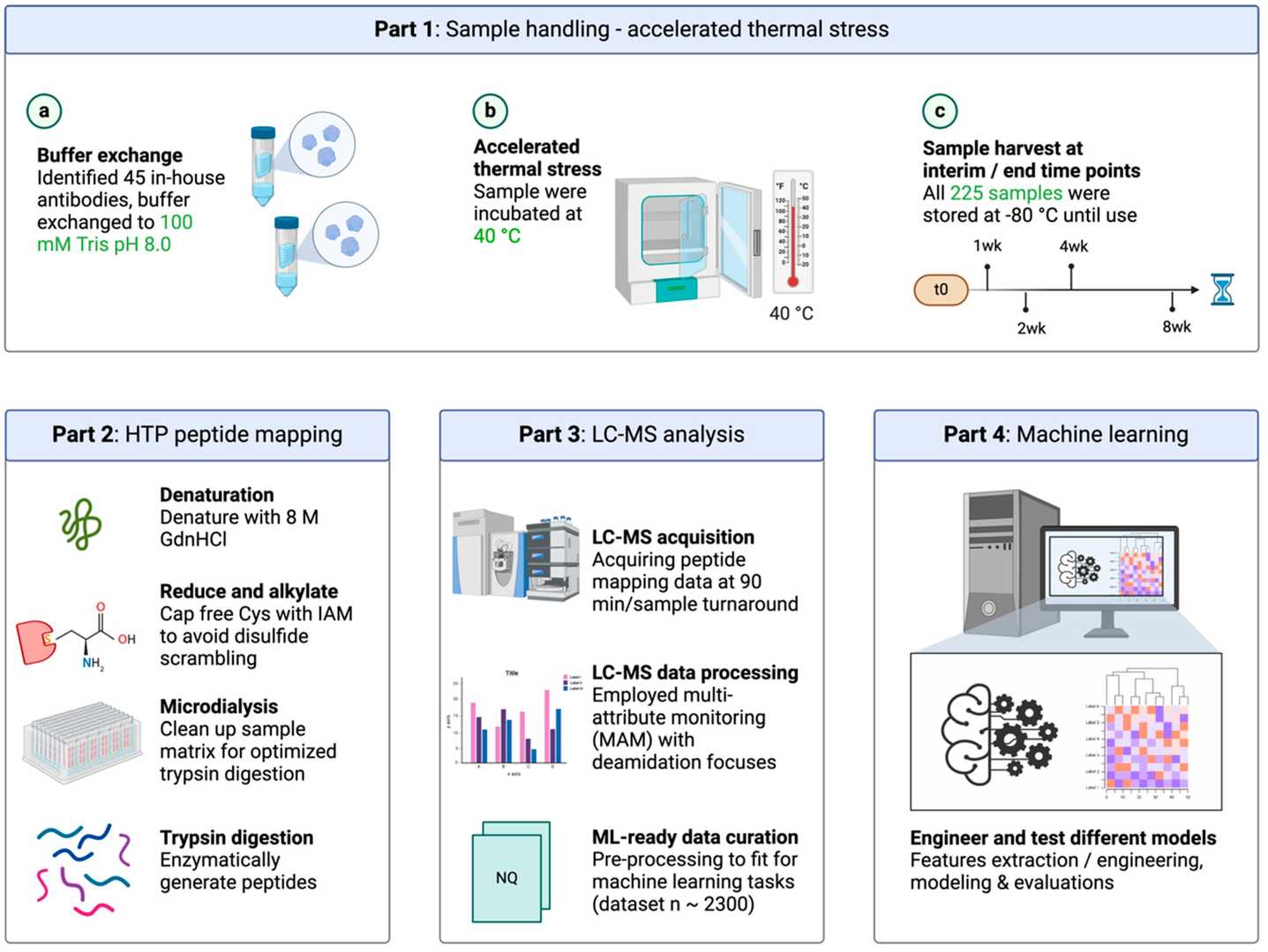 Fig. 1 Development of a systematic workflow to predict therapeutic antibody deamidations.1
The versatility of peptide mapping lies in the combination of various analytical techniques, each contributing unique information to the overall characterization.
Tryptic peptide analysis is the most widely used and fundamental step in peptide mapping. The enzyme trypsin specifically cleaves peptide bonds at the carboxyl side of lysine (K) and arginine (R) residues, unless followed by proline (P). This enzymatic digestion generates a reproducible set of peptides with characteristic masses, forming the "tryptic map."
Mass spectrometry (MS) is the core technology that enables the detection and accurate mass measurement of the generated peptides. This information is then used to identify the peptides and, by extension, the parent protein.
Table 1. Comparison of MALDI-TOF MS and LC-MS/MS for Peptide Mapping
| Feature | MALDI-TOF MS | LC-MS/MS |
| Separation | No pre-separation, direct analysis | High-resolution chromatographic separation |
| Throughput | High | Moderate to high |
| Sequence Info | Limited (primarily mass fingerprint) | Extensive (fragmentation provides sequence) |
| Sensitivity | Moderate to high | High |
| PTM Analysis | Possible, but challenging | Excellent for identification and localization |
| Complexity | Simpler setup and data interpretation | More complex setup and data interpretation |
While LC-MS/MS provides de novo sequencing capabilities, traditional Edman degradation is a well-established method for N-terminal sequencing of peptides. In Edman degradation, amino acids are sequentially cleaved from the N-terminus and identified. While slower and less sensitive than MS-based methods, it remains valuable for confirming N-terminal sequence fidelity.
Peptide fingerprinting, specifically peptide mass fingerprinting (PMF), relies on the characteristic pattern of peptide masses generated after enzymatic digestion. This pattern is compared to a theoretical digest of a known protein sequence from a database. A strong match indicates the identity of the protein. Any deviations in the observed masses or missing peptides can indicate modifications or sequence variations.
Peptide arrays involve synthesizing a library of peptides on a solid surface (e.g., glass slide). These arrays can be used for various applications, including epitope mapping (identifying regions of a protein that antibodies bind to), enzyme activity profiling, and protein-protein interaction studies. While not a primary technique for routine protein characterization in the same vein as MS-based peptide mapping, it is a powerful tool for specific research questions related to peptide interactions and binding.
A typical peptide mapping workflow involves several interconnected steps, from sample preparation to data analysis.
The initial step is crucial for obtaining accurate and reproducible results. It typically involves:
The prepared protein is then subjected to enzymatic digestion. As discussed, trypsin is the most common enzyme due to its specificity and ability to generate peptides within the ideal mass range for MS analysis. Other enzymes (e.g., chymotrypsin, Lys-C, Glu-C) can be used to generate overlapping peptide sets, which is valuable for achieving higher sequence coverage or resolving ambiguities.
Following digestion, the complex mixture of peptides is typically separated before mass spectrometric analysis.
The separated peptides are then introduced into the mass spectrometer for detection and analysis.
Peptide mapping has become an indispensable analytical tool across various stages of biopharmaceutical development and manufacturing.
During the early stages of biopharmaceutical development, comprehensive characterization is paramount. Peptide mapping provides:
In manufacturing, peptide mapping is a critical quality control (QC) attribute for ensuring product consistency and safety.
PTMs are covalent modifications to proteins that occur after protein synthesis. They are crucial for regulating protein function, localization, and interactions. Peptide mapping is the gold standard for PTM analysis.
In conclusion, peptide mapping has the ability to provide highly detailed structural information about proteins and peptides makes it indispensable for ensuring the quality, safety, and efficacy of therapeutic biopharmaceuticals. At Creative Biolabs, we leverage our extensive expertise and state-of-the-art platforms to provide comprehensive peptide mapping services. Meanwhile, we offer de novo antibody sequencing and de novo protein sequencing services, powered by our propriety DASS (Database Assisted Shotgun Sequencing) technology to meet the diverse protein research needs of our clients, driving innovation and advancement in the field of biomedical science.
Learn more about Creative Biolabs' de novo antibody sequencing services:
All listed services and products are For Research Use Only. Do Not use in any diagnostic or therapeutic applications.








