Creative Biolabs is offering the most comprehensive services for antibody development projects. With strict regulation and effective execution, we are dedicated to providing the most valuable solutions to complete your projects.
HighlightsCreative Biolabs is offering the most comprehensive services for antibody development projects. With strict regulation and effective execution, we are dedicated to providing the most valuable solutions to complete your projects.
HighlightsCreative Biolabs has established a broad range of platforms for developing novel antibodies or equivalents. These cutting-edge technologies enable our scientists to meet your demands from different aspects and tailor the most appropriate solution that contributes to the success of your projects.
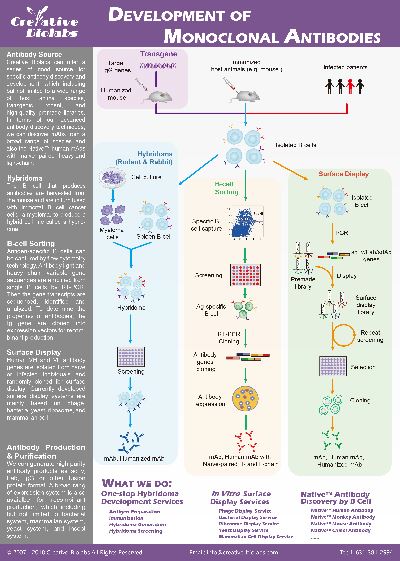
HighlightsWith deep understanding in antibody-related realms and extensive project experience, Creative Biolabs offers a variety of references to help you learn more about our capacities and achievements, including infographic, flyer, case study, peer-reviewed publications, and all kinds of knowledge that can assist your projects. You are also welcome to contact us directly for more specific solutions.
HighlightsGet a real taste of Creative Biolabs, one of the most professional custom service providers in the world. We are committed to providing highly customized comprehensive solutions with the best quality to advance your projects.
Highlights
The humoral immune response, a cornerstone of adaptive immunity, is orchestrated by B lymphocytes, which recognize an immense diversity of antigens via their B cell receptors (BCRs). The BCR is a membrane-bound immunoglobulin composed of a heavy (VH) and a light (VL) chain, the variable domains of which form a unique, antigen-binding paratope. Upon antigen encounter, B cells undergo a sophisticated process of clonal selection, somatic hypermutation (SHM), and class switch recombination to produce high-affinity antibodies that neutralize pathogens and confer long-term immunological memory. A comprehensive understanding of these processes is paramount for the development of effective vaccines, diagnostics, and therapeutics.
| Key Advantage | Impact |
| Preserves VH-VL pairing | Enables faithful reconstruction of native antibodies |
| Single Cell resolution | Captures repertoire diversity at the individual B cell level |
| Dual-modality analysis (BCR + transcriptome) | Links clonotype with functional state, lineage, and phenotype |
| Real-time tracking | Monitors immune responses during infection or vaccination |
| Microenvironment insights | Dissects B cell dynamics in cancer and autoimmune diseases |
Creative Biolabs provides a state-of-the-art Single Cell BCR Profiling Service designed to empower researchers to explore these frontiers with unprecedented precision and depth.
At the core of our service is the proprietary platform, an integrated system engineered for high-throughput, high-fidelity Single Cell immune repertoire analysis. Our platform is built upon a sophisticated microfluidic technology that couples Single Cell partitioning with a unique emulsion-based linkage PCR methodology. This approach physically isolates individual B cells in nano-liter scale droplets, creating discrete reaction chambers for cell lysis, mRNA capture, and reverse transcription.
Our emulsion-based linkage PCR ensures the endogenous pairing of VH and VL chains is maintained, which is critical for the functional reconstruction of monoclonal antibodies.
The platform is capable of analyzing thousands of individual B cells per sample, providing the necessary depth to accurately capture the diversity of the B cell repertoire, including rare clones.
The platform seamlessly integrates 5' gene expression profiling, enabling the direct correlation of BCR sequence with the transcriptional signature of the same cell, thereby elucidating its functional status (e.g., naïve, memory, or plasma cell).
We provide a comprehensive analysis suite that delivers clonotype definition, somatic hypermutation analysis, isotype distribution, and clonal lineage reconstruction, presenting complex data in a clear, publication-ready format.
The Single Cell BCR Profiling Service at Creative Biolabs is a comprehensive, end-to-end solution designed to deliver maximal insight with minimal client-side burden. Our process is refined for precision and efficiency:

Every project begins with a detailed consultation with our scientific team to define experimental goals, select appropriate sample types, and establish a clear project timeline.
We accept a wide range of input materials, including peripheral blood mononuclear cells (PBMCs), purified B cells, and Single Cell suspensions derived from complex tissues such as tumors or lymph nodes. A key advantage of our workflow is its compatibility with both live and cryopreserved cells, offering significant logistical flexibility for sample collection and shipment. Upon receipt, each sample undergoes rigorous quality control, including cell viability and concentration assessment, to ensure optimal data generation.
Viable single cells are loaded onto our microfluidic system for high-efficiency capture and partitioning into emulsion droplets along with magnetic beads for mRNA capture and barcoding reagents.
Following reverse transcription and barcoding within the droplets, our proprietary emulsion linkage PCR is performed to generate paired VH:VL amplicons. These products are then used to construct next-generation sequencing libraries, which are indexed and quantified prior to sequencing.
Libraries are sequenced on our high-throughput platform. The resulting data is processed through our specialized bioinformatics pipeline to perform error correction, V(D)J annotation, pairing, clonotype assembly, and, if requested, integrated analysis with the 5' gene expression data.
Clients receive a comprehensive data package containing raw sequencing files, processed data tables, and a detailed report summarizing key findings, including clonal frequencies, SHM rates, isotype usage, and publication-quality figures illustrating the repertoire landscape.
Explore Your Immune Repertoire Like Never Before. .
The high-resolution data generated by our service has transformative potential across numerous domains of biomedical research and development:
Rapidly identify and screen naturally occurring, high-affinity human antibodies with their native chain pairings from convalescent patients or vaccinated donors. This accelerates the discovery-to-clinic pipeline for novel monoclonal antibody therapeutics against infectious agents, cancer antigens, and other targets.
Delineate the precise B cell clonal lineages that expand and evolve in response to vaccination. This allows for the molecular-level assessment of vaccine efficacy, identification of epitopes targeted by neutralizing antibodies, and rational design of next-generation immunogens.
Interrogate the B cell repertoire within the tumor microenvironment to understand the role of tumor-infiltrating B lymphocytes (TIL-Bs). Characterizing their clonality and functional states can uncover novel prognostic biomarkers and therapeutic targets for immunotherapy.
Deconstruct the B cell-mediated pathology in autoimmune diseases by identifying and characterizing autoreactive clones. In infectious disease, our service enables the tracking of antigen-specific B cell dynamics, providing critical insights into pathogenesis and protective immunity.
Longitudinally monitor the reconstitution and health of the B cell compartment in settings such as hematopoietic stem cell transplantation, immunodeficiency disorders, or during therapeutic interventions. It can also be applied to monitor for minimal residual disease (MRD) in B cell malignancies.
From Data to Discovery — .
Choosing Creative Biolabs for your Single Cell BCR profiling needs provides several distinct advantages:

Our core technology is specifically designed to preserve the endogenous heavy and light chain pairing, eliminating the ambiguity and artifacts associated with computational pairing methods.
Our assay's unique tolerance for non-live cells dramatically simplifies logistics. Researchers can work with fixed or cryopreserved samples from remote clinical sites without compromising data integrity, reducing costs and expanding experimental possibilities.
We have optimized our protocols to minimize reagent consumption while maximizing cell throughput, making deep, Single Cell repertoire analysis more accessible and affordable without sacrificing quality.
Our team consists of seasoned immunologists and bioinformaticians who provide expert guidance from experimental design to data interpretation, ensuring your project yields the most impactful results. We offer customized analysis and collaborative support to help you achieve your research objectives.
Accelerate Your Research. .
Ready to Decode the BCR Landscape? .
Use the resources in our library to help you understand your options and make critical decisions for your study.

All listed services and products are For Research Use Only. Do Not use in any diagnostic or therapeutic applications.