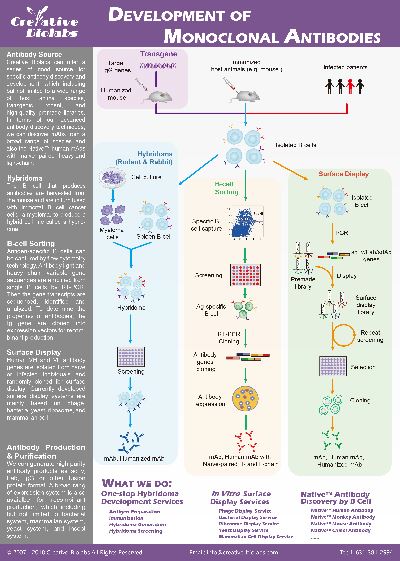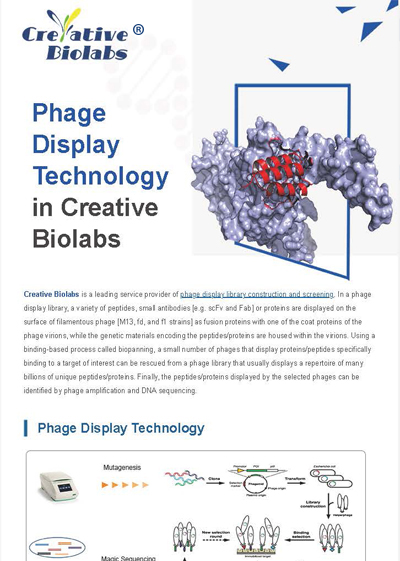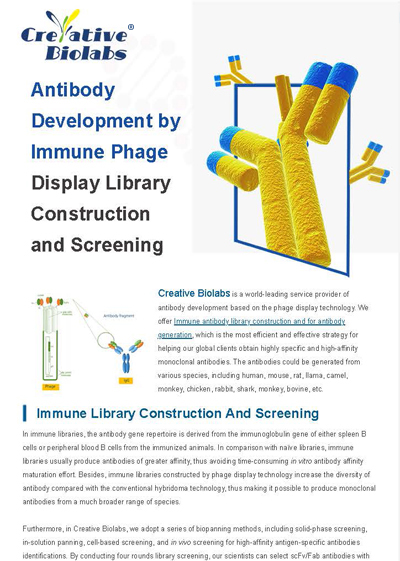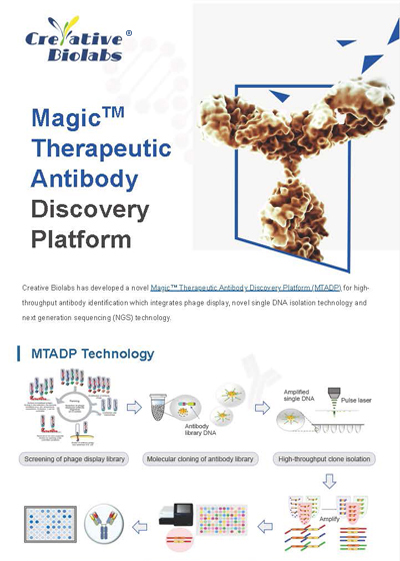
Creative Biolabs is offering the most comprehensive services for antibody development projects. With strict regulation and effective execution, we are dedicated to providing the most valuable solutions to complete your projects.
HighlightsCreative Biolabs is offering the most comprehensive services for antibody development projects. With strict regulation and effective execution, we are dedicated to providing the most valuable solutions to complete your projects.
HighlightsCreative Biolabs has established a broad range of platforms for developing novel antibodies or equivalents. These cutting-edge technologies enable our scientists to meet your demands from different aspects and tailor the most appropriate solution that contributes to the success of your projects.
HighlightsWith deep understanding in antibody-related realms and extensive project experience, Creative Biolabs offers a variety of references to help you learn more about our capacities and achievements, including infographic, flyer, case study, peer-reviewed publications, and all kinds of knowledge that can assist your projects. You are also welcome to contact us directly for more specific solutions.
HighlightsGet a real taste of Creative Biolabs, one of the most professional custom service providers in the world. We are committed to providing highly customized comprehensive solutions with the best quality to advance your projects.
Highlights
The interrogation of the adaptive immune system, particularly the B-cell immunoglobulin (Ig) repertoire, offers profound insights into the mechanisms of humoral immunity. The vast diversity of this repertoire, generated through V(D)J recombination and refined by somatic hypermutation (SHM), is central to the host's ability to recognize and neutralize a virtually limitless array of antigens. Consequently, high-throughput, high-fidelity analysis of Ig repertoires has become an indispensable tool in fields ranging from vaccinology and infectious disease research to oncology and the development of therapeutic antibodies.
Despite its importance, analyzing the B-cell repertoire remains technically demanding due to several biological and methodological factors:
| Challenge | Description | Impact on Data Quality |
| Somatic Hypermutation (SHM) | Introduces numerous closely related sequence variants. | Makes it difficult to distinguish true variants from PCR/sequencing artifacts. |
| PCR Amplification Artifacts | Errors introduced during amplification. | Artificial sequence diversity and inaccurate clonotype identification. |
| mRNA Expression Variability | Different B-cell subsets express Ig mRNA at vastly different levels. | Leads to quantitative bias and skewed clonal representation. |
| Low-Frequency Clone Detection | Biologically relevant rare clones are often underrepresented. | Limits biological insight and discovery potential. |
These technical hurdles have historically made it difficult to obtain a truly accurate, quantitative, and error-free snapshot of Ig diversity, especially for low-frequency clones that may be of significant biological interest.
To surmount these challenges, a paradigm shift in methodology was required.
Key advantages of the molecular barcoding-based approach:
 Molecular Barcoding
Each original mRNA molecule receives a unique sequence tag during reverse transcription.
Error Correction
Enables bioinformatic reconstruction of the original molecular population and removal of PCR/sequencing errors.
Quantitative Accuracy
Allows direct, unbiased quantification of transcripts.
Full-Length Resolution
Facilitates comprehensive analysis of complete Ig heavy and light chain sequences.

This molecular barcoding-based approach transforms repertoire sequencing from a qualitative or semi-quantitative method into a precise, quantitative science, finally enabling the deep and accurate analysis of full-length Ig repertoires that the field has long required.
Uncover the True Diversity of Your Antibody Repertoire. Request a Quote Today.
At Creative Biolabs, we have engineered a robust, end-to-end service for the molecular barcoding-based, full-length profiling of both Ig heavy-chain (IgH) and light-chain (IgL) repertoires from human and mouse samples. Our comprehensive service pipeline is meticulously designed to deliver data of the highest possible quality and biological relevance.
| Stage | Key Process | Purpose & Highlights |
| 1. Sample Processing & Library Preparation | State-of-the-art protocols ensure sample integrity. | Optimized to handle cell-to-cell variation in mRNA expression levels. |
| 2. Molecular Barcoding Tagging (Reverse Transcription Stage) | Each Ig mRNA molecule is uniquely barcoded with a molecular barcoding. | Preserves accurate quantitative and sequence information for every transcript. |
| 3. Amplification & Library Construction | Carefully optimized amplification strategy. | Maintains fidelity and prepares samples for downstream sequencing. |
| 4. Sequencing on Platform | Proprietary high-throughput, long-read sequencing technology. | Captures the complete V(D)J variable region and constant-region segment for isotype identification. |
| 5. Bioinformatics Analysis | Molecular barcoding-based clustering and consensus sequence generation. | Removes PCR/sequencing errors and yields a highly accurate view of repertoire diversity and SHM patterns. |
See What Accurate, Quantitative Profiling Can Do for Your Research. Contact Our Experts.
For researchers seeking the ultimate level of resolution, our service portfolio extends to:
Individual Cell Level Full-Length Immunoglobulin Profiling Service
This advanced offering leverages individual cell partitioning technology to capture and sequence the natively paired heavy and light chains from individual B cells. This service not only provides a high-fidelity map of the Ig repertoire but also preserves the crucial cognate pairing information, which is essential for the functional expression and characterization of monoclonal antibodies.

The successful execution of molecular barcoding-based full-length Ig profiling is critically dependent on the underlying technology. The Creative Biolabs service is built upon an integrated platform optimized at every step for performance, accuracy, and throughput.
A cornerstone of our service is the Sequencing Platform. This platform possesses several key features that are highly advantageous for repertoire analysis:
The platform is engineered to generate long reads of exceptional quality, consistently capturing the entire variable region of IgH and IgL chains. This is a significant advantage over short-read technologies that may fail to cover the full V(D)J sequence, thereby losing critical information related to antigen binding.
The inherent low error rate of the platform, when combined with our molecular barcoding-based computational error correction strategy, results in sequence data with near-perfect accuracy. This fidelity is essential for confidently identifying true somatic hypermutations and distinguishing them from technical noise.
We offer customizable sequencing depth to ensure that even rare B-cell clones, which may be critical in an immune response, are detected and reliably quantified. This depth is vital for applications such as monitoring minimal residual disease or identifying rare neutralizing antibody lineages.
Empower Your Next Discovery with Precision Ig Profiling. Get in Touch.
The highly accurate, quantitative, and full-length Ig repertoire data generated by our service unlocks a vast range of research and clinical applications. By providing a truly clear view of the humoral immune response, we empower scientists to:
Mine the natural human or murine immune repertoire for antibodies with desired specificities. Full-length paired-chain data, in particular, allows for the direct synthesis and screening of promising candidates, dramatically shortening discovery timelines.
Assess the efficacy of vaccine candidates by quantitatively profiling the resulting antibody response. Track the expansion of specific B-cell lineages and map their affinity maturation pathways in response to immunization.
In autoimmunity, our service can be used to identify and track autoreactive B-cell clones. In oncology, it enables the characterization of tumor-infiltrating B lymphocytes and their role in the tumor microenvironment. In infectious disease, it allows for a deep analysis of the antibody response to pathogens, identifying potent neutralizing antibodies.
Investigate the fundamental principles of B-cell biology, including clonal selection, the mechanics of somatic hypermutation, and the development of B-cell memory with unprecedented clarity.
Ready to Explore the Full Potential of Molecular Barcoding? Schedule a Consultation.
Choosing Creative Biolabs for your immunoglobulin profiling needs provides a series of distinct advantages rooted in our scientific expertise and technological superiority.

Transform Your Sequencing Results with Molecular Barcoding Accuracy. Learn More.
Unlock Full-Length Ig Profiling Without Compromise. Get a Free Consultation.
Use the resources in our library to help you understand your options and make critical decisions for your study.

All listed services and products are For Research Use Only. Do Not use in any diagnostic or therapeutic applications.