Creative Biolabs is offering the most comprehensive services for antibody development projects. With strict regulation and effective execution, we are dedicated to providing the most valuable solutions to complete your projects.
HighlightsCreative Biolabs is offering the most comprehensive services for antibody development projects. With strict regulation and effective execution, we are dedicated to providing the most valuable solutions to complete your projects.
HighlightsCreative Biolabs has established a broad range of platforms for developing novel antibodies or equivalents. These cutting-edge technologies enable our scientists to meet your demands from different aspects and tailor the most appropriate solution that contributes to the success of your projects.
HighlightsWith deep understanding in antibody-related realms and extensive project experience, Creative Biolabs offers a variety of references to help you learn more about our capacities and achievements, including infographic, flyer, case study, peer-reviewed publications, and all kinds of knowledge that can assist your projects. You are also welcome to contact us directly for more specific solutions.
HighlightsGet a real taste of Creative Biolabs, one of the most professional custom service providers in the world. We are committed to providing highly customized comprehensive solutions with the best quality to advance your projects.
Highlights Loading...
All listed services and products are For Research Use Only. Do Not use in any diagnostic or therapeutic applications.
The C5 gene, located on chromosome 9q33.2, spans roughly 79 kb and contains 41 exons. C5 is synthesized in the liver as a single-chain precursor of 1,676 amino acids; intracellular proteolytic processing removes the signal peptide and an arginine-rich linker (RPRR), yielding a mature two-chain protein—a 75 kDa β-chain linked by disulfide bonds to a 115 kDa α-chain. The crystal structure of human C5 has been determined at 3.1 Å resolution. Similar to its homolog C3, C5 contains eight macroglobulin-like domains (MG1–MG8), an anaphylatoxin domain (C5a), a C5d domain, a CUB domain, and a C-terminal C345C domain. Unlike C3 and C4, C5 lacks an internal thioester bond. The C345C domain at the C terminus is essential for C5 function, mediating interactions with C5 convertases and binding to the membrane attack complex components C6 and C7 with high affinity.
C5 acts at the convergence point of the early complement pathways—classical, lectin, and alternative—and connects them to the terminal effector cascade. C5 convertases (C3bBbC3b for the alternative pathway, or C4bC2aC3b for the classical and lectin pathways) cleave C5 at the Arg751-Leu752 bond within the α-chain, generating two functionally distinct fragments. The small 74-amino-acid anaphylatoxin C5a (approximately 11 kDa) is one of the most potent pro-inflammatory mediators. It binds to two distinct receptors on immune and non-immune cells: the classical G protein-coupled receptor C5aR1 (CD88) and the non-canonical C5aR2 (C5L2/GPR77), which lacks classical G-protein coupling. Signaling through C5aR1 exerts powerful chemotactic activity that recruits neutrophils, monocytes, and macrophages to sites of infection or tissue injury. C5a also induces degranulation, histamine release, and cytokine production, contributing to increased vascular permeability and smooth muscle contraction. The larger C5b fragment (approximately 180 kDa) exposes a binding site that sequentially recruits C6, C7, C8, and multiple C9 molecules to assemble the membrane attack complex (MAC, C5b-9)—a transmembrane pore structure capable of lysing susceptible pathogens. Through these dual functions—anaphylatoxin-mediated inflammatory signaling and MAC-dependent cytolysis—C5 serves as a critical research target for studies of complement activation, innate immunity, inflammatory pathways, and host defense mechanisms.
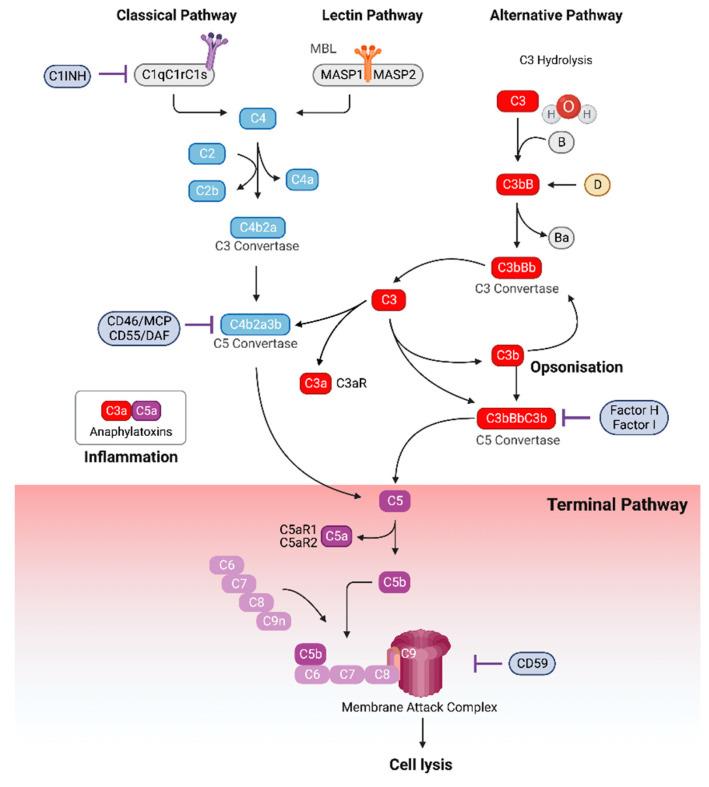 Fig. 1 Complement can be activated through the lectin, classical, and alternative pathway.1
C5, encoded by the C5 gene, functions as the central gateway to the terminal complement pathway through its proteolytic cleavage into two functionally distinct fragments:
Creative Biolabs offers high-quality C5 proteins produced using optimized expression systems, including full-length complement component and purified fragment variants. The C345C domain at the C terminus mediates interactions with C5 convertases and with MAC components C6 and C7, making these proteins suitable for studies of complement activation, convertase recognition, and MAC assembly. All C5 proteins undergo strict quality control to support consistent performance across applicable research platforms.
Not finding the protein product you need? Contact us to start your one-stop custom service!
Creative Biolabs provides custom-engineered C5 stable cell lines, including overexpression and knockdown models. These cell lines are optimized for studies of complement activation pathways, anaphylatoxin signaling, MAC assembly, and host-pathogen interaction mechanisms. Each cell line undergoes stringent validation to ensure stable expression profiles and consistent functional performance in diverse experimental contexts.
Not finding the stable cell line product you need? Contact us to start your one-stop custom service!
High-specificity recombinant antibodies targeting C5 are developed using antibody engineering technologies for research applications involving C5 expression, localization, and protein-protein interaction studies. These antibodies can be used in studies of C5 distribution in relevant cell and tissue models and may also support characterization of C5-containing convertase complexes and MAC assembly in combination with appropriate detection reagents.
Not finding the recombinant antibody product you need? Contact us to start your one-stop custom service!
Beyond catalog products, Creative Biolabs offers specialized custom services for C5 research: