Graphene Oxide based Delivery System Development Service for Targeted Drug Delivery
Graphite oxide and its derivatives possess potential applications in a variety of areas. The drug delivery based on Graphite oxide has attracted ever-increasing interest due to their exceptional physiochemical properties and unique planar structure. As a leader in the field of targeted delivery system, Creative Biolabs is committed to providing the most comprehensive targeted delivery services for our global clients. Now we provide targeted delivery services based on graphene oxide (GO) with the best quality and the most competitive prices.
Graphene Oxide
Graphite oxide, also known as graphitic oxide or graphitic acid, was first described by Oxford chemist Benjamin C. Brodie in 1859. It consists of carbon, oxygen, and hydrogen in variable ratios, obtained by treating graphite with strong oxidizers. The maximally oxidized bulk product is a yellow solid with C:O ratio between 2.1 and 2.9, which resembles the layer structure of graphite but with a much larger and irregular spacing. The bulk material disperses in basic solutions to result in monomolecular sheets, referred to as graphene oxide, the single-layer form of graphite. Graphite oxide is hydrophilic and easily hydrated when exposed to water vapor or immersed in liquid water, leading to a distinct increase of the inter-planar distance. Graphene oxide sheets can be used to prepare strong paper-like materials, membranes, thin films, and composite materials.
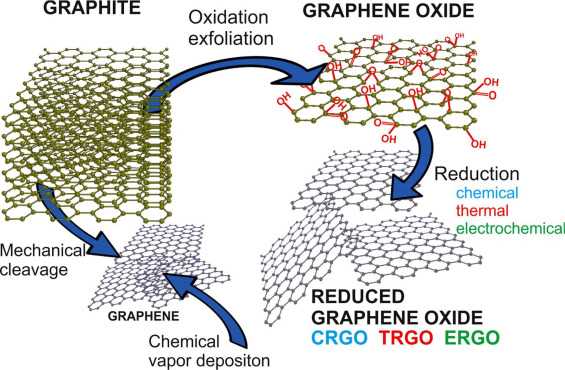 Fig.1 Graphite oxide.1,3
Delivery System Based on Graphene Oxide
As a popular material in material science, graphene oxide and its derivatives harbor potential applications in a number of areas. In recent years, the application of graphene oxide as drug delivery has aroused intensive interest in the biomedical fields including cancer therapy. GO possesses higher drug loading efficiency because the hydrophilic oxygenated functional groups, compared with other nanomaterials, promote its surface modifications via both covalent and noncovalent approaches. Currently, GO has been widely used for drug/gene delivery, cancer photothermal/photodynamic therapy and imaging. In addition, GO derivatives have been exploited for cancer-targeted therapy by binding special groups.
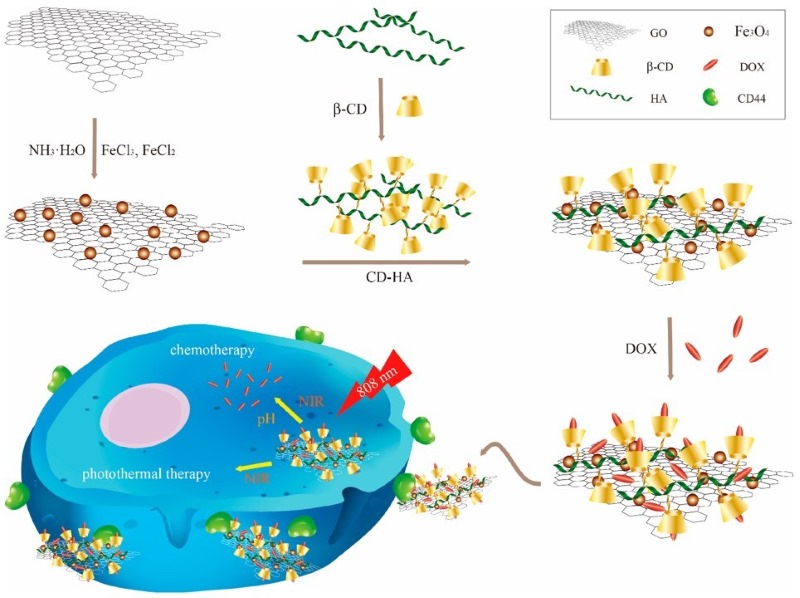 Fig.2 Illustration of the synthesis of β-cyclodextrin–hyaluronic acid polymers grafted with Fe3O4–graphene oxide (CDHA–MGO) for targeted photo-chemotherapy of tumor cells.2,3
A number of scientists have explored GO’s application as a molecular carrier for in vitro and in vivo drug delivery, as well as the successive cancer therapy. For example, Dai group and collaborators have performed the pioneering work on the use of polyethylene glycol (PEG) functionalized GO (PEG-GO) as a nano-carrier to bind water-insoluble anticancer drugs and evaluated its cytotoxicity to the human colon cancer cell. In addition to the function of drug delivery, GO and its derivatives have a wide range of potential applications in the biomedical field, ranging from biosensor, living cell detecting and imaging, antibacterial materials, to biocompatible scaffolds for cell culture.
Features of Our Delivery Services
- High biocompatibility and stability
- Water solubility and low toxicity
- Easy to cross cellular barriers
- Biodegradability and low immunogenicity
Creative Biolabs is capable to provide a large and diversiform portfolio of targeted delivery services based on GO. Our proven and optimized platforms can help our clients quickly get results. We also provide custom services based on the requirements of the clients to meet the specific demand. Please contact us for more information.
References
- Rowley-Neale, Samuel J., et al. "An overview of recent applications of reduced graphene oxide as a basis of electroanalytical sensing platforms." Applied Materials Today 10 (2018): 218-226.
- Liang, Wenting, et al. "β-cyclodextrin–hyaluronic acid polymer functionalized magnetic graphene oxide nanocomposites for targeted photo-chemotherapy of tumor cells." Polymers 11.1 (2019): 133.
- Distributed under Open Access license CC BY 4.0, without modification.