
Pickering Emulsion-Based Delivery Strategies
Pickering emulsion-based delivery strategies are rapidly transforming how researchers stabilize, protect, and release active ingredients across pharmaceuticals, food, and cosmetic formulations. By replacing traditional surfactants with solid particles, these systems deliver exceptional stability and high encapsulation efficiency while supporting cleaner and more biocompatible designs. As R&D teams look for smarter and more reliable delivery platforms, Pickering emulsions offer a powerful, versatile solution. At Creative Biolabs, we help innovators unlock their full potential through advanced formulation and characterization expertise.
Introduction
What Makes Pickering Emulsions Unique?
Pickering emulsions are not just another formulation trend. They offer a different stabilization mechanism that uses solid particles instead of surfactants (Figure 1). Because of this, they meet growing needs for higher stability, cleaner labels, and better performance in complex environments.
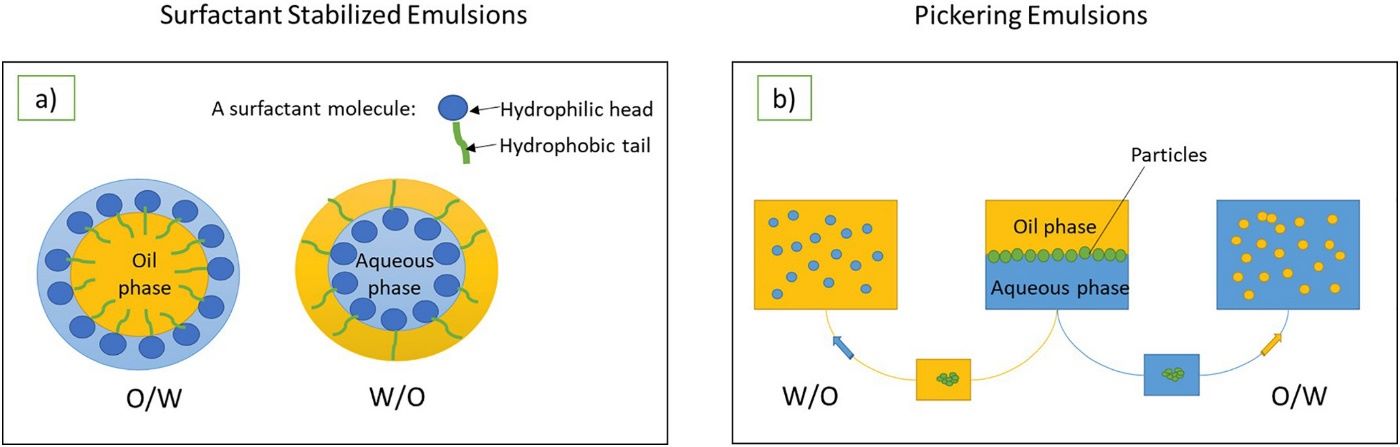 Fig.1
The surfactant-stabilized (a) and particle-stabilized (b) emulsions.2
Fig.1
The surfactant-stabilized (a) and particle-stabilized (b) emulsions.2
For formulation scientists, this means more control over droplet structure, release profile, and compatibility with sensitive actives. For a service provider like Creative Biolabs, it opens up robust options for designing smarter delivery systems across pharmaceuticals, food, cosmetics, and advanced materials.
What Is a Pickering Emulsion?
A Pickering emulsion is an emulsion where solid particles stabilize the interface between two immiscible liquids, most often oil and water. These particles sit at the interface and act like a physical shield around each droplet. Instead of classic surfactants that reduce interfacial tension through molecular adsorption, solid particles form a rigid or semi-rigid shell. This makes the droplets harder to merge and helps keep the emulsion stable over time.
Typical examples include:
- Oil-in-water emulsions stabilized by silica or protein particles
- Water-in-oil systems stabilized by hydrophobic clays or modified polymers
- Complex multiple emulsions for encapsulating sensitive bioactives
This concept has been applied successfully in drug delivery, functional foods, and cosmetic formulations, where both stability and safety are critical.
How Pickering Emulsions Work: Mechanism of Stabilization
The mechanism behind Pickering emulsion-based delivery strategies is simple but powerful, relying on solid particles' unique behavior at the oil-water interface.
Particle adsorption
Solid micro/nanoparticles (e.g., clay, cellulose, silica) spontaneously migrate to the oil-water interface, driven by partial wetting of both phases. As shown in Figure 2, this wetting is quantified by the contact angle (θ): θ < 90°(hydrophilic particles) forms oil-in-water (O/W) emulsions, while θ> 90°(hydrophobic particles) creates water-in-oil (W/O) emulsions—only partially wetted particles anchor effectively (Figure 2).
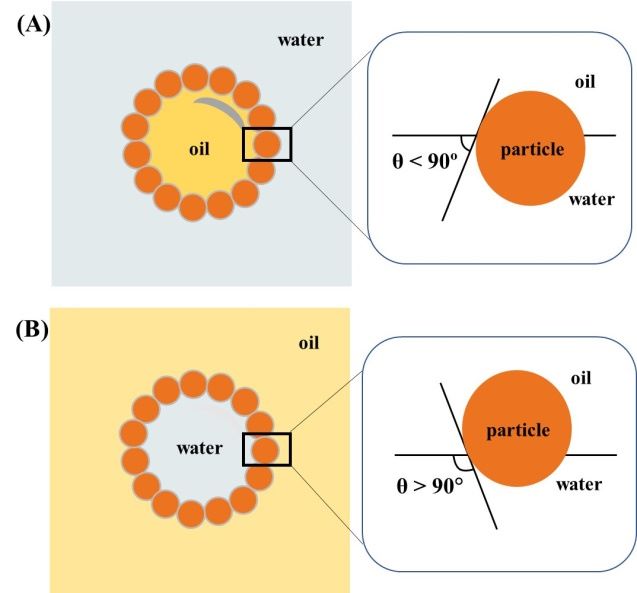 Fig.2
Position of a solid particle at the drop interface with a contact angle of less than/greater than
90° corresponding to the formation of an O/W emulsion / W/O
emulsion.1
Fig.2
Position of a solid particle at the drop interface with a contact angle of less than/greater than
90° corresponding to the formation of an O/W emulsion / W/O
emulsion.1
Interfacial armor
Once adsorbed, particles form a dense, rigid layer (or network) around droplets. Unlike smooth surfactant films, this "armor" acts as a physical barrier, blocking droplet contact and preventing coalescence—critical for preserving encapsulated actives.
Energy barrier to separation
Removing particles from the interface requires significant energy. As a result, the emulsion resists coarsening, flocculation, and phase separation.
Control over droplet size and release
By tuning particle size, shape, and wettability, scientists can influence droplet size distribution and release kinetics of the encapsulated actives.
Note:
A useful way to visualize this is to imagine each droplet wrapped in a thin, granular armor made of particles rather than in a smooth surfactant film.
Advantages of Pickering Emulsion-Based Delivery Systems
Pickering emulsion-based delivery strategies offer several clear advantages over classic surfactant-stabilized systems:
- Superior stability against coalescence, Ostwald ripening, and gravitational separation
- High encapsulation efficiency, especially for hydrophobic or labile compounds
- Lower toxicity and irritation, due to reduced surfactant content
- Tunable release profiles, by modifying particle type, crosslinking, and network density
- Enhanced protection of sensitive bioactives against light, oxygen, pH, or temperature stress
- Alignment with "green" and "clean label" trends, especially when particles are natural or biodegradable
For researchers and R&D teams, this means more reliable delivery performance and greater flexibility in formulation design.
Potential Drawbacks and How to Overcome Them
Despite their strengths, Pickering emulsions are not without challenges:
- Slower equilibration of particle shells
The solid shell may take longer to reach a stable state during processing.
- Droplet-size control
Achieving very narrow size distributions can be harder than in surfactant systems without proper process tuning.
- Particle wettability limits
Some particles may not provide the right balance between the oil and water phases, limiting formulation options.
- Scale-up complexity
Particle distribution and shear conditions must be tightly controlled in large-scale equipment.
These challenges can be addressed by systematic screening of particles, careful pre-formulation studies, and scale-up planning—areas where Creative Biolabs supports clients through integrated delivery-system development.
Industrial and Research Applications of Pickering Emulsions
Pickering emulsion-based delivery strategies are now used or explored across many sectors.
Pharmaceutical Delivery Systems
In pharmaceuticals, Pickering emulsions are used to improve the solubility and stability of hydrophobic molecules, support controlled release, and enhance bioavailability in preclinical studies. They can also be combined with other delivery modules, similar to the options in our Module Delivery Systems portfolio.
Food & Nutraceutical Encapsulation
In food systems, Pickering emulsions help protect sensitive nutrients, flavors, and bioactives. They support reduced surfactant usage and allow heat treatment while maintaining encapsulation efficiency.
Cosmetics & Personal Care Formulations
In cosmetics, they improve texture, stability, and sensorial properties. They enable "surfactant-light" or "surfactant-free" claims while keeping formulations stable under varying storage conditions.
Paints, Coatings & Advanced Materials
In coatings and advanced materials, Pickering emulsions offer controlled morphology and high stability, enabling more sustainable and innovative products.
Case Studies: How Pickering Emulsions Are Used in Real Products
Below are simplified examples that reflect common directions in current research and development:
Hydrophobic drug encapsulation
A poorly water-soluble compound is encapsulated in oil droplets stabilized by biodegradable polymer particles, improving apparent solubility and stability in preclinical models.
Bioactive nutrients in functional foods
A sensitive vitamin is protected in an oil-in-water Pickering emulsion with protein or polysaccharide particles, supporting shelf stability and controlled release during digestion.
High-stability cosmetic emulsion
A skin-care emulsion uses silica or modified starch particles to maintain a smooth texture and prevent phase separation under repeated temperature cycling.
Eco-friendly coating systems
Water-based coatings use particle-stabilized droplets to create uniform films with reduced reliance on traditional surfactants.
These examples highlight how Pickering emulsions bridge performance, stability, and sustainability.
Preparation Techniques for Pickering Emulsions
Pickering emulsions rely on particle-based stabilization, with several tailored standard techniques to suit different needs (Table 1).
Common Preparation Methods
- High-pressure homogenization:
Uses intense pressure to create small, uniform droplets, ideal for scaling up, but needs cost and heat control.
- Rotor-stator mixing:
They are flexible, easy to operate, and lab-friendly, though they produce larger droplets with less small-scale control.
- Ultrasonication:
Leverages cavitation for very fine droplets, great for research optimization but limited in scale and requiring strict heat management.
- Microfluidization:
Ensures narrow droplet size distribution and reproducibility, yet demands complex equipment and process tuning.
Table 1 Common preparation methods.
| Technique | Typical Benefits | Considerations |
|---|---|---|
| High-pressure homogenizer | Small droplets, scalable, high energy input | Equipment cost, heat generation |
| Rotor–stator mixer | Flexible, easy to use, lab-friendly | Larger droplet size, less control at the small scale |
| Ultrasonication | Very fine droplets, good for research optimization | Limited scale, requires careful heat management |
| Microfluidization | Narrow droplet size distribution, reproducible | More complex equipment, process optimization needed |
Note:
Process parameters (pressure, time, temperature, and particle loading) are tuned to balance energy input and structural integrity of both particles and encapsulated actives.
Choosing the Right Particles for Pickering Emulsions
Particle choice is central to any Pickering emulsion-based delivery strategy. The particles must be:
- Small enough to pack densely at the interface
- Partially wettable by both phases
- Chemically compatible with the active and excipients
Common particle classes include:
- Proteins (e.g., whey protein, zein) for food and nutraceutical systems
- Polysaccharides such as cellulose, starch, or chitosan derivatives
- Silica nanoparticles for robust and tunable interfaces
- Clays and layered silicates for highly stable systems
- Biodegradable polymer particles for advanced drug delivery
Key design variables:
- Size: nano- to micron-scale particles control droplet size and packing
- Wettability: contact angle determines whether you get oil-in-water or water-in-oil systems
- Surface charge and modification: influence stability, interactions, and release
Creative Biolabs can integrate particle screening into broader modular delivery system design, aligning with platforms like our module-based delivery systems.
Key Performance Metrics for Pickering Emulsion Delivery
To evaluate and optimize a Pickering emulsion-based delivery strategy, teams usually monitor:
- Encapsulation efficiency (EE%)
- Droplet size and polydispersity index (PDI)
- Zeta potential as a proxy for electrostatic stabilization
- Stability over time under stress (temperature, centrifugation, freeze–thaw)
- Release profile in relevant media
- Rheological properties, which affect mouthfeel, spreadability, and processability
With robust analytical workflows, Creative Biolabs can integrate these metrics into a systematic design-build-test cycle for each project.
Need to optimize your Pickering emulsion delivery?
Share your payload, target route, and performance expectations with our Targeted Delivery team. We'll design a customized evaluation plan—including encapsulation efficiency analysis, droplet size/PDI/Zeta potential testing, stability profiling, and release kinetics assessment—tailored to your project's success.
Why Pickering Emulsions Matter for Future Delivery Strategies
Future delivery challenges demand systems that are stable, efficient, and responsible. Pickering emulsions address all three:
- They provide strong physical stability without heavy surfactant use.
- They protect and deliver complex actives with high efficiency.
- They align with sustainability and green chemistry goals when built from natural or biodegradable particles.
As personalized products, complex biologics, and multifunctional formulations continue to grow, Pickering emulsion-based delivery strategies are likely to become a core tool in the formulation toolbox.
Work With Creative Biolabs on Pickering Emulsion Formulation
Creative Biolabs supports R&D teams who want to move beyond theoretical concepts and build decision-ready data packages around Pickering emulsion-based delivery.
Our capabilities can include:
- Particle selection and surface modification
- Pre-formulation screening for target actives
- Process development using high-pressure homogenization, microfluidization, or other methods
- Integration with module-based delivery systems for combination strategies
- Stability, release, and performance evaluation using fit-for-purpose assays
We work as an extension of your internal team, helping you compare Pickering emulsions with other advanced carriers such as liposomes, nanoemulsions, or polymeric systems.
Related Services You May Be Interested in
FAQs
What is a Pickering emulsion?
A Pickering emulsion is an emulsion stabilized by solid particles, rather than surfactant molecules, which form a protective shell at the oil-water interface.
Why are Pickering emulsions more stable?
Because particles are strongly anchored at the interface, they form a rigid barrier that prevents droplets from merging and reduces phase separation.
What particles are commonly used?
Typical options include silica, nanocellulose, proteins, clays, and biodegradable polymer particles, each chosen for specific compatibility and performance needs.
Are Pickering emulsions safe for use in food and cosmetics?
When particles are food-grade or cosmetic-grade and properly evaluated, they can support the development of safe and stable formulations for these applications at the research and development stage.
How do Pickering emulsions control release?
The particle shell can slow diffusion of actives, and by tuning particle type and packing density, teams can design faster or slower release profiles.
Can Pickering emulsions be scaled up?
Yes, but scale-up requires careful control of shear, particle distribution, and process conditions, which is why a structured development strategy is important.
Conclusion
Pickering emulsion-based delivery strategies offer a rare combination of stability, efficiency, and flexibility. By using solid particles to protect and control droplets, they give formulation scientists a powerful way to handle challenging actives, design more robust products, and support cleaner labels and greener technologies.
Ready to discuss your project?
Reach out to Creative Biolabs today and turn your next formulation concept into a well-structured, data-driven Pickering emulsion strategy.
For Research Use Only. Not for Clinical Use.
References
- De Carvalho-Guimarães, F. B. et al. "A Review of Pickering Emulsions: Perspectives and Applications." Pharmaceuticals 15, 1413 (2022). https://www.mdpi.com/1424-8247/15/11/1413. Distributed under Open Access license CC BY 4.0, without modification.
- Guzmán, E., Ortega, F. & Rubio, R. G. "Pickering Emulsions: A Novel Tool for Cosmetic Formulators." Cosmetics 9, 68 (2022). https://www.mdpi.com/2079-9284/9/4/68. Distributed under Open Access license CC BY 4.0, without modification.
- Yang, Y. et al. "An Overview of Pickering Emulsions: Solid-Particle Materials, Classification, Morphology, and Applications." Front. Pharmacol. 8, 287 (2017). http://journal.frontiersin.org/article/10.3389/fphar.2017.00287/full.