
Transethosomes: Fast-Penetrating Vesicles for Smarter, Gentler Delivery
Transethosomes represent a new generation of ultra-flexible nanocarriers that merge the strengths of liposomes and ethosomes to achieve exceptional permeability and stability. Built with phospholipids, ethanol, and edge activators, these vesicles can effortlessly cross biological barriers such as the skin, eye, or mucosa. Their versatility enables the delivery of both hydrophilic and lipophilic molecules with greater precision and bioavailability. At Creative Biolabs, our experts specialize in designing and optimizing transethosome-based delivery systems tailored to diverse research applications.
Introduction: What Are Transethosomes?
Transethosomes (TEs) are advanced ultra-deformable lipid-based nanocarriers engineered to overcome the limitations of conventional drug delivery systems. By combining the advantages of both transfersomes and ethosomes, TEs can translocate across biological membranes, with enhanced targeted delivery and controlled release. Structurally, TEs consist of four core components that define their functionality (Figure 1).
- Phospholipids (e.g., lecithin, phosphatidylcholine), which act as vesicle-forming agents;
- High concentrations of ethanol (10%–50%) to enhance membrane flexibility and permeation;
- Edge activators (e.g., Tweens, oleic acid) that boost deformability;
- Optional stabilizers (e.g., cholesterol, hydroxypropyl-β-cyclodextrin) to improve shelf-life.
These components work in tandem to create soft, flexible vesicles that are capable of encapsulating both hydrophilic and lipophilic drugs. Unlike traditional liposomes, TEs penetrate deeper into tissues, such as skin, ocular mucosa, and pulmonary epithelia, with minimized first-pass metabolism, organ toxicity, and plasma fluctuations. Their biocompatibility, scalability, and versatility across administration routes make them a promising platform for smarter, gentler therapeutic delivery, addressing unmet needs in treating fungal infections, inflammation, cancer, and more.
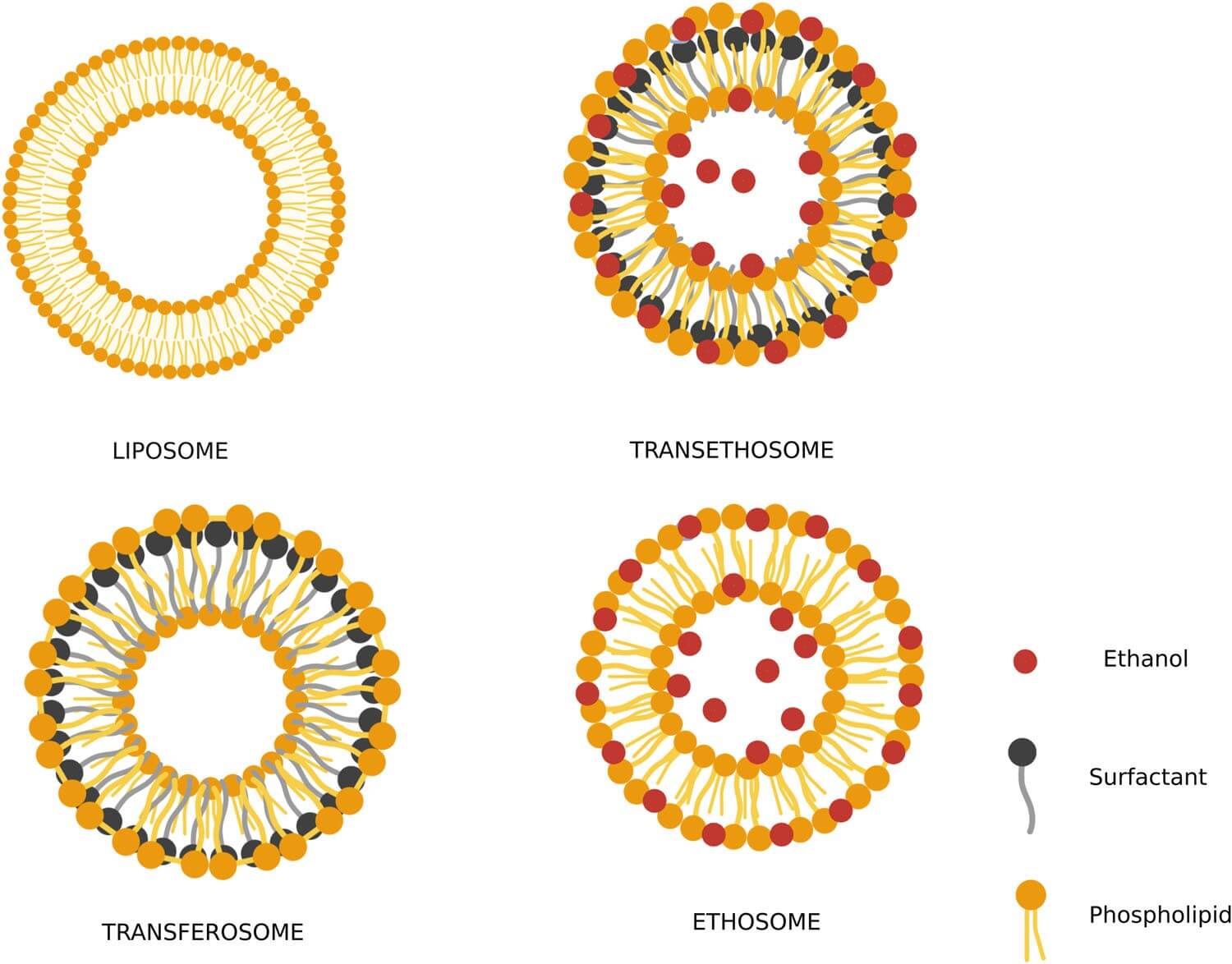 Fig.1
The structures of various lipid-based nanocarriers: liposome, transethosome, transfersome, and ethosome.1
Fig.1
The structures of various lipid-based nanocarriers: liposome, transethosome, transfersome, and ethosome.1
How Do Transethosomes Work?
To demystify how transethosomes (TEs) live up to their "fast-penetrating, smarter delivery" promise, let's break down their working mechanism into clear, science-backed steps (Figure 2).
1. Barrier Preparation with Core Components:
First, transethosomes (TEs) use their 10%-50% ethanol content to fluidize lipids in biological barriers (e.g., skin's stratum corneum, ocular mucosa). These fluidized lipids weaken the barrier's structure, and edge activators (e.g., Tweens, oleic acid) enable TEs to be ultra-deformable, which is key for squeezing through tiny pores without breaking.
2. Targeted Adhesion & Penetration:
Next, TEs' surface properties (e.g., zeta potential from phospholipids like phosphatidylcholine) enable adhesion to tissue surfaces. Their soft, phospholipid-based vesicles then penetrate deeper than traditional carriers: for transdermal delivery, they move past the stratum corneum into the dermis; for ocular use, they cross corneal epithelium.
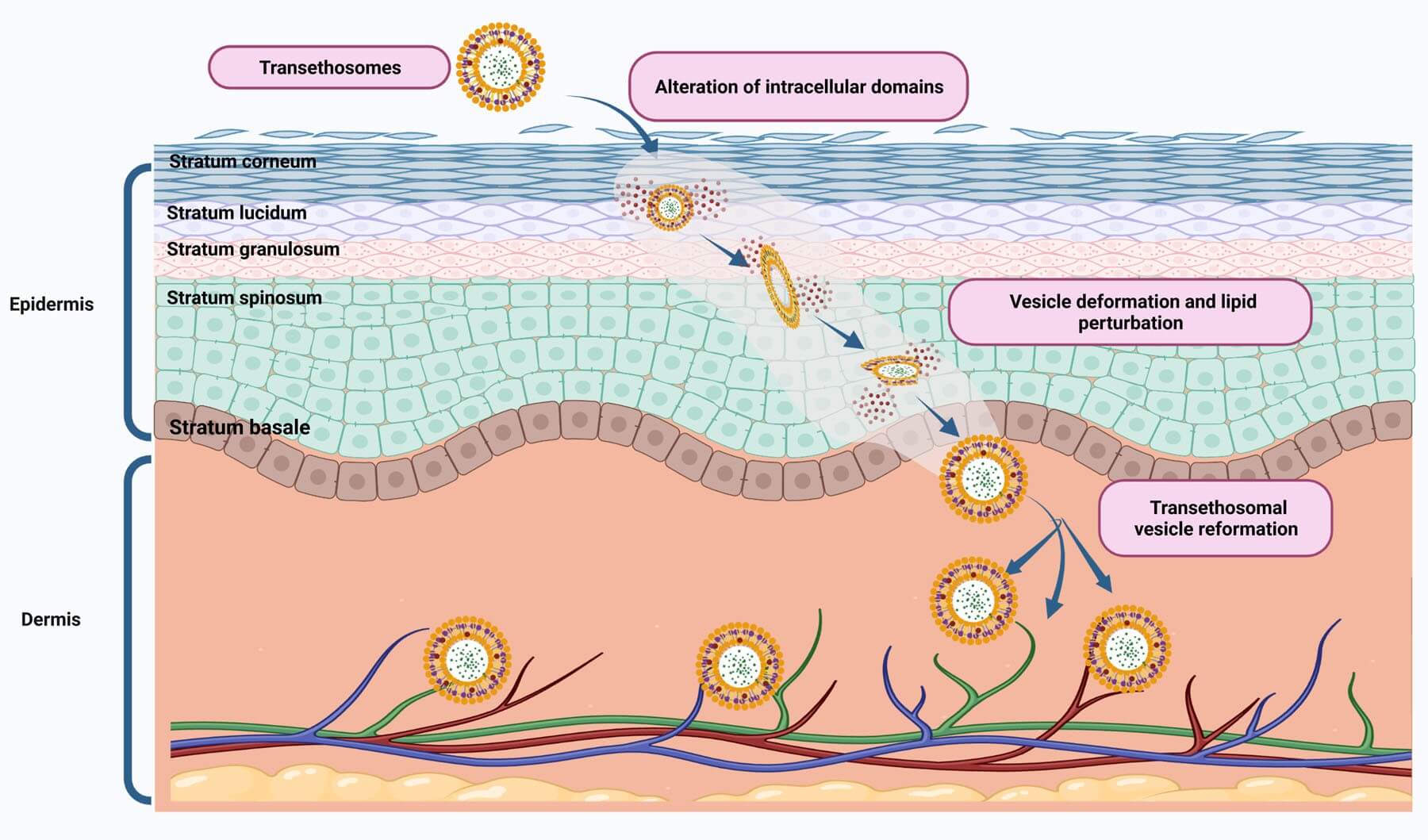 Fig.2
The transdermal route of transethosomes during permeation.1
Fig.2
The transdermal route of transethosomes during permeation.1
3. Controlled Drug Release:
Before drug release, stabilizers (e.g., cholesterol) will ensure vesicle integrity, thus avoiding sudden plasma spikes. Once at the target site, TEs release encapsulated hydrophilic/lipophilic drugs gradually.
4. Gentle, Efficient Delivery:
Finally, TEs bypass first-pass metabolism (skipping liver/gastrointestinal breakdown), delivering drugs precisely, with reduced organ toxicity.
Advantages of Transethosomes Over Conventional Nanocarriers
TEs stand out as a game-changer in drug delivery by addressing key limitations of conventional nanocarriers (Table 1). Their unique design translates to a suite of advantages that make them ideal for "smarter, gentler" delivery, as outlined below.
- Deeper penetration: Reaches viable epidermis and sometimes the upper dermis.
- High versatility: Loads hydrophilic, lipophilic, and amphiphilic molecules.
- Gentle conditions: Often prepared without extreme heat or strong organic solvents.
- Better local bioavailability: Supports lower dose while keeping target exposure.
- User-friendly formats: Gels, sprays, thin films, patches, and drops are all feasible.
Table 1 Comparison of transethosomes with liposomes and ethosomes.
| Feature | Liposomes | Ethosomes | Transethosomes |
|---|---|---|---|
| Ethanol content | 0% | 20–40% | 20–40% + edge activator |
| Membrane flexibility | Moderate | High | Very high |
| Barrier penetration | Moderate | High | Very high |
| Payload breadth | Medium | High | Very high |
| Typical irritation risk | Low–Moderate | Moderate | Low–Moderate (formulation dependent) |
Pro tip:
If ethosomes still struggle with payload versatility or robustness, transethosomes often fix that gap by adding an edge activator for extra flexibility.
Formulation and Production Techniques (With Practical Levers)
Multiple scalable methods can be used for transethosome production. Each is tailored to balance efficiency, vesicle quality, and batch reproducibility. TE properties, such as size, entrapment efficiency (EE), and deformability, can be fine-tuned by adjusting key "practical levers".
Common methods
Thin-Film Hydration (TFH) with Ethanol Phase & Surfactant
-
A gold-standard method for pilot-scale production (Figure 3).
- Mix phospholipids, surfactants, and drugs in ethanol-organic solvent;
- Rotary-evaporate to form a thin lipid film;
- Hydrate with preheated aqueous phase;
- Sonicate/extrude to refine size (62-200 nm);
- Store at 4-8℃.
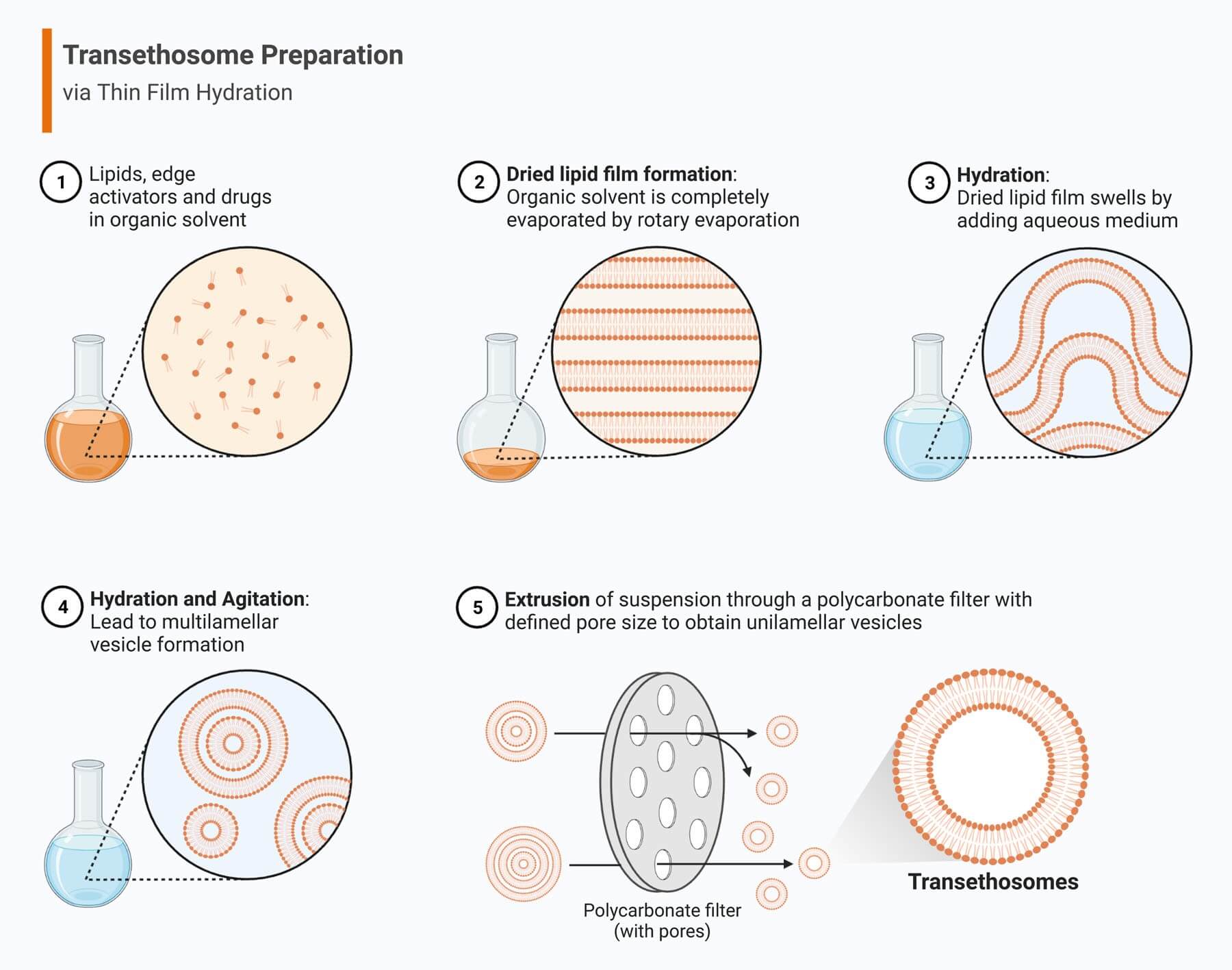 Fig.3
Transethosome preparation via thin film hydration.1
Fig.3
Transethosome preparation via thin film hydration.1
Ethanol Injection into Aqueous Phase with Stirring
-
A simple, rapid method ideal for hydrophilic drug loading.
- Mix phospholipids, surfactants, and drugs in ethanol;
- Inject into stirred aqueous phase (700-2000 rpm) at 1-5 mL/min;
- Stir 15-30 min
- Sonicate to boost EE;
- Filter and store.
Cold/Hot Methods with Controlled Sonication or Extrusion
- These methods cater to heat-sensitive or high-lipid formulations.
Cold Method:
- Prepare ethanol-organic and aqueous phases at room temp;
- Mix dropwise while stirring (5-30 min);
- Sonicate briefly;
- Refrigerate (4±2°C) for heat-labile drugs.
Hot Method:
- Heat lipid-water and ethanol-polyol phases to 40°C;
- Mix while stirring;
- Extrude (100 nm pores);
- Cool and store.
Microfluidic Mixing for Tighter Size Control & Scale-Up Readiness
-
An advanced method for commercial-scale TEs.
- Pump ethanol-organic (with lipids/drugs) and aqueous phases into the microfluidic chip (1:3-1:5 flow ratio);
- Collect chilled suspension;
- Filter for sterility.
Optimization checklist
- Ethanol % (20–40%): Higher values can boost penetration but may affect irritation or stability.
- Phospholipid grade and ratio: Impacts bilayer strength, entrapment, and zeta potential.
- Edge activator choice: Ionic vs. nonionic surfactants change elasticity and tolerance.
- Size/PDI: Aim 80-200 nm with PDI ≤ 0.25 for consistent diffusion.
- Zeta potential: Target a stable absolute value (e.g., ≥ |25| mV) to reduce aggregation.
- Viscosifier for gels: Carbomer or cellulose derivatives improve residence time.
Need a custom transethosome formulation?
Partner with our experts at Creative Biolabs to design a system tailored to your research model.
Innovations and Functionalization in Transethosome
To elevate transethosomes (TEs) as a "smarter" delivery platform, researchers and developers are integrating advanced functionalization techniques and innovative approaches, from cell-specific targeting to triggerable release, that expand their utility and precision.
- Ligand targeting: Attach peptides, antibodies, or sugars for cell-type preference.
- Polymer decoration: PEGylation or mucoadhesive coats for better residence time.
- Co-loading strategies: Combine small molecules with photosensitizers or RNAs for research.
- Triggerable systems: pH-, temperature-, or light-responsive add-ons for precise release.
- Smart manufacturing: AI-assisted DoE and microfluidic platforms for fast optimization.
Routes of Administration and Typical Use Cases
A key strength of transethosomes (TEs) in "smarter, gentler" delivery lies in their adaptability to diverse routes of administration, each optimized for distinct use cases (from local skin treatments to targeted lung therapy) and supported by formats that boost patient compliance:
Transdermal / Topical
Use cases: anti-inflammatory agents, analgesics, hormones, and local antimicrobials.
Why it works: Strong lipid fluidization and flexible vesicles support quick entry.
Format ideas: hydrogel, spray, film-forming solutions, or roll-on formats.
Ocular
Use cases: anti-infectives, anti-inflammatories, and comfort agents.
Why it works: Enhanced corneal residence and controlled release minimize wash-off.
Format ideas: isotonic drops or in-situ gelling systems.
Pulmonary
Use cases: antivirals and anti-inflammatories for local lung delivery.
Why it works: The Nanometer size range supports aerosolization and alveolar reach.
Format ideas: nebulized suspensions with tight aerodynamic control.
Vaginal
Use cases: local antimicrobials, hormones, and microbiome-supporting actives.
Why it works: Flexible vesicles improve mucosal contact and retention.
Format ideas: mucoadhesive gels, films, or suppositories.
Therapeutic and Research Applications
By drug class
- Anti-inflammatory / analgesic: localized action with reduced systemic exposure.
- Hormones: improved consistency vs. some patches and creams.
- Anticancer and adjuvant actives: targeted local exposure for research models.
- Antibiotics/antivirals: higher local concentration where needed.
- Cosmeceutical actives: vitamins, peptides, and antioxidants for skin research.
By the research goal
- Boost local bioavailability without aggressive enhancers.
- Enable challenging APIs that are poorly soluble or unstable.
- Reduce dose while maintaining target exposure profiles.
- Achieve sustained release for better adherence in long protocols.
Challenges and Limitations
Stability and shelf life
Description:
Ethanol loss and vesicle fusion can occur.
Mitigation:
Tight packaging, antioxidants, cryoprotectants for lyophilization, and humidity control.
Scale-up reproducibility
Description:
Edge activators can change process windows.
Mitigation:
Move early to microfluidics or controlled high-shear mixing with in-line PAT.
Irritation risks
Description:
Higher ethanol or certain surfactants may irritate sensitive tissues.
Mitigation:
Titrate ethanol down, select milder surfactants, and use soothing gel bases.
Regulatory/analytical complexity
Description:
More parameters to control than simple creams.
Mitigation:
Build a robust CMC-like dossier: DLS, TEM/cryogenic EM, DSC, FTIR, viscosity, osmolality, and release testing.
Future Perspectives: What's Next
As transethosomes (TEs) solidify their role as "fast-penetrating, smarter delivery" tools, their future lies in pushing boundaries—from tailored patient-centric solutions to sustainable and tech-driven innovations.
- Personalized delivery: Formulate by genotype, phenotype, or microbiome profile.
- Greener processes: Less solvent, more recyclable packaging, and energy-efficient mixing.
- Digital twins for formulation: Predict size, PDI, and release profiles before the first batch.
- Hybrid systems: Transethosomes + microneedles or dissolving films for precision targeting.
Practical Playbook: From Idea to Data in 6 Steps
- Clarify the goal: local vs. systemic exposure, onset speed, and duration.
- Screen excipients: shortlist phospholipid grade, edge activator, and ethanol window.
- Pick a route: map specs by route (osmolality for ocular, aerodynamic size for pulmonary).
- Design DoE: explore size, PDI, zeta, entrapment, release, and permeation together.
- Build stability plan: ICH-like conditions, light stress, and in-use testing.
- Plan scale-up early: consider microfluidics and in-line analytics for reproducibility.
Need a head start?
Creative Biolabs supports end-to-end vesicle development—from screening to scale-ready processes. Explore our Targeted Delivery Solutions for related platforms and modules.
Troubleshooting & Optimization Guide
- High PDI (>0.3): Reduce sonication time; filter/extrude; refine surfactant level.
- Low entrapment: Adjust lipid:drug ratio; add co-solvents; tweak hydration time.
- Instability on storage: Optimize ethanol %, add stabilizers, consider lyophilization.
- Irritation signals: Switch to milder surfactant, reduce ethanol, add soothing polymers.
- Weak penetration: Increase elasticity via surfactant type or small ethanol increments.
For a deeper checklist and route-specific specs, connect with our team via the Module Delivery Systems page.
Related Services You May Be Interested in
FAQs
What makes transethosomes different from ethosomes?
Transethosomes add an edge activator to the ethanol-rich ethosomal bilayer. This extra surfactant gives higher deformability, which often means deeper penetration and broader payload flexibility.
Can transethosomes carry both hydrophilic and lipophilic drugs?
Yes. The aqueous core favors hydrophilic cargo, while the lipid bilayer holds lipophilic molecules. Therefore, one platform can support many API types.
Do transethosomes always beat patches or gels?
Not always, but they often penetrate faster and deeper in research models. Results depend on API, route, excipients, and process controls.
Are transethosomes safe for sensitive tissues like the eye?
Formulation matters. By tuning ethanol and surfactant levels and ensuring isotonicity, researchers have designed ocular-friendly systems in preclinical studies.
How do I improve stability without losing flexibility?
Optimize lipid grade, ethanol %, and surfactant. Add antioxidants, control pH, and consider lyophilization with cryoprotectants.
What size and PDI should I target?
For most routes, 80–200 nm and PDI ≤ 0.25 is a solid starting point. Then, adjust by route and device needs.
Which analytics are essential?
DLS, zeta potential, TEM/cryogenic EM, DSC, FTIR, in-vitro release, and permeation studies form a reliable core panel.
Conclusion
Because transethosomes combine ethanol-driven lipid fluidization with edge-activator elasticity, they give teams a practical path to deeper, gentler delivery across several routes. When you are ready to translate a concept into route-specific, scale-ready data, Creative Biolabs can help you design, characterize, and optimize transethosome-based systems—from first screen to reliable manufacturing parameters.
References
- Chowdary, P., Padmakumar, A. & Rengan, A. K. "Exploring the potential of transethosomes in therapeutic delivery: A comprehensive review." MedComm – Biomaterials and Applications 2, e59 (2023). https://onlinelibrary.wiley.com/doi/10.1002/mba2.59. Distributed under Open Access license CC BY 4.0, without modification.
- Soradech, S. et al. "Development of Transethosomes Loaded with Fruit Extract from Carissa carandas L. as a Brightening and Anti-Aging Cosmeceutical Ingredient." Cosmetics 11, 199 (2024). https://www.mdpi.com/2079-9284/11/6/199.