
Creative Biolabs is offering the most comprehensive services for antibody development projects. With strict regulation and effective execution, we are dedicated to providing the most valuable solutions to complete your projects.
HighlightsCreative Biolabs is offering the most comprehensive services for antibody development projects. With strict regulation and effective execution, we are dedicated to providing the most valuable solutions to complete your projects.
HighlightsCreative Biolabs has established a broad range of platforms for developing novel antibodies or equivalents. These cutting-edge technologies enable our scientists to meet your demands from different aspects and tailor the most appropriate solution that contributes to the success of your projects.
HighlightsWith deep understanding in antibody-related realms and extensive project experience, Creative Biolabs offers a variety of references to help you learn more about our capacities and achievements, including infographic, flyer, case study, peer-reviewed publications, and all kinds of knowledge that can assist your projects. You are also welcome to contact us directly for more specific solutions.
HighlightsGet a real taste of Creative Biolabs, one of the most professional custom service providers in the world. We are committed to providing highly customized comprehensive solutions with the best quality to advance your projects.
HighlightsPhage display technology has enabled scientists to discover and enhance therapeutic peptides and proteins through advanced drug discovery methods. During the last twenty years phage display peptide libraries have become essential tools for both drug development and cancer screening. This article explains the scientific principles of phage display peptide libraries while exploring their multiple uses and benefits in life science research.
Phage display peptide libraries lead drug development and peptide research with unmatched capabilities. This technology enables the rapid screening of large peptide collections to identify specific binding partners for target proteins and therapeutic peptides, accelerating the process far beyond the limitations of traditional methods.
Phage display peptide libraries are divided into groups based on their construction and the diversity of peptides they contain.
Researchers generate random peptide libraries that contain diverse peptide sequences. Random peptide sequencing enables the search of many different types of peptides which helps find effective binders. The process of making and using random peptide libraries helps screen for different types of peptides.
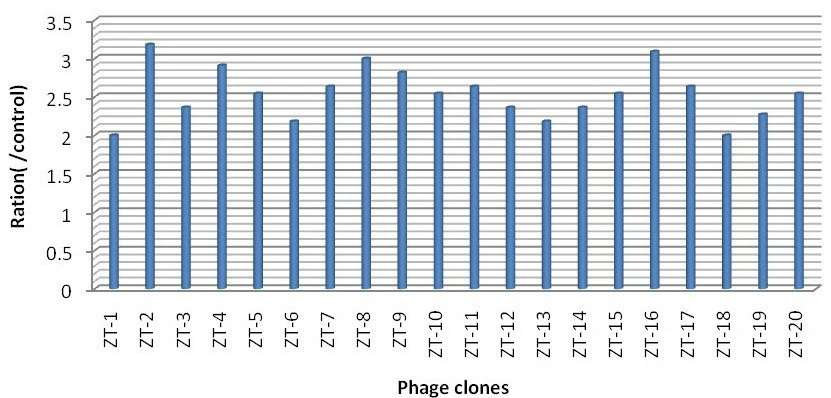 Fig. 1 Evaluation by cell-ELISA of the binding selectivity of twenty phage clones.1
Combining different random peptide sequences produces an expanded library of distinct variants through combinatorial peptide technology. These libraries are particularly useful for identifying exact peptide binding partners with high specificity and affinity.
Peptides can be classified into linear and cyclic structures, each offering unique advantages and challenges.
Table 1. Advantages of Linear Peptides and Cyclic Peptides
| Property | Linear Peptides | Cyclic Peptides |
| Stability | Less stable, prone to degradation | More stable, resistant to proteolysis |
| Synthesis | Easier and cheaper to synthesize | More complex synthesis process |
| Bioavailability | Often lower due to rapid degradation | Higher due to better stability |
| Applications | Less suitable for in vivo use | Ideal for therapeutic and diagnostic applications |
Phage display peptide libraries help find new biomarkers for medical tests and disease tracking. The discovery of biomarker-specific peptides enhances our ability to detect diseases early and provides better information about cancer development.
Researchers use peptides from phage display libraries to develop better cancer diagnostic imaging methods. The peptides connect to specific proteins found in cancer tissue so doctors can create better and gentler imaging tools to detect tumors.
The use of phage display peptide libraries proves effective for examining how proteins connect with each other. When researchers find peptides that stick to target proteins, they create better ways to see how proteins work with each other in cells.
Phage display peptide libraries undergo biopanning to identify peptides that bind to their target. The method helps us select peptides that strongly connect with our target of interest.
 Fig. 2 Competitive inhibition of binding of the positive phage to cells by the synthetic peptide.2
Researchers put their phage display library through biopanning steps to test its binding with target molecules. The phages that stick to the target protein during biopanning remain captured while other phages are removed.
The availability of premade and custom phage display peptide libraries enables researchers to select from available options or create personalized libraries according to their project requirements.
Business companies sell ready-made libraries with millions of different peptide sequences to help with drug discovery research as well as medical testing and disease diagnosis. Creative Biolabs assembled numerous premade peptide libraries including linear and constrained types over recent years. It is worth mentioning that we offer two high-quality linear peptide libraries (16-mer and 20-mer), which are developed using the same authentic phage system as the NEB Ph.D. peptide libraries. We also provide a cyclic 9-mer peptide library, constructed using the same technical route.
For specific research needs, custom phage display peptide libraries can be created. These libraries are designed to target particular proteins, cells, or diseases, offering tailored solutions for drug discovery and biomarker identification. Creative Biolabs has pioneered a technology for constructing constrained peptide libraries, enabling the creation of constrained peptides with target-specific cross-links. This approach involves the generation of natural or semi-synthetic peptides with constrained structures, enhancing their properties such as stability, protease resistance, protein binding affinity, and intrinsic cell permeability.
Phage display peptide libraries continue to face challenges, such as the instability of short linear peptides in vivo. Researchers are addressing this by modifying peptides to enhance their stability. Recent improvements in peptide library engineering have produced better-stable peptide structures to address existing difficulties.
Phage display peptide libraries show promising prospects as research continues to develop new therapeutic options and better peptide identification methods. Peptide development today aims to create exact medications that target particular disease markers especially for individualized cancer treatments. Combining phage display with other molecular display methods, such as yeast and ribosome display, will further enhance the diversity and specificity of peptide libraries.
All listed services and products are For Research Use Only. Do Not use in any diagnostic or therapeutic applications.








