Creative Biolabs is offering the most comprehensive services for antibody development projects. With strict regulation and effective execution, we are dedicated to providing the most valuable solutions to complete your projects.
HighlightsCreative Biolabs is offering the most comprehensive services for antibody development projects. With strict regulation and effective execution, we are dedicated to providing the most valuable solutions to complete your projects.
HighlightsCreative Biolabs has established a broad range of platforms for developing novel antibodies or equivalents. These cutting-edge technologies enable our scientists to meet your demands from different aspects and tailor the most appropriate solution that contributes to the success of your projects.
HighlightsWith deep understanding in antibody-related realms and extensive project experience, Creative Biolabs offers a variety of references to help you learn more about our capacities and achievements, including infographic, flyer, case study, peer-reviewed publications, and all kinds of knowledge that can assist your projects. You are also welcome to contact us directly for more specific solutions.
HighlightsGet a real taste of Creative Biolabs, one of the most professional custom service providers in the world. We are committed to providing highly customized comprehensive solutions with the best quality to advance your projects.
HighlightsIn the rapidly evolving landscape of biotherapeutics, the ability to rapidly screen and identify high-affinity ligands is paramount. Creative Biolabs, a global leader in phage display technology for over two decades, offers professional, end-to-end M13 Phage Library Construction Services. By leveraging the unique biology of the M13 filamentous phage, we provide researchers with high-capacity, high-diversity libraries tailored for antibody discovery, peptide screening, and protein engineering. Our platform integrates the latest advancements in synthetic biology and Next-Generation Sequencing (NGS) to ensure that every library we build meets the highest standards of diversity and functional integrity. Whether you require a custom immune library or access to our high-performance premade antibody libraries, Creative Biolabs is your definitive partner.
The M13 filamentous phage is the most widely utilized vehicle in phage display technology. Its unique life cycle—assembling in the periplasm and secreting through the E. coli membrane without host lysis—allows for the display of massive repertoires of proteins and peptides.
Structural Insights of M13 Phage
The M13 virion consists of a circular single-stranded DNA genome encased in a protein coat composed of five different capsid proteins:
Table 1. Structural Components of M13 Phage for Display
| Protein | Function | Copy Number | Display Strategy |
| pIII | Mediates host cell attachment and infection. | 3–5 copies at one tip. | Used for pIII-fusion display of large proteins/antibodies (low valency). |
| pVIII | Major coat protein forming the cylindrical body. | ~2,700 copies. | Used for pVIII-fusion display of short peptides (high valency). |
| pVI, pVII, pIX | Minor coat proteins at the tips. | ~5 copies each. | Alternative sites for specialized or dual-display applications. |
At Creative Biolabs, we specialize in the custom design and synthesis of high-quality phage display libraries. Our platform supports various display formats tailored to your specific project needs.
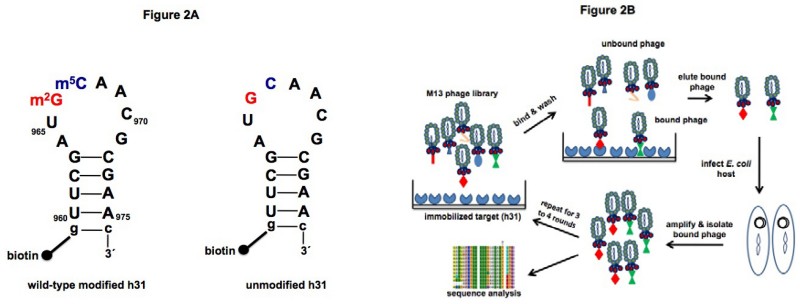 Fig. 1 RNA targets for phage display.1
pIII-Fusion Display Services
The pIII protein is the most common anchor for displaying large molecular weight proteins, such as ScFv or Fab fragments. Because pIII is present in low copy numbers, it allows for monovalent display, which is critical for selecting candidates based on high intrinsic affinity rather than avidity effects.
pVIII-Fusion Display Services
The pVIII protein is ideal for displaying short peptides (typically 6–12 amino acids). Given its high copy number (~2,700), it provides a multivalent display platform, significantly increasing the apparent affinity (avidity) of the phage for its target. This is particularly useful for identifying weak binders or developing biosensors.
Specialized and Other Display Vectors
Beyond standard pIII/pVIII fusions, we utilize other display vectors including:
Creative Biolabs utilizes the latest technologies to ensure the success of your M13 Phage Library Construction:
High-Efficiency Transformation
We employ specialized electro-competent E. coli strains and optimized electroporation protocols to achieve library sizes exceeding 1010 individual clones, ensuring maximum sequence coverage.
Trimer Codon Technology
To avoid the limitations of NNK or NNS degeneracy (such as premature stop codons or redundant amino acids), we offer Trimer Codon Synthesis. This ensures a precise distribution of amino acids and eliminates "junk" sequences, resulting in a "smart" library.
Table 2. Comparison of Library Types
| Feature | Peptide Libraries | Antibody Libraries (ScFv/Fab) | Protein Scaffold Libraries |
| Diversity | 109 - 1011 | 108 - 1010 | 108 - 109 |
| Typical Display | pVIII (High Valency) | pIII (Low Valency) | pIII / pVI |
| Main Application | Epitope Mapping, Mimotopes | Therapeutic Antibody Discovery | Enzyme Engineering |
Our streamlined process ensures transparency and quality at every stage:
Explore our hierarchical service offerings designed to meet every research need:
Learn more about other M13 phage library construction services:
Ready to accelerate your discovery? Our M13 Phage Library Construction Services are tailored to provide the precision and scale your research demands.
Reference
All listed services and products are For Research Use Only. Do Not use in any diagnostic or therapeutic applications.