Creative Biolabs is offering the most comprehensive services for antibody development projects. With strict regulation and effective execution, we are dedicated to providing the most valuable solutions to complete your projects.
HighlightsCreative Biolabs is offering the most comprehensive services for antibody development projects. With strict regulation and effective execution, we are dedicated to providing the most valuable solutions to complete your projects.
HighlightsCreative Biolabs has established a broad range of platforms for developing novel antibodies or equivalents. These cutting-edge technologies enable our scientists to meet your demands from different aspects and tailor the most appropriate solution that contributes to the success of your projects.
HighlightsWith deep understanding in antibody-related realms and extensive project experience, Creative Biolabs offers a variety of references to help you learn more about our capacities and achievements, including infographic, flyer, case study, peer-reviewed publications, and all kinds of knowledge that can assist your projects. You are also welcome to contact us directly for more specific solutions.
HighlightsGet a real taste of Creative Biolabs, one of the most professional custom service providers in the world. We are committed to providing highly customized comprehensive solutions with the best quality to advance your projects.
HighlightsEpitope masking is a targeted screening strategy designed to redirect phage display enrichment toward defined molecular regions while reducing selection against dominant or already characterized binding sites. Instead of allowing library members unrestricted access to the entire target surface, this approach intentionally shields selected epitopes so that alternative interaction regions become accessible for discovery. In many phage display campaigns, highly exposed or immunodominant regions can dominate enrichment and obscure potentially valuable binders directed toward less accessible surfaces. Strategic masking helps reshape this binding landscape by guiding selection pressure toward areas that may otherwise remain underrepresented.
At Creative Biolabs, we approach epitope-directed screening as a deliberate design strategy rather than a simple experimental modification. Our teams develop masking workflows that align with project goals, target complexity, and downstream research priorities. Whether the objective involves exploring new binding surfaces or avoiding previously identified regions, carefully planned masking can expand discovery potential while improving selection efficiency.
Certain molecular surfaces naturally attract disproportionate enrichment during phage display screening. While these regions may generate strong signals, they can restrict exploration of alternative interaction sites and reduce overall binder diversity.
Research programs often seek binders against novel or less characterized target areas rather than repeatedly enriching candidates directed toward familiar epitopes. Controlled shielding provides a practical way to redirect selection pressure.
Subdominant or partially inaccessible regions can support highly informative binding events. Without masking strategies, these interactions may remain undetected during conventional enrichment workflows.
When unrestricted binding occurs, highly favorable regions frequently outcompete other target areas. Managing surface accessibility creates a more balanced interaction environment.
By restricting access to chosen regions, researchers gain stronger control over which molecular features participate in enrichment.
The location of binder engagement often influences downstream analysis and mechanistic understanding. Screening strategies that account for epitope distribution may therefore generate more informative results.
For researchers interested in greater control over target engagement, Creative Biolabs provides scientifically guided masking strategies tailored to project objectives.
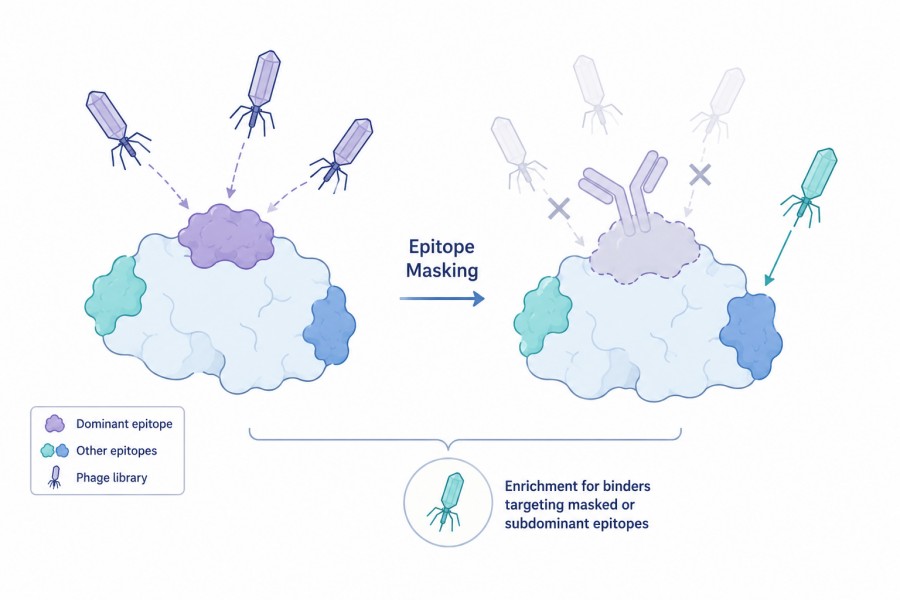 Fig.1 Targeted Epitope Shielding to Reveal Subdominant Binding Sites.
Masking strategies support the identification of binders directed toward secondary or previously overlooked regions of a target molecule.
Shielding defined surfaces enables researchers to evaluate how ligands behave when common interaction sites are unavailable.
Directed accessibility helps clarify the relationship between molecular regions and binding behavior, supporting mechanistic studies.
Researchers studying related proteins or structural variants can use masking workflows to explore region-specific interaction differences.
Redirecting enrichment away from dominant surfaces increases the likelihood of recovering diverse interaction profiles from a single library.
Projects involving multiple rounds of discovery often benefit from region-focused enrichment strategies that progressively broaden molecular coverage.
If your research aims to uncover new interaction landscapes or investigate underexplored target regions, Creative Biolabs can help design an appropriate screening approach.
Selection of suitable masking components
Creative Biolabs evaluates multiple masking approaches depending on project requirements. Antibodies, ligands, competing proteins, or engineered blocking systems may be considered based on target characteristics and desired accessibility.
Careful balance between shielding and exposure
Overly aggressive masking can eliminate meaningful interactions, while insufficient coverage may fail to redirect enrichment. Our teams optimize this balance to preserve discovery potential.
Flexible implementation across screening rounds
Masking does not need to remain static throughout a campaign. Screening architecture can evolve as enrichment patterns emerge and research priorities shift.
Compatibility with diverse target formats
Our workflows support soluble proteins, membrane-associated systems, engineered constructs, and structurally complex targets.
Monitoring enrichment behavior throughout the process
Sequencing and enrichment analysis provide insight into how shielding influences library evolution and candidate distribution.
Adaptive optimization guided by experimental data
Observed results inform ongoing refinement so that screening conditions remain aligned with project goals.
To discuss how these workflow elements may be adapted to your project, Creative Biolabs encourages direct communication with our scientific team.
 Extensive experience with phage display optimization
Creative Biolabs has developed screening workflows across diverse targets and library systems, allowing us to apply practical insight to complex enrichment challenges.
Project-specific experimental design
We recognize that no single masking strategy fits every project. Each workflow is designed around scientific objectives rather than rigid templates.
Integration of screening and analysis expertise
Library screening, enrichment interpretation, and downstream evaluation are coordinated to support coherent project development.
Strong emphasis on experimental transparency
Clients receive clear communication regarding design logic, workflow progression, and optimization decisions.
Focus on meaningful binder diversity
Rather than prioritizing enrichment alone, Creative Biolabs emphasizes generation of candidates that expand research possibilities.
Commitment to foundational scientific research
Our services are designed to support discovery, mechanistic studies, and exploratory biology without clinical positioning.
Researchers seeking a technically experienced and collaborative screening partner are invited to contact Creative Biolabs for further discussion.
More research groups are incorporating controlled accessibility strategies into screening workflows to achieve broader interaction coverage.
Masking approaches are increasingly paired with competition-based workflows to improve binder discrimination and surface specificity.
Advances in structural biology allow more informed identification of target regions suitable for shielding or selective exposure.
NGS-based monitoring provides deeper insight into how accessibility changes influence enrichment dynamics and clone emergence.
Rather than relying on fixed workflows, researchers increasingly favor experimental designs that evolve in response to observed data.
Ongoing research continues to demonstrate that meaningful binding landscapes extend beyond dominant interaction regions.
Creative Biolabs continuously evaluates advances in epitope-directed screening and incorporates relevant innovations into our phage display service platform.
Epitope Masking offers a sophisticated way to influence phage display library screening by controlling which molecular surfaces participate in enrichment. Rather than allowing dominant regions to dictate selection outcomes, this strategy helps researchers access alternative interaction landscapes, broaden binder diversity, and generate more informative screening results.
At Creative Biolabs, we integrate accessibility control into customized phage display workflows designed for foundational research and discovery-driven projects. We welcome the opportunity to discuss how region-focused screening strategies can strengthen your next phage display program.
All listed services and products are For Research Use Only. Do Not use in any diagnostic or therapeutic applications.