
Creative Biolabs is offering the most comprehensive services for antibody development projects. With strict regulation and effective execution, we are dedicated to providing the most valuable solutions to complete your projects.
HighlightsCreative Biolabs is offering the most comprehensive services for antibody development projects. With strict regulation and effective execution, we are dedicated to providing the most valuable solutions to complete your projects.
HighlightsCreative Biolabs has established a broad range of platforms for developing novel antibodies or equivalents. These cutting-edge technologies enable our scientists to meet your demands from different aspects and tailor the most appropriate solution that contributes to the success of your projects.
HighlightsWith deep understanding in antibody-related realms and extensive project experience, Creative Biolabs offers a variety of references to help you learn more about our capacities and achievements, including infographic, flyer, case study, peer-reviewed publications, and all kinds of knowledge that can assist your projects. You are also welcome to contact us directly for more specific solutions.
HighlightsGet a real taste of Creative Biolabs, one of the most professional custom service providers in the world. We are committed to providing highly customized comprehensive solutions with the best quality to advance your projects.
HighlightsKinetic binding based selection focuses on how rapidly ligands associate with targets and how long those interactions remain stable over time. Unlike screening strategies centered primarily on endpoint affinity, this approach evaluates interaction behavior dynamically, providing deeper insight into binding quality and molecular performance. In many phage display projects, candidates with similar apparent affinity may behave very differently once association and dissociation characteristics are examined more carefully.
By incorporating kinetic considerations into library screening workflows, researchers can identify binders with improved retention, stronger interaction persistence, or faster target engagement depending on the goals of the study. At Creative Biolabs, we design screening campaigns that move beyond simple enrichment and instead emphasize interaction behavior under biologically relevant conditions. This enables a more refined understanding of candidate performance during foundational research and downstream characterization.
Some ligands interact rapidly with their targets yet dissociate almost immediately afterward. Evaluating interaction speed alone can therefore produce misleading enrichment outcomes during phage display screening.
Candidates that remain bound for extended periods are frequently more valuable for downstream applications requiring sustained target engagement or reliable molecular recognition.
Traditional affinity assessments can mask meaningful differences between candidates with distinct association and dissociation profiles. Kinetic analysis provides a more complete understanding of binding behavior.
Without appropriate selection pressure, rapidly associating binders may become enriched even when their long term stability is limited. Kinetic oriented screening helps reduce this bias.
Incubation periods, washing conditions, and dissociation steps all affect which binders remain in the enriched population. Careful workflow design is therefore essential.
Two candidates with comparable affinity may exhibit very different kinetic signatures, offering additional insight into specificity, interaction mechanism, and molecular robustness.
For researchers seeking a more nuanced understanding of molecular interactions, Creative Biolabs provides tailored screening workflows focused on kinetic performance.
Researchers studying persistent molecular interactions can prioritize candidates with slower dissociation characteristics and improved retention behavior.
Kinetic profiling helps distinguish subtle interaction differences that may not be apparent through affinity measurements alone.
Evaluating interaction dynamics supports investigations into conformational effects, binding pathways, and recognition mechanisms.
Understanding association and dissociation behavior allows researchers to refine washing conditions and selection timing more effectively.
Some biologically relevant interactions occur with moderate affinity yet display important kinetic stability. Dynamic screening approaches help preserve these candidates.
In early stage discovery programs, kinetic focused selection provides additional layers of information that improve candidate prioritization.
If your research involves complex interaction behavior or difficult to distinguish candidates, Creative Biolabs can help develop a suitable screening framework.
01 Controlled dissociation steps during selection
Creative Biolabs incorporates carefully designed wash and incubation procedures to distinguish rapidly dissociating binders from more stable candidates.
02 Adjustment of incubation timing
Association periods can be optimized to favor either rapid target engagement or stable interaction formation depending on project objectives.
03 Progressive increase in selection stringency
Selection pressure may be gradually intensified across rounds to improve enrichment quality while preserving valuable diversity.
04 Integration with analytical characterization methods
Screening results can be correlated with independent interaction analysis techniques for improved validation and interpretation.
05 Parallel comparison of screening conditions
Multiple workflow configurations allow researchers to evaluate how timing and washing parameters influence enrichment patterns.
06 Data guided optimization throughout the project
Sequencing and enrichment monitoring help Creative Biolabs refine screening parameters in response to observed library behavior.
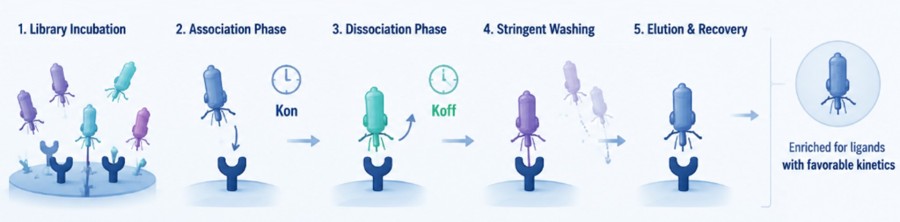 Fig.1 Kinetic Binding Based Selection Phases.
To learn how these workflow strategies can support your phage display project, Creative Biolabs encourages you to contact our scientific team.
 Strong expertise in phage display optimization
Creative Biolabs has extensive experience designing selection workflows that balance enrichment efficiency with meaningful interaction analysis.
Customized project development
Every screening campaign is adapted according to target characteristics, research goals, and desired interaction profiles.
Emphasis on practical interpretability
Our teams prioritize data clarity and experimental relevance rather than relying solely on numerical enrichment metrics.
Comprehensive support from design through analysis
Creative Biolabs assists clients throughout the entire screening process, from workflow planning to downstream evaluation.
Flexible handling of diverse target formats
Our experience spans soluble proteins, membrane associated systems, engineered constructs, and complex biological samples.
Commitment to research driven collaboration
We work closely with investigators to ensure screening strategies remain aligned with scientific objectives and evolving project needs.
Researchers interested in more informative and behavior oriented screening approaches are invited to discuss the projects with Creative Biolabs.
More researchers are recognizing the value of retaining candidates with slower off rates rather than relying exclusively on endpoint affinity.
NGS based enrichment tracking allows detailed analysis of how interaction dynamics shape library evolution across rounds.
Dynamic interaction focused workflows are increasingly paired with competitive, subtractive, or valency controlled approaches.
Researchers are designing screening conditions that better reflect the temporal complexity of biological systems.
More projects now incorporate measurable kinetic parameters into decision making during candidate prioritization.
Candidates selected using interaction behavior criteria often demonstrate more consistent performance during later characterization studies.
Creative Biolabs continuously evaluates methodological advances in this field and incorporates relevant innovations into our phage display service platform.
Kinetic Binding Based Selection offers a deeper perspective on molecular interactions by emphasizing how binding events occur and persist over time. Rather than relying solely on endpoint enrichment, this strategy enables researchers to distinguish candidates with meaningful interaction stability, improved retention behavior, and stronger experimental relevance.
At Creative Biolabs, we integrate interaction dynamics into customized phage display screening workflows designed for foundational research applications. Our team welcomes the opportunity to discuss how kinetic focused selection strategies can support your next discovery project.
All listed services and products are For Research Use Only. Do Not use in any diagnostic or therapeutic applications.








