Creative Biolabs is offering the most comprehensive services for antibody development projects. With strict regulation and effective execution, we are dedicated to providing the most valuable solutions to complete your projects.
HighlightsCreative Biolabs is offering the most comprehensive services for antibody development projects. With strict regulation and effective execution, we are dedicated to providing the most valuable solutions to complete your projects.
HighlightsCreative Biolabs has established a broad range of platforms for developing novel antibodies or equivalents. These cutting-edge technologies enable our scientists to meet your demands from different aspects and tailor the most appropriate solution that contributes to the success of your projects.
HighlightsWith deep understanding in antibody-related realms and extensive project experience, Creative Biolabs offers a variety of references to help you learn more about our capacities and achievements, including infographic, flyer, case study, peer-reviewed publications, and all kinds of knowledge that can assist your projects. You are also welcome to contact us directly for more specific solutions.
HighlightsGet a real taste of Creative Biolabs, one of the most professional custom service providers in the world. We are committed to providing highly customized comprehensive solutions with the best quality to advance your projects.
HighlightsValency based selection focuses on controlling and exploiting the number of binding interactions between displayed ligands and their targets during phage display screening. Rather than treating all binding events equally, this strategy differentiates between multivalent and monovalent interactions, enabling a more nuanced evaluation of binding strength, stability, and true affinity.
In practical terms, adjusting valency conditions allows researchers to distinguish candidates that rely on cooperative binding from those that maintain strong interactions independently. This distinction is especially important when transitioning from discovery to downstream characterization, where binding robustness often becomes a defining factor. At Creative Biolabs, we incorporate valency aware screening design into our workflows to help clients obtain binders that better reflect their intended research context.
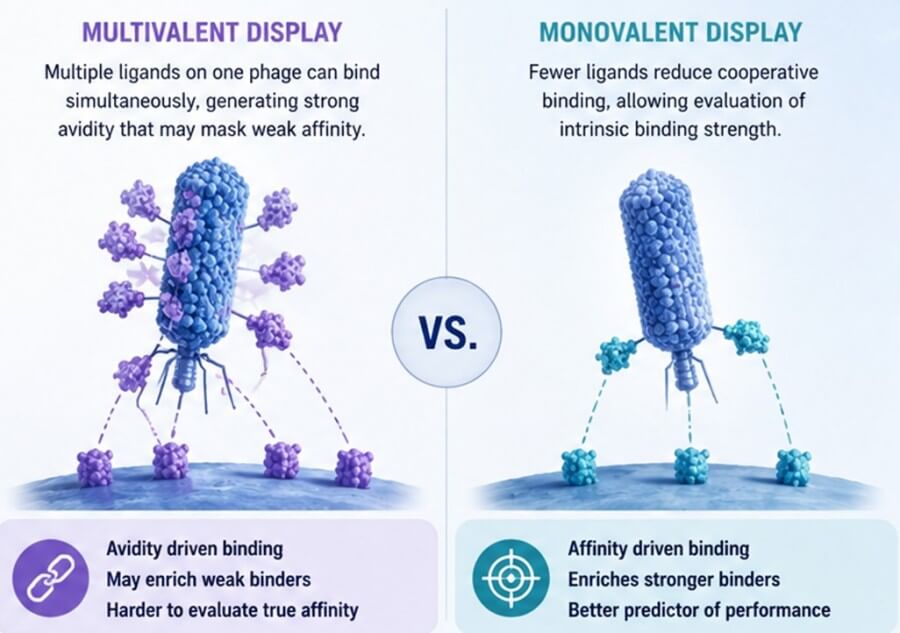
When multiple binding sites engage simultaneously, weak individual interactions may appear artificially strong. Controlling display valency helps reveal the intrinsic strength of each interaction. This distinction becomes particularly important during early enrichment stages, where highly multivalent binders may dominate despite limited single site affinity. By reducing cooperative effects, researchers can better distinguish truly robust candidates from those relying primarily on cumulative weak interactions.
By limiting the number of displayed ligands per phage particle, researchers can assess whether a candidate maintains binding without cooperative support. This creates a more demanding screening environment that favors binders with stronger intrinsic recognition properties. Monovalent presentation is especially useful when the goal is to identify ligands capable of maintaining stable interactions under reduced binding opportunities.
Valency aware screening separates transient interactions from those with genuine stability, improving the relevance of selected candidates. Some ligands may exhibit rapid association yet dissociate quickly once cooperative support is removed. Evaluating both persistence and interaction quality helps researchers prioritize candidates with more dependable performance characteristics.
Different phage systems and expression conditions influence how many copies of a ligand are presented, providing a lever to adjust screening stringency. Careful modulation of display density allows researchers to gradually increase selection rigor across rounds without abruptly eliminating potentially valuable diversity from the library.
Understanding whether enrichment is driven by avidity effects or true affinity allows for more informed downstream decisions. Patterns observed under varying valency conditions can also provide insight into library composition, enrichment dynamics, and potential biases within the screening process.
While stricter conditions are useful, maintaining sufficient diversity is essential. Valency modulation provides a controlled way to achieve this balance. Rather than applying excessive pressure too early, researchers can progressively refine candidate pools while preserving rare binders that may become highly valuable after further characterization.
For guidance on applying these principles to your phage display project, Creative Biolabs invites you to connect with our technical team.
Valency controlled screening helps identify candidates that retain binding under reduced display density, supporting refinement efforts.
Reducing cooperative binding can reveal ligands that recognize specific and subtle structural features.
Researchers investigating interaction mechanisms can use valency modulation to distinguish biologically meaningful binding from aggregation driven effects.
In systems where multiple binding opportunities exist, such as cell surfaces, adjusting valency helps clarify which interactions are truly selective.
Running parallel conditions with different display levels provides additional layers of data for evaluating candidate performance.
Observing how enrichment shifts under varying valency conditions offers insight into library composition and bias.
If your project requires deeper insight into binding behavior rather than simple enrichment, Creative Biolabs can help design an appropriate screening strategy.
Selection of appropriate phage display system
Different vectors and helper phage systems influence ligand copy number, and Creative Biolabs selects formats aligned with project goals.
Dynamic adjustment across screening rounds
Valency conditions can be gradually modified to transition from permissive enrichment to more stringent evaluation.
Careful control of expression levels
Fine tuning expression ensures reproducibility and prevents unintended shifts in display density.
Parallel screening configurations
Running multiple conditions simultaneously allows direct comparison between high and low valency outcomes.
Integration with binding assays
Screening results are correlated with independent validation methods to confirm observed trends.
Data informed decision making
Sequencing and enrichment analysis guide adjustments in later rounds, ensuring that screening remains aligned with research objectives.
To explore how these workflow elements can be tailored to your system, Creative Biolabs welcomes further discussion.
 Extensive hands on experience with display systems
Creative Biolabs has worked with multiple phage platforms, enabling precise control over ligand presentation.
Project specific experimental design
We avoid one size fits all approaches and instead align screening conditions with the biological question at hand.
Strong emphasis on data clarity
Our workflows are structured to generate results that are not only robust but also easy to interpret.
Seamless integration with downstream analysis
Selected candidates can be smoothly transitioned into further characterization pipelines.
Collaborative scientific communication
Clients are kept informed of design choices and experimental observations throughout the project.
Focus on foundational research applications
All services are designed to support discovery and mechanistic studies without drifting into clinical positioning.
If you are looking for a partner with both technical depth and practical insight, Creative Biolabs is ready to support your screening needs.
Valency based selection provides a deeper level of control in phage display library screening by focusing on how binding interactions are presented and evaluated. By distinguishing between cooperative and intrinsic binding behavior, this strategy enables researchers to obtain candidates that are more reliable, interpretable, and aligned with their experimental goals.
At Creative Biolabs, we integrate valency aware design into customized screening workflows that reflect real research challenges. With a strong foundation in phage display technologies and a commitment to scientific rigor, we support clients in generating meaningful and reproducible results. We invite you to reach out and explore how this approach can strengthen your next project.
All listed services and products are For Research Use Only. Do Not use in any diagnostic or therapeutic applications.