Creative Biolabs is offering the most comprehensive services for antibody development projects. With strict regulation and effective execution, we are dedicated to providing the most valuable solutions to complete your projects.
HighlightsCreative Biolabs is offering the most comprehensive services for antibody development projects. With strict regulation and effective execution, we are dedicated to providing the most valuable solutions to complete your projects.
HighlightsCreative Biolabs has established a broad range of platforms for developing novel antibodies or equivalents. These cutting-edge technologies enable our scientists to meet your demands from different aspects and tailor the most appropriate solution that contributes to the success of your projects.
HighlightsWith deep understanding in antibody-related realms and extensive project experience, Creative Biolabs offers a variety of references to help you learn more about our capacities and achievements, including infographic, flyer, case study, peer-reviewed publications, and all kinds of knowledge that can assist your projects. You are also welcome to contact us directly for more specific solutions.
HighlightsGet a real taste of Creative Biolabs, one of the most professional custom service providers in the world. We are committed to providing highly customized comprehensive solutions with the best quality to advance your projects.
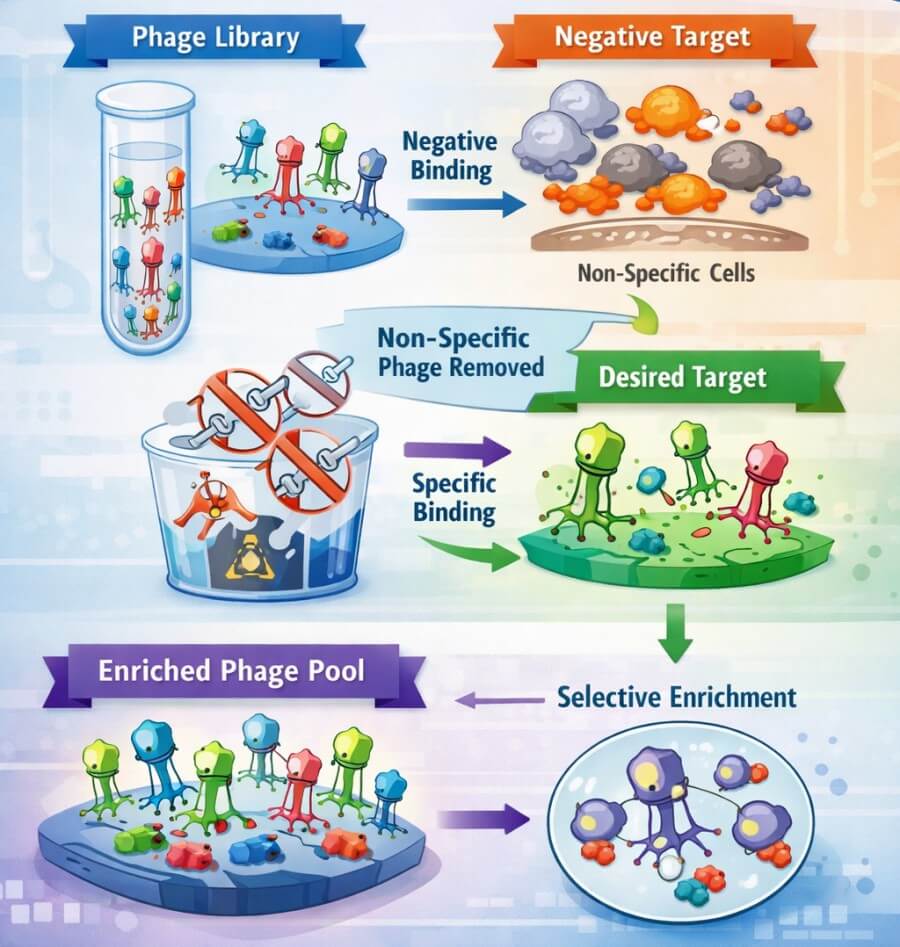
HighlightsSubtractive selection is a strategic screening approach designed to enhance binding specificity within complex phage display libraries. By deliberately removing phage populations that interact with irrelevant or undesired targets, this strategy allows researchers to enrich ligands that recognize subtle molecular differences. Compared with conventional positive selection workflows, subtractive selection emphasizes discrimination rather than abundance, making it particularly valuable for projects involving closely related antigens, heterogeneous samples, or background-rich systems.
At Creative Biolabs, subtractive selection is treated not as a single procedural step, but as an integrated screening philosophy. Our teams design each workflow to balance library diversity, selective pressure, and experimental feasibility, enabling researchers to obtain candidates that are both specific and biologically meaningful. This approach has supported a wide range of foundational research programs where accuracy and interpretability matter as much as enrichment efficiency.
In many phage display campaigns, high-abundance binders can dominate enrichment outcomes even when their interactions lack biological relevance. Subtractive selection systematically removes these nonspecific or promiscuous populations, allowing lower-frequency but contextually relevant binders to emerge. This improves the signal quality of subsequent positive selection rounds.
When targets share structural homology or conserved domains, conventional screening approaches often struggle to achieve sufficient specificity. Subtractive strategies introduce controlled negative selection steps against related structures, sharpening molecular recognition and improving discrimination between closely related targets. This is particularly valuable for resolving subtle binding differences.
Cleaner enrichment pools reduce sequence noise and minimize the carryover of irrelevant binders into downstream analysis. This simplification improves the reliability of clone ranking, sequence convergence assessment, and functional characterization in later research stages. As a result, data interpretation becomes more robust and reproducible.
Cell-based targets, tissue-derived samples, or multi-component systems often introduce unavoidable background interactions that complicate screening outcomes. Subtractive workflows help manage this complexity by selectively filtering matrix-associated binders without oversimplifying the biological model. This enables more realistic interrogation of binding behavior in complex environments.
 For tailored technical guidance on applying subtractive selection principles to your phage display library, Creative Biolabs encourages you to reach out for a focused consultation.
Subtractive selection enables the identification of binders that recognize unique epitopes while ignoring conserved or shared regions, supporting detailed structure function studies.
Researchers studying protein variants, isoforms, or modified targets can use subtractive approaches to isolate ligands that respond only to defined molecular differences.
When screening against cells, subtractive steps using control cell lines help eliminate binders driven by common membrane features rather than meaningful surface markers.
By subtracting irrelevant components, researchers can focus on interactions tied to specific signaling contexts or functional states.
Subtractive workflows provide insight into library bias, background tendencies, and enrichment dynamics, offering valuable feedback for future library design.
For early stage research with undefined binding landscapes, subtractive selection helps refine discovery space without prematurely narrowing diversity.
If your research program involves complex targets or nuanced specificity requirements, Creative Biolabs can help design an application aligned subtractive screening strategy.
Thoughtful negative target selection
Choosing appropriate subtraction targets is critical to the success of subtractive selection. Creative Biolabs evaluates biological relevance, structural similarity, and experimental accessibility before defining negative selection components, ensuring that irrelevant binders are removed without eliminating meaningful variants.
Controlled selection stringency
Selection pressure is adjusted gradually across screening rounds to balance background removal with diversity preservation. This controlled approach helps eliminate dominant nonspecific binders while retaining lower-frequency candidates that may exhibit context-dependent relevance.
Flexible round architecture
Subtractive steps can be introduced at different stages of the screening campaign based on library behavior and observed enrichment trends. This flexibility allows workflows to be adapted dynamically rather than following a rigid, predefined panning scheme.
Compatibility with diverse library types
Our subtractive selection workflows support peptide libraries, antibody fragment libraries, and engineered scaffold systems. This compatibility ensures that subtraction strategies can be applied consistently across different molecular formats without compromising library integrity.
Integration with sequencing analysis
NGS-driven monitoring enables Creative Biolabs to evaluate enrichment trajectories and population shifts across selection rounds. These data support real-time refinement of subtraction strategies, improving interpretability and overall screening efficiency.
To discuss how these workflow elements can be adapted to your project, Creative Biolabs invites you to initiate a technical exchange with our screening specialists.
 Deep experience across screening scenarios
Creative Biolabs has implemented subtractive screening strategies across a broad range of targets and experimental formats, accumulating practical insights beyond theoretical protocols.
Project specific customization
No two subtractive selection projects are identical. Our teams design each campaign based on scientific context rather than applying fixed templates.
Cross functional scientific support
Screening scientists collaborate closely with library engineers and data analysts to ensure cohesive project execution.
Transparent communication throughout the process
Clients receive clear explanations of design decisions, observed challenges, and optimization steps at each stage.
Emphasis on data interpretability
Beyond enrichment, Creative Biolabs prioritizes the generation of data that researchers can confidently analyze and build upon.
Commitment to foundational research values
All services are positioned to support non clinical, discovery driven scientific exploration.
Researchers seeking a reliable partner for subtractive screening are encouraged to contact Creative Biolabs to explore collaborative possibilities.
Subtractive selection represents a refined and intentional approach to phage display library screening, prioritizing specificity, relevance, and interpretability. When thoughtfully designed, it enables researchers to navigate complex binding landscapes with greater confidence and clarity. At Creative Biolabs, we view subtractive screening not as a corrective measure, but as a strategic choice that reflects mature experimental thinking.
By combining technical rigor, flexible design, and extensive hands on experience, Creative Biolabs supports foundational research teams seeking dependable and insightful screening outcomes. We invite you to connect with us to discuss how subtractive selection can be integrated into your next phage display project and how our expertise can help advance your research objectives.
All listed services and products are For Research Use Only. Do Not use in any diagnostic or therapeutic applications.