
Creative Biolabs is offering the most comprehensive services for antibody development projects. With strict regulation and effective execution, we are dedicated to providing the most valuable solutions to complete your projects.
HighlightsCreative Biolabs is offering the most comprehensive services for antibody development projects. With strict regulation and effective execution, we are dedicated to providing the most valuable solutions to complete your projects.
HighlightsCreative Biolabs has established a broad range of platforms for developing novel antibodies or equivalents. These cutting-edge technologies enable our scientists to meet your demands from different aspects and tailor the most appropriate solution that contributes to the success of your projects.
HighlightsWith deep understanding in antibody-related realms and extensive project experience, Creative Biolabs offers a variety of references to help you learn more about our capacities and achievements, including infographic, flyer, case study, peer-reviewed publications, and all kinds of knowledge that can assist your projects. You are also welcome to contact us directly for more specific solutions.
HighlightsGet a real taste of Creative Biolabs, one of the most professional custom service providers in the world. We are committed to providing highly customized comprehensive solutions with the best quality to advance your projects.
HighlightsSequential antigen panning is a strategic approach in phage display screening that focuses on progressively enriching binders against multiple targets or target variants in a defined order. By applying staged selection pressures across different antigens, this approach enables researchers to identify candidates with broad specificity, cross-reactivity, or preferential binding profiles. Unlike single-target selection workflows, sequential panning provides a controlled mechanism to explore the interaction landscape across a panel of related or structurally diverse molecules. Creative Biolabs implements this approach to maximize the discovery of functionally relevant binders while maintaining library diversity.
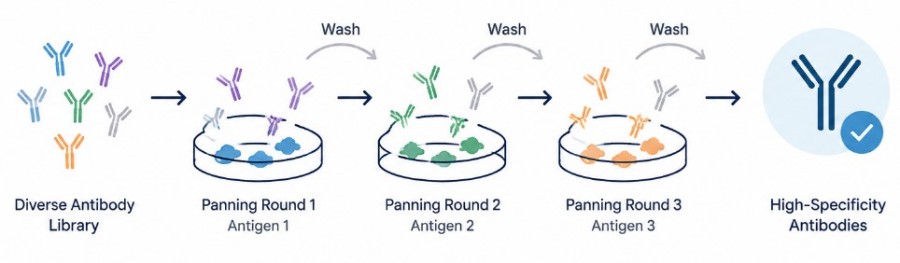 Fig.1 Progressive Antigen-Guided Selection for Multi-Target Binder Discovery.
Candidates are sequentially exposed to different antigens, allowing selective enrichment based on desired specificity. This staged approach prevents dominance of clones that bind only one target.
Screening conditions are gradually intensified across rounds to favor high-quality binders. Creative Biolabs adjusts washing, incubation, and elution parameters to optimize recovery while maintaining diversity.
By carefully sequencing target exposure, this strategy preserves clones capable of binding multiple related molecules. This enhances the discovery of cross-reactive or broadly neutralizing candidates.
Sequential panning reduces the likelihood of false positives caused by dominant but non-specific binders. Controlled order and timing of antigen exposure help filter out undesirable clones.
Phage populations are tracked using sequencing or functional assays to ensure that enrichment aligns with experimental objectives. Creative Biolabs leverages these data to refine selection conditions.
Observed trends guide adjustments in subsequent rounds, allowing fine-tuning of antigen order, incubation duration, and selection stringency for optimal enrichment.
For guidance on designing sequential antigen panning workflows, Creative Biolabs is available to provide expert consultation.
Sequential Antigen Panning enables researchers to isolate antibodies capable of recognizing conserved epitopes across multiple targets. By progressively exposing candidates to different antigens, rare cross-reactive binders that would be lost in single-target screenings are retained. Creative Biolabs designs workflows that maximize both specificity and cross-reactivity, providing valuable candidates for mechanistic studies or comparative analyses.
Exposure to antigen variants across sequential rounds allows precise mapping of binding sites. Researchers can identify which residues or domains are consistently recognized, revealing key functional surfaces. This facilitates downstream structural or mutagenesis studies. Sandwiching sequential panning with analytical assays ensures that selected clones maintain relevant binding patterns.
Proteins with multiple domains, post-translational modifications, or conformational flexibility pose challenges for standard screens. Sequential panning ensures that functional binders targeting accessible and biologically relevant regions are enriched.
Sequential exposure prevents dominant clones from outcompeting rare but meaningful binders. This increases the diversity and potential utility of the selected candidates.
Integration with automated ELISA or screening platforms allows efficient handling of large libraries. Multiple antigens can be assessed simultaneously without compromising assay quality.
Sequential antigen panning complements other guided selection strategies, ensuring that candidates identified in early discovery are robust and informative for downstream characterization.
Reach out to Creative Biolabs to explore how sequential antigen-guided workflows can enhance your discovery campaigns.
01 Strategic antigen sequencing
Creative Biolabs designs the order of target exposure based on structural similarity, functional relevance, and experimental goals. This maximizes enrichment of desired binders.
02 Controlled selection stringency
Incubation times, washing conditions, and elution parameters are adjusted across rounds to balance diversity and specificity.
03 Integration with analytical platforms
Enrichment trends are monitored using sequencing, ELISA, or alternative assays to evaluate clone performance. Feedback informs subsequent panning rounds.
04 Preservation of functional diversity
Even under progressive selection pressure, rare and moderate-affinity clones are maintained. This allows retention of candidates with unique binding profiles.
05 Parallel target evaluation
Multiple antigen panels can be screened simultaneously, enabling comparative assessment of specificity and cross-reactivity.
06 Iterative refinement of workflow
Data-driven adjustments to antigen order, selection parameters, and library handling optimize enrichment efficiency and functional relevance.
Contact Creative Biolabs to discuss how sequential panning workflows can be customized for your phage display libraries.
 Controlled enrichment across multiple targets
Sequential antigen exposure allows selective enrichment tailored to specific research objectives. This control reduces overrepresentation of clones binding only a single target. By managing the order and timing of antigen presentation, Creative Biolabs ensures enrichment reflects desired specificity profiles.
Preservation of rare and diverse binders
Even under progressive selection pressures, subdominant and low-frequency clones are maintained. This preserves diversity critical for mechanistic insight and downstream optimization. Maintaining rare binders also increases the likelihood of discovering functionally unique antibodies.
Discovery of cross-reactive antibodies
The workflow supports identification of candidates that engage multiple antigens, offering broader applicability. Cross-reactive binders can be prioritized for studies on related proteins or functional families. This expands the potential utility of the library and supports comparative research.
Insights into epitope specificity
Sequential panning reveals which epitopes are recognized consistently across rounds and targets. This mapping enhances mechanistic understanding and informs rational antibody design. Researchers gain a clearer picture of molecular recognition patterns.
Integration with downstream characterization
Candidates enriched through sequential antigen panning are pre-validated for functional binding. This alignment reduces redundancy in downstream testing and accelerates structural or mechanistic analysis. Early functional confirmation increases confidence in the quality of selected clones.
Flexible and customizable workflows
Creative Biolabs tailors sequential panning strategies to library type, antigen complexity, and project objectives. Customization ensures high-quality outcomes while accommodating diverse research needs. The workflow can be adapted for peptide libraries, antibody fragments, or alternative scaffold systems.
Researchers interested in high-specificity, multi-target binder discovery are encouraged to contact Creative Biolabs for workflow design.
Sequential Antigen Panning offers a robust, data-driven strategy for exploring binder specificity across multiple targets. By combining staged antigen exposure with controlled selection parameters, researchers can enrich functionally relevant and cross-reactive clones while preserving library diversity. Creative Biolabs integrates this workflow with analytical monitoring and iterative optimization to ensure reproducible, high-quality results. Connect with Creative Biolabs to learn how sequential antigen-guided selection can support your next phage display discovery project.
All listed services and products are For Research Use Only. Do Not use in any diagnostic or therapeutic applications.








