"Creative Biolabs is committed to providing highly customized comprehensive solutions with the best quality to advance our global clients’ projects."
High-Quality cDNA Library Construction Services: Empowering Functional Genomics and Antibody Discovery
Background TS-FL Synthesis DSN-Normalization Phage Display Workflow Library Types Advantage FAQ Online Inquiry
In the rapidly evolving landscape of biotechnology and drug discovery, a high-quality cDNA Library Construction is the foundational tool for exploring functional genomics, identifying novel biomarkers, and screening therapeutic antibodies. Creative Biolabs, a global leader with over 20 years of expertise, provides comprehensive solutions for the construction of premium cDNA libraries. Our services are specifically designed to overcome the common hurdles of library construction—such as low representation of rare transcripts, truncated inserts, and insufficient library titers. By integrating the latest SMART technology, advanced normalization strategies, and our world-renowned phage display platforms, we ensure that every library we deliver is a precise reflection of the target transcriptome.
Discuss Your Project Today
The Importance of Professional cDNA Library Construction
A cDNA (complementary DNA) library represents the collection of cloned DNA fragments synthesized from a specific mRNA population. Unlike genomic libraries, cDNA libraries only contain the expressed sequences (exons) of an organism, making them indispensable for:
-
Protein Expression and Purification: Directly cloning open reading frames (ORFs).
-
Functional Screening: Identifying genes involved in specific biological pathways.
-
Phage Display Screening: Discovering high-affinity binders through phage display cDNA libraries.
-
Transcriptome Mapping: Understanding tissue-specific or stage-specific gene expression.
At Creative Biolabs, we don't just "build" libraries; we engineer them to meet the highest standards of diversity and integrity required for cutting-edge research.
Advanced Technology: The Science of Template Switching Full-Length (TS-FL) Synthesis
Traditional cDNA synthesis methods often struggle with truncated inserts, especially for long or highly structured mRNAs. At Creative Biolabs, we have optimized the Template Switching Full-Length (TS-FL) strategy to overcome these limitations.
The TS-FL Mechanism
Our TS-FL approach utilizes the unique biochemical properties of an engineered MMLV Reverse Transcriptase (RT). When the RT reaches the 5' end of the mRNA template, its intrinsic terminal transferase activity adds a few non-templated nucleotides (typically deoxycytidines) to the 3' end of the newly synthesized cDNA.
-
Oligo-Hybridization: A specially designed Template Switching Oligo (TSO) with a complementary 3' tail (riboguanosines) hybridizes to these non-templated extensions.
-
Template Switching: The RT enzyme then switches templates—from the mRNA to the TSO—continuing replication to the end of the oligo.
-
Result: This process incorporates a universal sequence tag at the 5' end of every cDNA molecule, ensuring that only full-length transcripts containing the 5' cap structure are efficiently amplified and cloned.
Key Advantages of TS-FL over Traditional Methods
-
5'-End Enrichment: Captures complete Open Reading Frames (ORFs) and 5' Untranslated Regions (UTRs).
-
High Sensitivity: Capable of generating high-titer libraries from as little as 50 ng of total RNA.
-
Directional Accuracy: Integrated adapters allow for seamless, directional cloning into any expression or phage vector.
Overcoming Transcript Abundance Bias: DSN-Normalization
A significant challenge in cDNA Library Construction is the overwhelming presence of "housekeeping" genes (e.g., Actin, GAPDH, Ribosomal proteins). These high-abundance transcripts can account for 50-90% of a library, effectively "masking" rare regulatory genes or novel biomarkers.
The DSN-Normalization Process
To solve this, Creative Biolabs employs Duplex-Specific Nuclease (DSN) normalization:
-
Denaturation & Reannealing: The double-stranded cDNA is denatured and allowed to reanneal.
-
Selective Digestion: High-abundance transcripts reanneal much faster than rare ones. The DSN enzyme specifically degrades these double-stranded, high-abundance fractions.
-
Equalization: The remaining single-stranded cDNA (the rare transcripts) is then amplified, resulting in a "normalized" library where the frequency of each gene is more uniform.
Phage Display cDNA Libraries: Our Core Specialty
Creative Biolabs is world-renowned for integrating cDNA technology with phage display. Phage display cDNA libraries are powerful tools for high-throughput screening of protein-ligand interactions, antigen discovery, and epitope mapping.
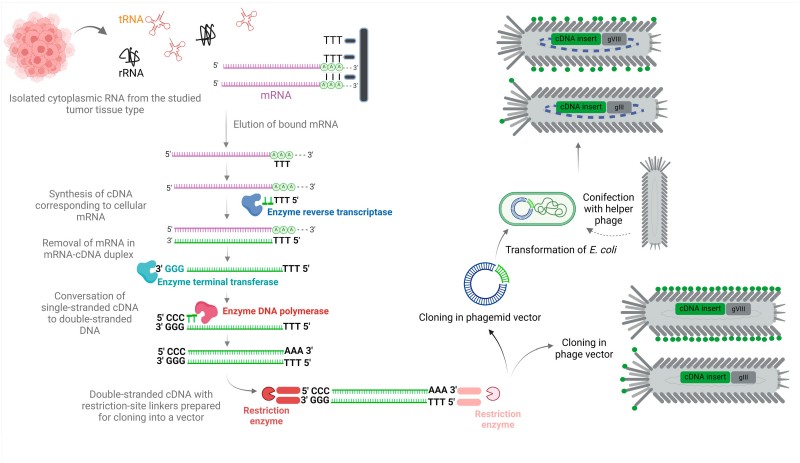 Fig. 1 Schematic representation of the construction of cDNA libraries and their display on filamentous bacteriophages.1
Comprehensive Phage Systems Comparison
We offer a variety of bacteriophage platforms, each tailored to specific molecular targets:
|
Feature
|
M13 System (pIII/pVIII)
|
T7 System (Lytic)
|
T4 System (SOC/HOC)
|
|
Localization
|
Secreted to Periplasm
|
Cytoplasmic
|
Cytoplasmic
|
|
Protein Folding
|
Ideal for disulfide bonds
|
Ideal for cytosolic proteins
|
High-capacity folding
|
|
Insert Size
|
Small to Medium (<50 kDa)
|
Large (up to 1200 aa)
|
Very Large / Complexes
|
|
Display Density
|
Low (pIII) to High (pVIII)
|
Very High (415 copies)
|
High (Variable)
|
|
Best Application
|
Antibody discovery, Peptides
|
Functional cDNA screening
|
Vaccine development
|
Strategic Advantage of Our Phage Display cDNA Library Construction
Our libraries are designed with directional cloning and in-frame selection markers. This ensures that the displayed proteins are in the correct reading frame, maximizing the functional "effective" size of the library and reducing the background of non-functional clones.
Applications of Phage Display cDNA Libraries
-
Antigen Discovery: Screening patient sera against a cDNA library to identify diagnostic markers.
-
Protein-Protein Interactions (PPI): Finding binding partners for a specific bait protein.
-
Drug Target Identification: Screening small molecules against a cellular library to find receptors.
Comprehensive Workflow for cDNA Library Construction
Our process is rigorous and transparent, ensuring every step meets international quality standards.
|
Phase
|
Description
|
Key Quality Control (QC)
|
|
1. RNA Extraction
|
Isolation of total RNA/mRNA from tissues, cells, or environmental samples.
|
RIN, A260/280
|
|
2. cDNA Synthesis
|
SMART-based reverse transcription with specialized adaptors.
|
Sizing check
|
|
3. Normalization
|
DSN treatment to equalize transcript abundance (Optional).
|
qPCR of abundant vs. rare genes
|
|
4. Vector Ligation
|
Directional cloning into specialized expression or phage vectors.
|
Efficiency testing
|
|
5. Transformation
|
Electroporation into ultra-competent E. coli cells.
|
Titer calculation
|
|
6. Validation
|
Colony PCR and random sequencing of 100+ clones.
|
Insert rate & average length
|
|
7. NGS Analysis
|
Deep sequencing to assess library diversity (Optional).
|
Coverage & redundancy analysis
|
Specialized cDNA Library Services
To cater to diverse research needs, Creative Biolabs provides various specialized cDNA Library Construction options:
Tissue-Specific & Disease-Specific Libraries
We maintain an extensive inventory of pre-made libraries from human (tumor vs. normal), mouse, rat, and primate tissues. We can also construct custom libraries from specific clinical biopsies.
Standard cDNA Library
In case urgent use for straightforward screening and downstream application is required, we can construct standard cDNA libraries with at least 3×10⁶ primary clones with an average insert size of at least 1 kb. We guarantee that all the clones are properly oriented for expression, antibody screening or isolation of specific cDNA clones.
Normalized cDNA Libraries
Highly recommended for gene discovery projects. By equalizing the concentration of all transcripts, we maximize the efficiency of downstream screening assays.
Full-Length cDNA Libraries
Optimized for protein expression and structural biology. We use proprietary "Cap-trapping" or SMART methods to ensure the capture of the complete mRNA sequence.
Subtractive cDNA Library
This technique is exceptionally appropriate when the target gene is assumed to express in poor level. With proprietary self-subtraction and tissue-tissue subtraction techniques, we are able to reduce irrelevant abundant sequences 10-100 folds, making it easier to find desired targets.
Small RNA/miRNA Libraries
Designed for the study of non-coding RNAs, utilizing specialized adaptors to capture 18-30 nt fragments.
Why Choose Creative Biolabs?
At Creative Biolabs, we understand that the success of your downstream applications—whether it be antibody screening, protein interaction studies, or gene discovery—hinges on the quality of your library. By choosing our cDNA Library Construction services, you are gaining a partner with the technical depth and professional dedication to move your research forward.
-
Unmatched Expertise: Over two decades of experience in phage display cDNA Library Construction.
-
High Diversity: We routinely achieve library titers of 107 to 1010 independent clones.
-
State-of-the-Art Platforms: From T7 lytic phage to M13 filamentous systems.
-
Global Reach: Serving thousands of academic institutions and pharmaceutical companies worldwide.
-
Scientific Support: Consult directly with PhD-level experts to design your project.
Contact us today to discuss your project requirements and receive a customized quote from our expert team.
Contact Us Today for a Free Quote!
Frequently Asked Questions (FAQs)
-
Q: What is the minimum amount of starting material required for cDNA Library Construction?
A: For standard libraries, we recommend 5-10 ug of total RNA. However, using our optimized amplification protocols, we can construct high-quality libraries from as little as 50-100 ng of total RNA or even from single-cell preparations.
-
Q: How do you ensure the orientation of the cDNA inserts?
A: We use directional cloning strategies. During cDNA synthesis, specific restriction sites are incorporated into the 5' and 3' ends of the cDNA via specialized primers. This ensures that the cDNA ligates into the vector in the correct reading frame for expression.
-
Q: What is the advantage of using the T7 phage system over M13 for cDNA libraries?
A: The T7 system is a lytic system, meaning the protein is displayed on the phage shell within the cytoplasm before the cell bursts. This is ideal for proteins that are difficult to secrete or require a reducing environment for proper folding. M13 requires the protein to be secreted into the periplasm, which is better for disulfide-bonded proteins like antibodies.
-
Q: Can you construct libraries from non-model organisms?
A: Absolutely. Creative Biolabs has extensive experience with "exotic" samples, including rare medicinal plants, extreme-environment microbes, and non-standard laboratory animals. We customize our extraction and priming strategies based on the specific GC content and biochemical properties of the sample.
-
Q: What is the typical insert size in your libraries?
A: Our libraries usually show a size distribution between 0.5 kb and 5.0 kb, with an average insert size of 1.2 kb to 1.8 kb, which covers the majority of eukaryotic protein-coding transcripts.
-
Q: Is normalization necessary for every project?
A: Not necessarily. If your goal is to study the relative expression levels of genes (transcriptomics), you should avoid normalization. However, if your goal is "gene hunting" or finding a specific rare binder in a phage display cDNA library, normalization is highly recommended to prevent abundant "junk" clones from overwhelming your screen.
Reference
-
Brišar, Nuša, Katja Šuster, and Andrej Cör. "Preparation of Phage Display cDNA Libraries for Identifying Immunogenic Tumor Antigens: Challenges in Functional cDNA Presentation and Approaches to Overcoming Them." Viruses 16.12 (2024): 1855. Distributed under Open Access license CC BY 4.0, without modification. https://doi.org/10.3390/v16121855