Creative Biolabs is offering the most comprehensive services for antibody development projects. With strict regulation and effective execution, we are dedicated to providing the most valuable solutions to complete your projects.
HighlightsCreative Biolabs is offering the most comprehensive services for antibody development projects. With strict regulation and effective execution, we are dedicated to providing the most valuable solutions to complete your projects.
HighlightsCreative Biolabs has established a broad range of platforms for developing novel antibodies or equivalents. These cutting-edge technologies enable our scientists to meet your demands from different aspects and tailor the most appropriate solution that contributes to the success of your projects.
HighlightsWith deep understanding in antibody-related realms and extensive project experience, Creative Biolabs offers a variety of references to help you learn more about our capacities and achievements, including infographic, flyer, case study, peer-reviewed publications, and all kinds of knowledge that can assist your projects. You are also welcome to contact us directly for more specific solutions.
HighlightsGet a real taste of Creative Biolabs, one of the most professional custom service providers in the world. We are committed to providing highly customized comprehensive solutions with the best quality to advance your projects.
HighlightsNon-human primate (NHP) models, particularly cynomolgus and rhesus macaques, represent the gold standard in preclinical evaluation for many novel biologic drugs due to their profound physiological and immunological similarity to humans. Antibodies developed or validated in these models offer a highly predictive assessment of therapeutic potential. However, despite high sequence homology (typically >95%), subtle yet critical differences in framework regions (FRs) can elicit an anti-drug antibody (ADA) response in human patients, compromising safety and efficacy. At Creative Biolabs, with over 20 years of leadership in antibody engineering, our Non-Human Primate (NHP) Antibody Humanization service meticulously re-engineers your candidate antibody, eliminating potential immunogenic epitopes while rigorously preserving its binding affinity, specificity, and therapeutic function.
NHP-derived antibodies are invaluable because they often recognize human orthologs with functionally equivalent activity and affinity. This makes them superior candidates for humanization compared to rodent antibodies.
| Feature | Murine Antibody | Non-Human Primate (NHP) Antibody | Human Antibody |
| Sequence Homology to Human | ~80-85% | >95% | 100% |
| Immunogenicity Risk | High | Low to Moderate | None (Theoretic) |
| Framework Mismatches | Numerous | Few, but critical | None |
| Humanization Requirement | Essential | Highly Recommended for Clinical Success | Not Applicable |
| Predictive Value | Moderate | High | Not Applicable |
Even a few amino acid differences in the framework regions can be recognized as foreign by the human immune system. Our service is designed to systematically identify and replace these residues with their human germline counterparts, effectively "cloaking" the antibody to evade immune detection.
Creative Biolabs employs a multi-faceted, technology-driven approach that goes beyond simple CDR grafting. Our platform integrates computational biology with proven molecular engineering techniques to guarantee optimal results.
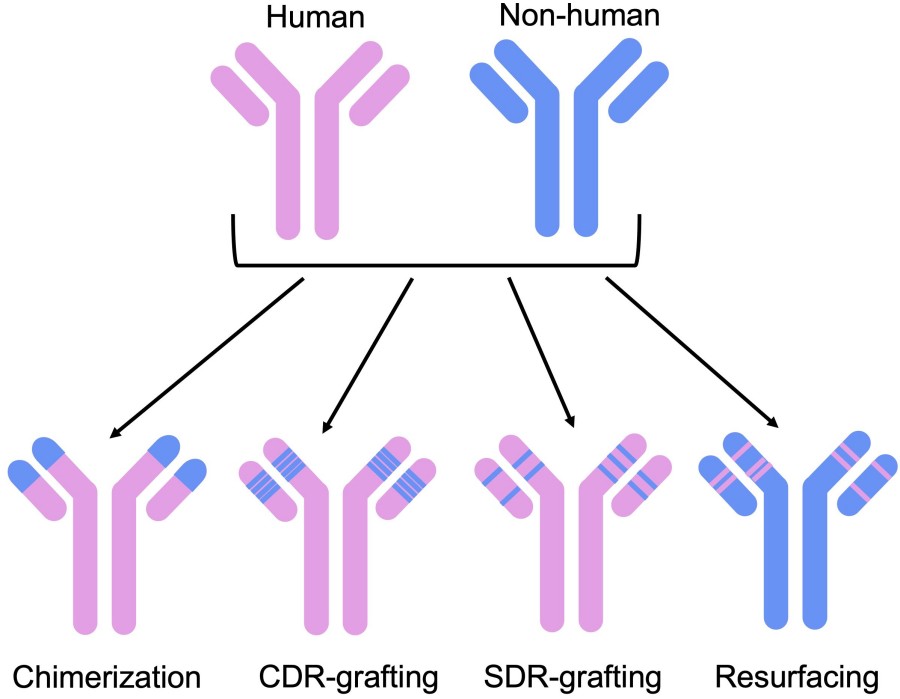 Fig. 1 Humanization methods have evolved from initial chimerization approaches, aiming to reduce non-humanness without compromising functionality.1
The foundation of our service is a deep, structure-based understanding of your antibody.
We utilize a comprehensive human germline database to select the most suitable acceptor framework. Our selection process is based on:
We offer a range of grafting strategies tailored to your project's specific needs:
A direct graft can sometimes lead to a loss of affinity. Our experts meticulously analyze the 3D model to identify key NHP framework residues that are crucial for maintaining the optimal CDR conformation. Through a rational design process, we introduce a minimal number of critical "back-mutations" to the human framework, effectively restoring or even enhancing the original antibody's affinity and stability.
Our process is structured, transparent, and collaborative, ensuring you are informed at every stage.
Our process is structured, transparent, and collaborative, ensuring you are informed at every stage.
Phase 1: In-depth Analysis and Strategic Design
Phase 2: Molecular Construction and Expression
Phase 3: Rigorous Biophysical Validation
Unparalleled Expertise: Leverage our 20+ years of dedicated experience in antibody engineering.
To further advance your therapeutic antibody program, Creative Biolabs offers a comprehensive suite of integrated services:
Ready to move your NHP antibody toward the clinic? Trust the experts at Creative Biolabs to deliver a meticulously engineered, low-immunogenicity, high-affinity clinical candidate.
Q: Why is it necessary to humanize a Non-Human Primate (NHP) antibody if its sequence is already over 95% identical to human antibodies?
A: While the sequence homology is high, the remaining 1-5% differences, primarily in the framework regions, can contain T-cell and B-cell epitopes. These can trigger an anti-drug antibody (ADA) response in patients, leading to reduced efficacy, altered pharmacokinetics, and potential adverse events. Professional humanization mitigates this risk significantly.
Q: What is the typical timeline for an NHP antibody humanization project?
A: A standard project, from sequence receipt to delivery of purified, validated antibody candidates, typically takes between 8 and 12 weeks. This timeline can be adjusted based on project complexity.
Q: How do you ensure the binding affinity is not lost during the humanization process?
A: Our structure-based approach is key. By creating a high-resolution 3D model, we understand the interplay between the framework and the CDR loops. This allows us to perform rational back-mutations, re-introducing only the most critical parental NHP residues needed to maintain the CDRs' antigen-binding conformation. All candidates are then experimentally validated for affinity using SPR or BLI.
Q: What starting material do I need to provide?
A: The ideal starting material is the DNA or amino acid sequence of the variable heavy (VH) and light (VL) chains of your NHP antibody. If you only have the hybridoma cell line or purified antibody protein, we can perform antibody sequencing as an initial step.
All listed services and products are For Research Use Only. Do Not use in any diagnostic or therapeutic applications.