In modern drug development, the primary cause of clinical failure is often not the molecule's potency, but its inability to reach the target site in sufficient concentrations. Systemic administration faces formidable hurdles: rapid clearance, non-specific distribution, and the inability to cross biological barriers. At Creative Biolabs, we solve these delivery challenges. We focus entirely on engineering targeted, high-efficiency liposomal systems that actively navigate the body.
To achieve high-efficiency drug delivery, we must systematically dismantle the barriers that prevent accumulation at the disease site. The evolution of nanomedicine has shifted from passive "stealth" carriers to active, intelligent systems that mimic biological entities and respond to environmental cues.
Nature has evolved sophisticated mechanisms for transport and immune evasion. Biomimetic strategies involve engineering synthetic liposomes to replicate the surface properties of endogenous cells or vesicles, effectively "camouflaging" the carrier to navigate the body undetected.
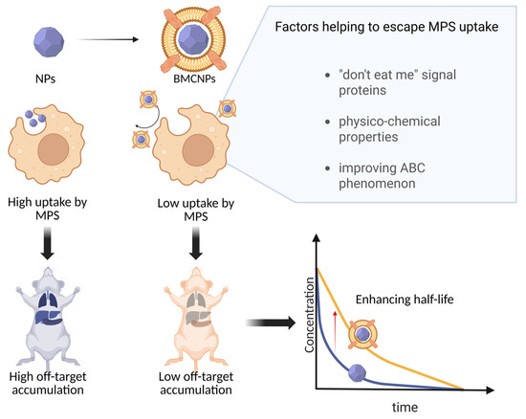 Fig. 1 Interaction MPS with NPs after cell
coating.1
Fig. 1 Interaction MPS with NPs after cell
coating.1
By fusing natural cell membranes onto synthetic lipid cores, we transfer the complete, functional protein repertoire of the source cell to the liposome.
Merges the advantages of synthetic lipids (high drug loading, tunable rigidity) with biological exosomes. This strategy overcomes the low yield and loading efficiency of native exosomes while retaining their tissue-specific tropism.
Fully synthetic liposomes engineered via lipidomics to replicate the precise lipid ratio (e.g., high cholesterol, specific sphingomyelins, and phosphatidylserine) of natural exosomes. These mimetics replicate the physical behavior of exosomes—such as interacting with recipient cells—without the variability of biological sourcing.
Targeting is futile if the drug remains trapped within the carrier. Stimuli-responsive strategies transform the liposome into a logic-gated device that releases its payload only in response to specific microenvironmental or external triggers, ensuring maximum concentration at the active site.
Endogenous Stimuli (Physiological Triggers)
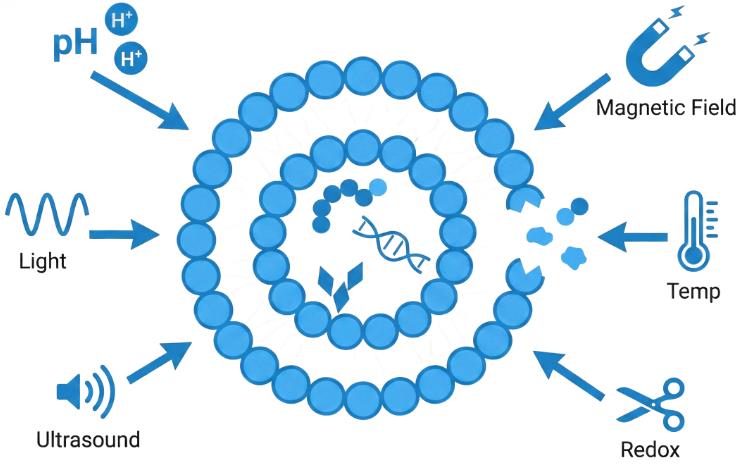
Exogenous Stimuli (External Triggers)
We offer a modular platform for designing targeted delivery systems. Choose the architecture that fits your specific biological barrier and payload requirements.
We support your formulation needs from the molecular level up. Our chemical synthesis team creates bespoke lipids required for advanced stimuli-responsive and biomimetic systems. In addition to custom synthesis, we maintain a robust inventory of high-purity, off-the-shelf functionalized lipid ready for immediate shipment to accelerate your project timelines.
Stimuli-Responsive Lipids
Custom synthesis of ionizable cationic lipids, pH-sensitive DOPE derivatives, disulfide-linked redox lipids, and photo-cleavable lipids.
Exosome-Mimetic Lipids
Synthesis of high-purity sphingomyelins, ceramides, and modified sterols essential for replicating exosomal membrane rafts and rigidity.
Ligand-Conjugated Lipids
Precision synthesis of lipid anchors (DSPE-PEG) functionalized with reactive groups (Maleimide, NHS) or targeting moieties (Folate, RGD, DPA-metal chelators).
Focus on Efficiency
Our proprietary loading techniques ensure minimal drug waste and maximum payload per particle.
Barrier-Centric Design
Every formulation starts with an analysis of the biological barriers you need to cross.
Access a library of validated targeting modules (Membranes, Ligands, Responsive Lipids) to build your ideal carrier.
Translational Quality
High batch-to-batch consistency and scalability ensure your results are reproducible and ready for preclinical advancement.
Request a Technical Consultation with Our Experts
Creative Biolabs is dedicated to overcoming the barriers that stand between your drug and its target. Let us engineer a delivery system that ensures your therapeutic reaches its potential.
| Product Name | Description | |
|---|---|---|
| Lipid-Protein Conjugation Kit (Universal) | A universal tool for the conjugation of antibodies, peptides, and proteins to phospholipid surfaces, facilitating the rapid development of targeted liposomes and LNPs. | |
| Responsive Lipids Catalog | A comprehensive library of functional lipids including pH-sensitive, redox-sensitive (SS-cleavable), and photo-cleavable variants for engineering smart release systems. | |
| Exosome Isolation Kits | High-yield isolation reagents optimized for specific matrices including urine, saliva, serum/plasma, emulsion, and cell culture media, essential for hybrid fusion workflows. | |
| Functionalized PEG-Lipids | High-purity DSPE-PEG derivatives functionalized with Biotin, Folate, RGD, or Maleimide anchors for modular ligand attachment. |
Yes. By using cell membrane coatings (e.g., RBC membranes), we create a "self" surface that naturally resists protein adsorption (opsonization) far better than synthetic PEG, maintaining the efficacy of targeting modules in vivo.
We recommend our stimuli-responsive (pH-sensitive) service. We incorporate fusogenic lipids that change conformation in the acidic endosome, destabilizing the membrane and releasing the drug into the cytoplasm before lysosomal fusion occurs.
Pure exosomes often have very low drug-loading capacity and production yields. Our hybrid approach solves this by loading the drug into a synthetic liposome first (high efficiency) and then fusing it with exosomes to gain the targeting benefit. This gives you the "best of both worlds."
Reference
Creatibe Biolabs' custom LNP was the only solution that successfully delivered our CRISPR-Cas9 payload across the blood-brain barrier with high efficiency and low toxicity.”

Dr. Evelyn Reed
Postdoctoral Researcher, Leading University
Our siRNA candidate was failing due to off-target toxicity, but Creatibe Biolabs' team rapidly redesigned our LNP using their modular platform, rescuing our preclinical program.”

Ben Carter
Project Manager
Achieving cytosolic delivery of our protein degrader with Creatibe Biolabs' exosome platform was the key to unlocking our candidate's full therapeutic potential.”

Dr. Kenji Tanaka
Principal Scientist, Large Pharma Corp
Our oncology drug's efficacy was limited by poor tumor accumulation. Creatibe Biolabs' peptide-conjugated liposomes provided the precise targeting we needed, dramatically increasing the drug's therapeutic index.”
Dr. Clara Schmidt
Senior Scientist, Oncology Innovations Inc.
We required a delivery system that would only release its payload in the tumor's acidic microenvironment. Creatibe Biolabs' pH-responsive liposomes performed flawlessly, minimizing systemic exposure.”
David Chen
Formulation Scientist
Outstanding expertise in antibody engineering.The team's attention to detail and innovative approaches have sianificantly accelerated our development timeline.
Sarah L.
Senior Research Scientist